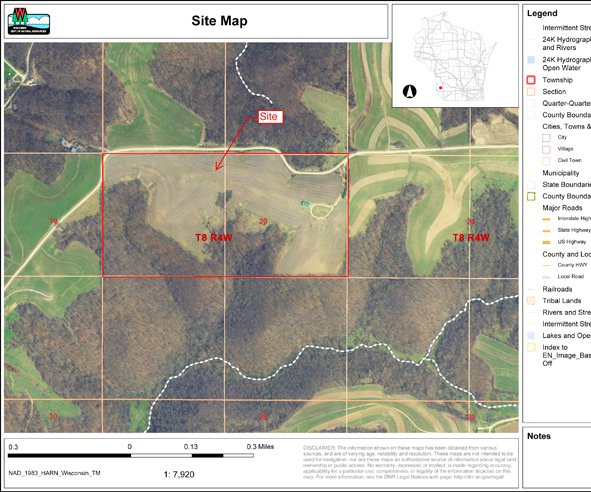
Livestock Facility Siting Permits, issued by Crawford County, were approved for two cookie-cutter identical hog production facilities by the Crawford County Land Conservation Committee (LCC) at their January 13 meeting. Gruber South and Gruber North propose to build the facilities in Marietta Township.
Committee member Chad Sime moved, and committee member Kate Krachey seconded the two motions to approve the permits. The vote to approve both permits was unanimous.
Each of the two facilities will produce sow replacement hogs in numbers just one hog short of the level where a Wisconsin Pollution Discharge Elimination System (WPDES) water quality permit would have been required by WDNR. This puts the burden of enforcement on Crawford County Land Conservation Department staff.
At their December meeting, the committee had numerous questions for the two permittees, centering mainly on their nutrient management plans, and the projected yield goals on cropland where the facilities’ manure would be spread. At that time, they voted to defer the permit decisions to their January 13 meeting.
According to County Conservation Director, the two permittees submitted an updated nutrient management plan, with yield goals revised to be more in line with the average yields typically seen in Crawford County.
“The Gruber applicants and their consultant responded to all questions and clarifications that the committee requested,” Troester told the Independent-Scout after the meeting. “They resubmitted a nutrient management plan that reflected a continuous corn grain rotation, with estimated yield goals of 171-190 bushels per acre.”
Three requests
Following the permit approvals, LCC chairman Supervisor Gary Koch shared three requests with the Grubers from the committee. Those requests are:
1. Increase the acres available for manure spreading; and
2. Support for well testing efforts in the county, including financial support; and
3. On an annual basis, share a copy of plans for infectious disease, biosecurity, fire response, and use of county roadways with the Land Conservation Department, Public Health Department, Highway Department, Emergency Management, and local fire departments and town boards.
“Because of the karst geology, the already endangered waterways, and the health and welfare of all county residents, particularly in the area of the two facilities, the committee requests that over the course of the next three years, spreadable acres be increased in some way, shape or form,” Koch said. “By increasing spreadable acreage, Gruber Farms achieves approximately the same level of acre-per-animal-unit as previously approved in the Roth Feeder Pigs II permit, and would help ensure that Gruber Farms is less likely to fail in compliance with the permits just issued over the long term.
“We ask you to support our well-testing effort in order to scientifically determine the extent of the danger of the water resources from all sources of pollution. The county has participated and helped fund an annual well testing program,” Koch told the Grubers. “The committee requests that you join the county in an effort by contributing to the cost of additional water tests to be conducted throughout the county for next three years in order to protect all the landowners in Crawford County.
“We understand your participation in these requests is voluntary, but by responding positively to these requests, Gruber Farms will give us a better understanding and appreciation for your commitment to preserving and enhancing the valuable natural resources of land and water in Crawford County for all concerned residents, businesses and visitors to enjoy,” Koch concluded. “I think you've said that in some of your comments to our committee that that's of the utmost importance to you, from a citizen standpoint, so I'm hopeful that's the case.”
Public comment
Crawford Stewardship Project’s Forest Jahnke reported the spring well testing event aims to get a total of 400 well water samples tested in Crawford, Vernon and Richland counties. He said the planned well water testing date would be March 24.
Jahnke also addressed the committee’s approval of the two Gruber permits:
“You felt like you had to approve these permits, and couldn't add conditions in to address the public comments and feedback that was received,” Jahnke stated. “My comment to the committee is that, unless you're ready and willing to approve more of these permits just like this, and have your hands tied and not be able to condition things, I would suggest that you take some steps to address the situation. The specific steps I would suggest would be re another CAFO moratorium starting at 500 animal units, and taking the time to review our ordinances and see how we can be in a better situation where we're not making faith-based requests. I appreciate the requests, and hope those are taken in good faith and followed. But at the end of the day, as a regulatory body, it's best not to rely on faith and good neighbors, but to have clear expectations.”