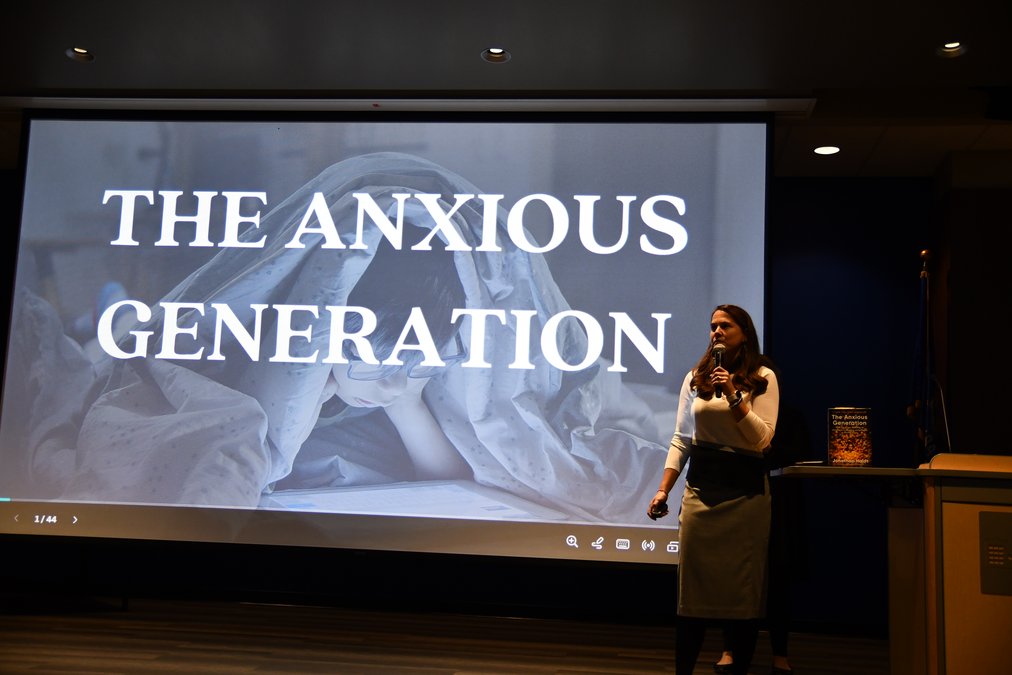
As part of the recent CESA 3 Business and Education Summit held at Southwest Wisconsin Technical College, a presentation was given by Ellie Olson and Niki Smith of CESA 3.
Their presentation was based on the best selling book, “The Anxious Generation,” by Jonathan Haidt.
With educators and employers in the audience, Olson and Smith discussed Haidt’s book which examines how increased anxiety, pressures, technology, and social media are impacting adolescents and young adults in leaning environments and workplaces.
A similar CESA 3 presentation was recently given at Fennimore Elementary School last month.
The main focus of the presentation was those born between 1995-2009, also known as “Generation Z.” Those born in that time frame are now 16-30 years old and are also dubbed “the anxious generation.”
Olson and Smith explained that those that belong to this generation group have increased levels of depression, anxiety, ER visits due to self harm, and suicide rates.
Contrary to popular belief, these statistics were all pre-Covid-19 lock downs and are not limited to just here in the United States.
Generation Z members have also seen drops in reading and math levels.
Why one may ask? The rise of smart phones, or rather this generation being to first to grow up with always having access to them.
Those who grew up in that time period have seen as children a drop in independent playtime and social interaction and favoring to be “behind the phone.”
Olson and Smith stated that this generation has grown up more in a virtual world, than any other generation before them, or in other words, have a “phone based lifestyle.”
Traits seen in this generation are a disconnect from people, lack of sleep, and having an almost addiction to not only the phone itself, but all the “alerts” from Facebook, Snapchat, Instagram, etc.
Instead of making social acquaintances or actual friends, trends show an emphasis on “likes, shares, comments, etc.” over social media.
The effects are different between males and females, Olson and Smith stated.
Boys, for example, play video games more as a whole than girls, and unlike the “old days” of playing together next to one another, modern multi player games are played online, resulting in an isolation.
Girls, studies show, use apps for social comparisons, who is more fit, who has more friends, who is hanging out where and with who, and who has more followers, likes, etc, over social media apps.
What can be done
The solution is easier said than done. Social media is ever changing and new territory to many parents who weren’t introduced to it until well into their adulthood.
“Working together” was the main solution, Olson and Smith stressed. They also mentioned more regulations do need to be made, but our government only works so fast.
In the meantime, schools/educators may decrease the emphasis on “screens” for learning tools, and promote more interaction between students for school/projects.
Parents can try working together to have similar phone regulations themselves with other parents such as age when one gets a smart phone, time to be on the phone, appropriate apps, etc., to avoid the ever popular, “But so and so and everyone else gets to...”
As a whole, our culture needs to “bring childhood back to Earth and away from the virtual world,” Olson and Smith explained.
Employers, Olson and Smith explained, also need to have a “different take” on this generation of employees as many lack the soft skills, or personal attributes, behaviors, and social abilities that influence how well someone interacts with others and handles work situations.
With more screen time and less social interaction, Generation Z employees lack these skills more than previous generations throughout the workforce and industry.
And like parents and educators, Olson and Smith explained employees of Generation Z and employers must also work together to overcome this social media reliant culture, empathizing more problem solving and conflict resolution be established between employee and employer.