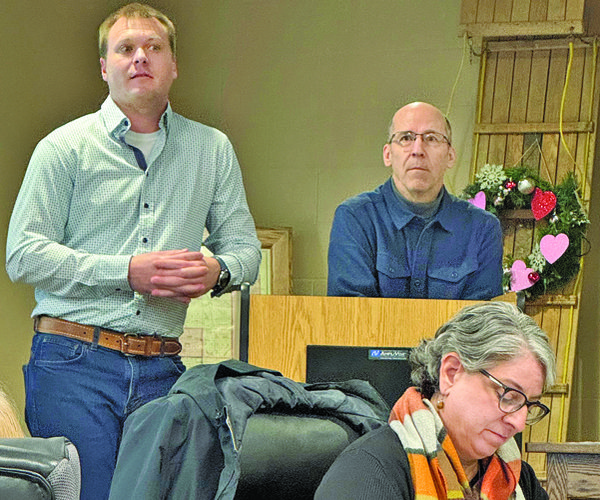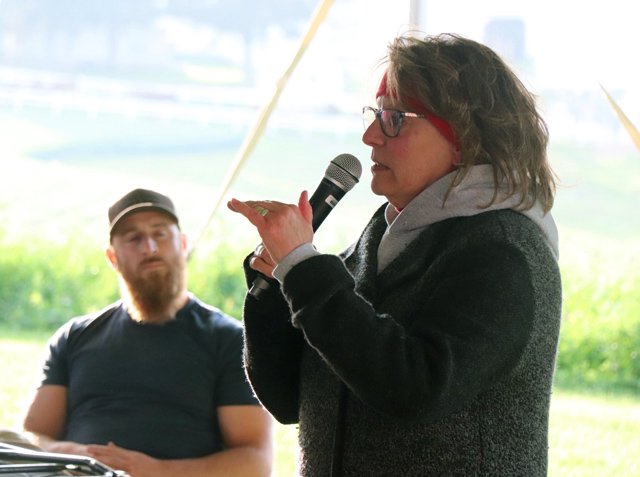
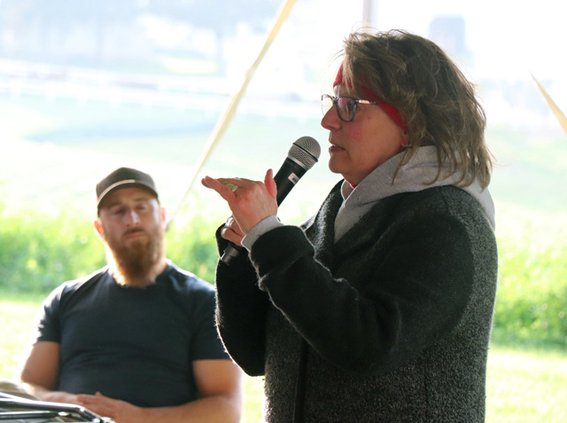
At the August 26 meeting of the Vernon County Flood Mitigation Alliance (VCFMA), Coon Creek Community Watershed Council President Nancy Wedwick, and CCCWC Board Member Tim Hundt, presented a proposal for a ‘Million Points of Mitigation’ to the Alliance members.
At the Alliance’s July meeting, they also heard a presentation from the ‘UniverCity Alliance,’ whose vision is that “UW-Madison will be a recognized leader, innovator, and contributor in improving the sustainability, resilience, livability, and general wellbeing of communities.”
At the July meeting, the Alliance called for proposals about how the UniverCity Alliance could assist Vernon County in achieving its flood mitigation goals.
The proposal from Wedwick and Hundt starts with the following preamble:
“This proposal is a multijurisdictional, interdisciplinary, comprehensive watershed-wide pilot project to develop, implement and test existing, as well as new techniques, practices and initiatives aimed at mitigating the effects of increasingly intense and frequent weather events and changes, in partnership with UniverCity Alliance. The three-phased project is multifaceted, touching on a variety of environmental components, conservation, education, health, engineering, agriculture, agroforestry, psychology, architecture, sociology, economics, law, and policy, to create a sustainable, continued habitat in our rural and urban areas. The result will be a million points of mitigation.”
Nancy Wedwick spoke in introducing the proposal, and shared the following story:
“Once upon a time, the Soil Erosion Service, now the Natural Resources Conservation Service, authored the Soil Erosion Sentinel. In one volume, the play ‘Old Man Erosion’ is summarized, followed by this poem offered by a brave soul, 90 years ago:
“Somebody said it couldn't be done
But he with a chuckle replied
That maybe it couldn't, but he would be one,
One who wouldn't say so till he tried.
So he buckled right in with a bit of a grin,
Without any doubting or quiddit,
He started to sing as he tackled the thing,
That couldn't be done and he did it."
Local knowledge
Wedwick explained that “On July 4, 2025, more than 100 people lost their lives, and homes and businesses were destroyed by flash flooding on the Guadalupe River in the Texas Hill Country. In the last month, reports have detailed how unprepared the area was for floods, the relatively new disaster planning for floods, and the lack of funding for basic preparedness such as early warning systems. Further, the area was called ‘Flash Flood Alley,’ and there were more than 70 oral histories going back to 1900 that described floods in the area. People knew the area had a long history of flooding, and lived with it.
“Here, residents of the steep, unglaciated Coon Creek Watershed, in southwest Wisconsin's Driftless Area, have a long history with floods,” Wedwick said. “The region was already prone to flooding, but settler conversion from native vegetation to agriculture in the late-1800s increased its severity. The introduction of soil conservation practices in the mid-1900s mitigated some impacts, but severe flooding has increased over the last 15 years because of the increasing frequency of heavy rainfall prompted by climate change. Recent life in Coon Creek has been punctuated by major floods in 2007, 2008, 2016, 2017, the worst in recorded history in 2018, and another in 2021; this trend holds true across the Upper Midwest. As flooding becomes more frequent and more severe in this rural and largely under-resourced region, community members are working together to reimagine ways to live with worsening floods.”
Coon Valley drownings
Wedwick told the story translated into English by Norwegian settlers, including her great aunt Maude in Coon Valley, who could also speak and write English, from a flood in 1881:
“A man named Hans Bergsen had just come from Biri, Norway with his family. They had not bought any land yet, but they were permitted to stay in a small cabin near the bridge over the Coon River, just west of the village of Coon Valley, on the north side of the road. This became the home for the wife and six small children. They were Anna 15, Julia 12, Agnete 8, Asbjorn 7, Halvor 4, and Peder 2 years old. In the meantime, the husband, a kind and simple man, worked in La Crosse. Late in the evening of July 20, 1881, a dreadful storm came. Rain poured down, lighting flashed, and the sharp bursts of thunder frightened the newcomer’s wife and her small children so they trembled with fear. Water dripped through the roof of the old cabin, but what was still worse was that it started to come in around the door. Soon the water was above the children’s knees, so they had to crawl from the bed up on the table. The poor mother stared in vain through the window for help, but outside the fierce storm only continued. Suddenly, a windowpane broke with a crash, and the rushing floodwaters came through the opening. Within seconds, the water was up to the mother’s hips. With a despairing call to God for help, the mother grasped the two small boys in her arms, and called to the two oldest children to take the other two children by their hands, and to hold onto them and to her skirt. Then she led them out into the dark, and the storm in search of dry land. But outside the floodwaters were rushing with greater force, and the water was two feet deeper than in the cabin. They were pulled into the current, and the children’s desperate cries were drowned by the raging waters. The ravaging storm took them away into the darkness over the fields and the meadows. The next day all seven bodies were found a couple miles down the creek. The mother still clutched her two smallest children in her arms, while a girl held her mother’s skirt. Two of the children were found in the branches of a tree where they fell with a heavy, wet plop into the arms of the two men who found them. Someone had to go to La Crosse to tell Bergsen about this terrible tragedy…”
Wedwick continued, “Another 19 floods from 1907 to 1956 that destroyed infrastructure, crops and ruined farm incomes are detailed in the application for the construction of the PL 566 dams in the Coon Creek Watershed. Fifteen more occurred, but these were the floods remembered and recorded by the people who lived at that time. These are the records of our community going back to 1881.”
Can’t deny the truth
“So what we are not in a position of doing is saying, ‘Oh, we didn't know.’ History is too heavy, it is too deep, it is palpable, and it is known on a national level,” Wedwick told Alliance members. “We are at a point because we know that these storms keep happening. Your Vernon County Multi-Hazard Mitigation Plan 2023-2028, outlines what are the threat in terms of storms and hazardous events. If you take a look, you can see that the biggest concern is flash flooding, and also flooding. I think the next highest thing that comes in close is ice storms.”
100-year plan
At CCCWC’s Fourth Anniversary Celebration, held in rural Stoddard on September 3, Wedwick pointed out that the period from settlement to the period of the iconic Coon Creek Watershed Project (1840’ to 1930) was 90 years. She said that it had taken 90 years to destabilize the environment after settlement before local citizens took steps to slow and reverse the devastation in the 1930s.
“Here we are 90 years later, and we are in the same mess, because we lost our way - we forgot some things, we stopped doing some things,” Wedwick told the crowd at the celebration. “And so we have a historical marker outside of Coon Valley on the way to La Crosse, commemorating the Coon Creek Watershed Project, that reminds us that we know this, and that this project was done in this area.”
Wedwick urged those assembled, and citizens of the broader Driftless Region, to join together to break this cycle of heroic effort and recovery followed by forgetting and slipping backward. She called for a 100-year plan so that the changes made to keep communities safe and prosperous will not be forgotten and abandoned, again and again, in a repeating cycle.
At the VCFMA’s meeting where the proposal was introduced, co-author Tim Hundt also weighed in.
“You know, the settlers who came and farmed in this area really just didn't know what they didn't know,” Hundt said. “They weren't intentionally going out and doing things to try and make things worse. They just didn't know.”
Gaining perspective
Hundt gained this insight in the course of covering the 75th Anniversary of the Coon Creek Watershed Project in 2008 as a community journalist.
“And so what I wrote about was we have to stand back occasionally and ask, what is it we're doing now that we don't know is having a negative impact, or what could we do better?” Hundt said. “And I think we're at that point again.”
Then, Hundt said, came the 2018 flood, and that changed everything.
“And then I started to deal with people in in Crawford County, and Crawford County is looking at Vernon County and going, what are you doing with those dams? And people in Viola asking what's going on upstream?” Hundt said. “So, it occurred to me that these things happen over political boundaries. They happen over a geographic area - over a watershed.”
Hundt says what has happened over time, and more in recent years, is moving people and infrastructure out of the way. He pointed to the history of Soldiers Grove and Gays Mills, and more recently, the efforts in Viola and Ontario. But, he said, just moving people out of the way isn’t enough, and you also must do the work in the uplands of the watersheds to infiltrate the stormwater, and prevent as much of it as possible from running off, and causing flash flooding and flooding.
“That upstream stuff is the rest of it, and that's where I think a comprehensive project that touches on all of these things is necessary because there are a lot of variables,” Hundt said. “A lot of this work has been focused on ag practices, which is a big piece of it, but it's not all of it.”
Hundt pointed out that the same upland conservation practices that help to prevent flooding would also help municipal water and sewer utilities meet their standards for nitrate and phosphorous. He said that for most small communities in the Driftless Region, achieving those standards through upgrades to their plants is financially out of reach.
Hundt pointed out that recent efforts to address the problem have benefited from more modern scientific methods, and are data intensive.
“Returning from an on-farm conservation demonstration event, a companion observed that these are data people, but this is a people problem. And I think that's absolutely right,” Hundt said. “So we can use our data and our information to back things up, but the people part is very important.”
He said that recent shifts in federal policy and funding for conservation and climate mitigation, combined with restructuring of FEMA and diversion of its resources, is all stacking up with the increasing frequency and intensity of large rain events to create a recipe for disaster.
“And you know that story from 1881, we could be right back there. So, my hope would be that the university could partner and help us look at all of these areas, and help us come up with a plan,” Hundt concluded.
The proposal
The proposal points out that in 2018, five flood control dams breached, and the floodwaters created destruction that drew national attention.
In the play titled ‘Old Man Erosion,’ performed in the early 1930s to encourage conservation practices in agriculture and forestry, Old Man Erosion eventually agrees to leave when he sees the farmers, including Farmer Brown, joining with the Soil Erosion Service to combat him. Old Man Erosion issues one final threat “if he ever catches (Farmer Brown) napping he’d better look out.”
The proposal continues:
“During the past 50 years, the conservation practices initiated in the 1930s and required with the construction of the PL-566 dams, have fallen away for a variety of reasons. The contour strips have diminished along with crop rotation. Gullies have formed, not yet as deep and treacherous as in the 1920s, hidden by foliage. Conservation practices have been abandoned. The memory of flooding has been veiled. In the span of 80-90 years, we have forgotten.
“Old Man Erosion has indeed caught us napping.”
The thoroughgoing proposal would address infrastructure, residential and urban practices, producer practices, next generation conservation practices, stakeholder engagement and social modeling, woodland practices, communications, education, land use and zoning, GIS and land information, physical and emotional health, economics, and long-range planning.
The proposal calls for the project to be developed in three phases – building partnerships, planning and implementation. This will be followed by continuous evaluation and improvement.
The proposal concludes with the following:
“Like the first pilot project in the 1930s, this is an effort to mitigate and reverse a mostly manmade ecological threat. Like the first project, the effort will take an examination of the variables that can impact that crisis and this time a new set of variables in more areas will be needed to achieve results. Like the first project, the crisis is here and that will increase the chances of support from those affected and from policy makers to implement solutions. Unlike the first project, this is not a top-down solution coming from the federal government to the community. This time it is the community, reflecting on its past and looking toward its future who is asking to partner once again with the UW-Madison and the government to create a resilient watershed project that can serve as a model for others.
“This proposal by no means addresses all the things that could be looked at or incorporated. It should, however, convey that this project needs to take a large and comprehensive approach.
“The good people in Texas had warnings. They had oral histories and people looking at problems. They had people pressure FEMA to take land out of the floodplain. These buildings and people washed away. We have oral histories. We have warnings. We have pressure to build in places that maybe we shouldn’t. We can learn from others or wait for the inevitable.”