Last week, both the Richland and Vernon county boards unanimously adopted resolutions requesting information about the 765 kilovolt (kV) transmission line proposed for the Driftless Region.
This followed adoption of similar resolutions in Crawford County and Houston County, Minnesota. In addition, Vernon County adopted a resolution expressing their reasons for opposing siting of the line in their county.
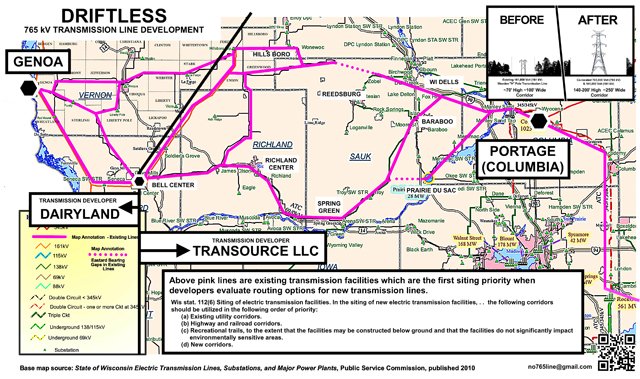
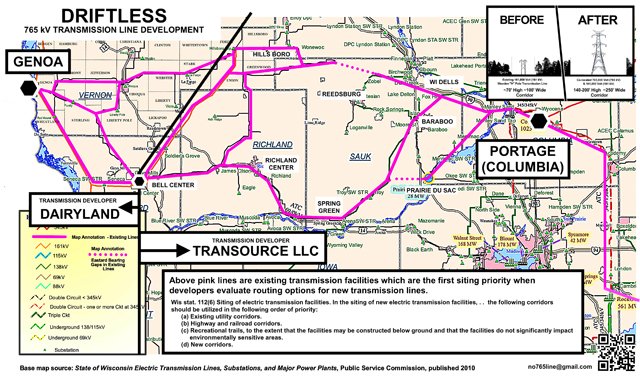
Two different developers have been approved to build the massive new transmission line, intended to run from Marion, Minnesota, cross the Mississippi River at Genoa, Wisconsin; and then run through Vernon and Crawford counties to Bell Center and continue east from Bell Center to Portage, Wisconsin; before heading south and then south to the Illinois state line.
Dairyland Power Cooperative and GridLiance will build the stretch running from Marion, Minnesota to Bell Center, Wisconsin . Transource will build the stretch running east from Bell Center to the Columbia Substation near Portage, and then south to the Illinois state line. The project name for the first segment is ‘MariBell,’ and for the second, ‘BECI.’
Only the MariBell project will impact counties in southeast Minnesota, and Richland County, but both lines have potential to impact Vernon and Crawford counties. For this reason, the resolution in Crawford County mentioned both developers, and Vernon County adopted two information request resolutions – one for each of the two developers.
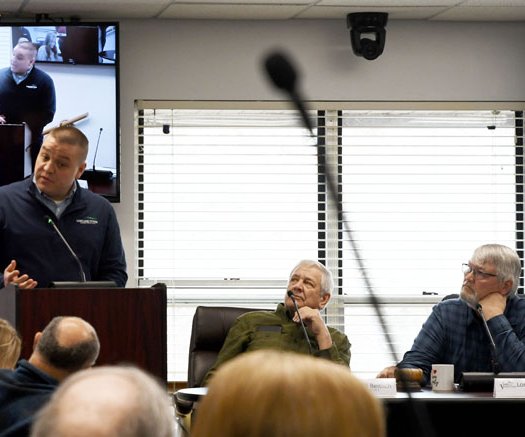
Prior to Richland County’s adoption, Supervisor Rod Perry (Richland Center), addressed his concerns with the board.
“I didn't speak out in opposition to this resolution, but I don't care for the way it’s worded. If you read it, you might think that the county board, has already decided they're against the transmission line before it's even been discussed,” Perry commented. “I have too much history in the electric industry to be against a transmission line, just on the basis of the transmission line, but I will support getting more information, because information is what drives decisions. We need to know all we can know.”
“My understanding is that even if we’re against it, it’s going to happen anyway,” Supervisor Richard McKee said.
Wisconsin bill
In public comment before the Vernon County Board, 96th Wisconsin Assembly District Representative Tara Johnson, spoke about the bill she and 32nd Wisconsin Senate District Senator Brad Pfaff, had recently co-sponsored.
“Senator Pfaff and I introduced a piece of legislation last week that adds clarity to state statute around how transmission lines are sited in the state of Wisconsin,” Johnson shared. “It has a Legislative Reference Bureau (LRB 6527) number now, but it does not have a bill number assigned to it yet.”
Johnson explained that currently, Wisconsin State Statute 1.12(6) says that in proposing siting of new transmission facilities, developers must follow an order of priorities. The first priority is existing utility corridors, and then highway and railroad corridors, then recreational trails, to the extent that the facilities may be constructed below ground and that the facilities do not significantly impact environmentally sensitive areas. And then the fourth is new corridors.
“The bill that we have introduced adds a criteria at the top of that list, requiring that mega transmission systems [345 kV or larger] use consolidated utility corridors and high voltage direct current (HVDC), or other underground solutions, co-located with existing 345 kV lines, highways, and railroads,” Johnson explained. “The intent of this is a rare legislative fix that we can make in the siting of transmission lines that otherwise is almost exclusively the purview of the Public Service Commission (PSC).”
Johnson emphasized that, despite reports to the contrary, the Wisconsin Legislature is still working, and there is still time for this bill, if passed and signed into law, to impact where the MariBell and BECI lines are sited.
Johnson explained that next steps in the process, once it clears LRB review and is introduced, is to seek co-sponsorship from other members of the Assembly and Senate. Johnson explained that the co-sponsorship process will stimulate conversations with her and Senator Pfaff’s colleagues in the legislature.
“Tara, do you have any sense of the appetite in the Legislature for a piece of legislation like this?” Supervisor Wade Lawler asked. “Clearly, it would require bipartisan support in order to become law. So just curious, your initial read.”
“I don't have a good sense, but I will say that I have had zero conversations with any legislator on either side of the aisle that is crazy happy to welcome the MariBell line,” Johnson responded. “You're right, it will take bipartisan support, and I expect that there are a number of legislators on both sides of the aisle who will be interested in signing on.”
Johnson told the board that the best thing citizens can do to move this legislation forward is to reach out to other legislators in the region, particularly those in district’s where the proposed line would be sited such as Representatives Travis Tranel and Tony Kurtz.
Public input
Rob Danielson, resident of the Vernon County Town of Stark, and a potentially impacted landowner, made the point that Dr. David Patton has challenged the idea that there is a need to build the MariBell and BECI 765 kV lines.
Patton is the independent evaluator charged with evaluating transmission expansion proposals put forth by the Midcontinent Independent System Operator (MISO) which has proposed, secured investor financing for, and selected the developers to build, the MariBell and BECI transmission lines.
“The person who is most qualified to evaluate the utility planning and its projected future need for these lines has stated on four occasions before the board of the utility regional planners that their projected need is exaggerated and unrealistic in five out of eight categories that they use to evaluate the need,” Danielson explained. “For me, this is about addressing a long overdue issue with utilities spending and expanding far more than we need in order to get their guaranteed returns on the investment.”
Tim Woodhouse, Town of Genoa patrolman and local farmer, weighed in on how the line would impact him and his family.
“My home in Genoa Township is within 300 feet of the center line of this project. My farm site is home to our beef cattle herd with a mix of modern and older farm buildings. The project beyond my farm affects my family members, my neighbors and pasture land where my cattle spend the summers grazing,” Woodhouse told the board. “From the very beginning, I have engaged, questioned and e-mailed the various people sent out to move this project forward, and every encounter leaves me with more concerns and promises of more dialogue.
“For 26 years, I have been a member of the Genoa-Harmony Fire Department. If approved, the largest high voltage transmission line in the state would be built across the fire district and through Vernon County,” Woodhouse pointed out. “Any emergency resulting from that project would fall to our local and county personnel. We all know local and county resources are spread thin. Who would be required to fund, train, coordinate, delegate and respond to any emergency involving this transmission line? What would the response time be for trained personnel for any incident? How would residents be made safe in such a scenario?
“The impacts to our area cannot be known as this is the first of its kind in the state. While executive staff and lawyers work to implement this proposal, people like me lie awake at night wondering if everything I have built as an adult will be impacted by the decision of three people in our state,” Woodhouse concluded.
Board discussion
Prior to unanimous passage of the three resolutions, the Vernon County Board engaged in a short round of discussion. The two information resolutions were amended to specify all providers that supply electricity to Vernon County, and to clarify information about high voltage direct current (HVDC) transmission.
“The resolution stating the county’s opposition to the line passed as presented, but was addressed in board discussion by its author, Supervisor Mary Henry.
“Your vote for this resolution will signify that we as a board feel that this is not a good thing for Vernon County, our branding and our vision, and its impact to our economy, agriculture, tourism, and the value of our land. Once it’s disrupted, it'll always be disrupted,” Henry stated. “Part of the reason that our county is being targeted is because we didn't have zoning, one of the few in the state. It is also our temperature, because these facilities, those power lines and the data centers, run very hot, and they need that cool water and our cool temperatures. So we are being targeted as Wisconsin for our temperature, our water, and for our environment and climate.”
Resolution text
While all of the information requests passed in Houston County, Minnesota, and Crawford, Vernon and Richland counties in Wisconsin are similar, the third resolution passed by Vernon County is unique in that it states explicit opposition to the siting of the transmission line in their county. The text of that resolution is as follows:
RESOLUTION OPPOSING THE PROPOSED 765kV HIGH-VOLTAGE TRANSMISSION LINE THROUGH VERNON COUNTY AND THE DRIFTLESS AREA
WHEREAS, Vernon County lies within the nationally recognized Driftless Area, a uniquely fragile landscape defined by steep ridges, cold-water trout streams, karst geology, and highly erodible soils that are particularly vulnerable to large-scale infrastructure disturbance; and
WHEREAS, The proposed high-voltage transmission line would require extensive clearing, construction corridors, blasting, and long-term maintenance that would fragment wildlife habitat, disrupt agricultural lands, and permanently alter the natural character of the region; and
WHEREAS, Vernon County’s agricultural economy depends on productive farmland, livestock operations, and regenerative farming systems that could be adversely affected by land fragmentation, easement restrictions, soil disruption, and concerns regarding electromagnetic field (EMF) exposure to livestock; and
WHEREAS, Vernon County is home to one of the largest Amish communities in Wisconsin, whose farms and homesteads lie within the proposed corridor and whose religious practices do not utilize electricity, and the placement of a high-voltage transmission line across their properties would impose infrastructure from which they receive no benefit while restricting land use and disrupting traditional agricultural operations; and
WHEREAS, Property owners face potential declines in land value and long-term uncertainty, and Vernon County’s tourism economy—driven by its scenic beauty, trout streams, outdoor recreation, and rural character—would be negatively affected; and
WHEREAS, Vernon County is currently engaged in watershed and dam decommissioning efforts within the Coon Creek and West Fork watersheds, and the cumulative impact of additional large-scale infrastructure development must be carefully considered.
NOW, THEREFORE, BE IT RESOLVED,
That the Vernon County Board of Supervisors formally and unequivocally opposes the proposed high voltage transmission line within Vernon County and the Driftless Area, finding that this region is not suitable for such development and that the project poses substantial risks to public health, safety, and welfare, as well as to environmental integrity, agricultural viability, economic stability, and cultural resources.