At the August 12 meeting of the Crawford County Land Conservation Committee, Conservation Director Dave Troester told the committee that two new livestock facility siting permit (LFSP) applications for hog Confined Animal Feeding Operations (CAFO) had come before him.
The two permit applications are from Gruber Livestock South LLC, and Gruber Livestock North LLC. The applicant for the proposed south facility is Mary Hrycyk of Bolingbrook, Ill., and the applicant for the proposed north facility is Dennis Gruber of Homer Glen, Ill. Both addresses are located in Will County in northeast Illinois, just to the south of Chicago.
“Gruber Ridge Farms has submitted two applications for two separate livestock facilities located on their land in Marietta Township,” Troester told the committee. “The parcels where the facilities would be located are actually about three miles due east of AV Roth’s proposed, but not yet constructed facility.”
“They wanted to make it clear that they were two separate facilities,” Troester said. “There's definitions and the state codes at that, and DNR, that defines if they're adjacent or not. If they were, they'd be considered one operation. So, if the parcels connect, even if it's two parcels touching at just a corner, they'd be adjacent. Their initial plan was to have them touching, but now they've moved one of the barns deeper onto the property.”
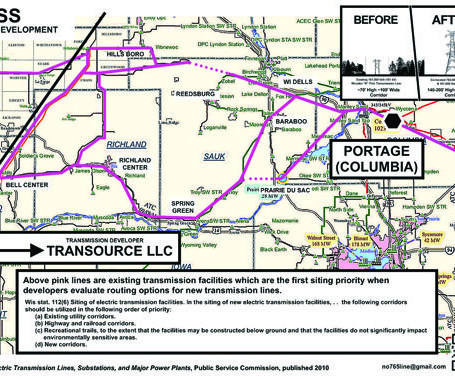
The two facilities will be located on two of the 15 parcels owned by Gruber Ridge Farms LLC located in Marietta Township off of Plainview Road. According to Troester, the Gruber North LLC barn would be on parcel 012-0659-0000, and the Gruber South LLC barn would be on parcel 012-0760-0000 (see map below).
The DATCP LFSP application defines “adjacent” as “located on land parcels that touch each other, or on land parcels that are separated only by a river, stream, or transportation or utility right-of-way.” The application defines “related livestock facilities” as “Two or more livestock facilities that are owned or managed by the same person and meet any of the following criteria: they are located on the same tax parcel or adjacent tax parcels; and/or they use any of the same livestock structures to collect or store manure; and/or they generate manure that is applied to the same parcel of land… Related livestock facilities are treated as a single livestock facility for purposes of local approval.”
Committee member Chad Sime pointed out that the 999.6 animal units cited on both applications is very close to the 1,000 animal units number which would trigger requirement of a Wisconsin Pollution Discharge Elimination System (WPDES) water quality permit. He asked how the farm would be monitored to ensure they are staying below the 1,000 animal unit number?
“I don't know how we regulate it, unless we go out and check,” Troester responded. “I think it's on DNR radar, and they are still reviewing things to make sure that they are staying under. But would DNR ever go in in six months after it's built and verify the animal units? I'm not sure.”
Permit standards
Wisconsin DNR requires agricultural producers operating livestock facilities with more than 1,000 animal units to apply for a WPDES permit. Crawford County requires a permit for operations with greater than 500 animal units.
Crawford County’s Livestock Facility Siting Ordinance is identical to the state statute ATCP 51, except that Crawford County voted to begin the threshold for requiring a permit at 500 animal units.
According to ATCP 51, a complete application will include five worksheets: animal units, odor management, waste and nutrient management, waste storage facilities, and runoff management.
The application form states, “The application form and worksheets ask for information to show compliance with Wisconsin livestock facility siting standards. A local government has very limited authority to modify the standards by local ordinance (modifications, if any, must be reflected in the local version of this application form).”
Animal units/manure
Both the Gruber north and south applications state their operations will house 999.6 hogs from 55 lbs. to market. Wisconsin Department of Agriculture, Trade and Consumer Protection defines each hog of 55 lbs. to market as 0.4 animal units. Thus, each facility proposes to house 2,499 hogs.
Gruber South’s application states that the facility will produce 1,023,896 gallons of manure each year, with the manure storage structure for the facility sized for 372 days of storage. That manure, according to their application, will be applied to 222.6 acres of cropland, providing 0.223 acres available for each animal unit.
Gruber North’s application, identical to Gruber South’s, states that the facility will also produce 1,023,896 gallons of manure each year, with the manure storage structure for the facility sized for 372 days of storage. That manure, according to their application, will be applied to 223.8 acres of cropland, providing 0.224 acres available for each animal unit.
Sime asked if there was any business connection between the farrowing operation proposed by AV Roth and the 55 lbs. to market operations proposed by Gruber North and South?
“I did look at the new nutrient management plan that was submitted by Roth Feeder Pigs II, and the fields under contract to Gruber Farms are no longer in AV’s plan,” Troester responded.
Land spreading acres
Crawford County recently amended their Animal Waste Storage Ordinance to require that operations in the county required to have a Nutrient Management Plan are required to submit signed agreements for acres available for land spreading of manure to the county.
“About 50% of each facility’s spreading acres will be on owned land, and the other 50% on leased land,” Troester said.
On July 9, 2025, Gruber Livestock South LLC applicant Mary Hrycyk entered into a 15-year manure application agreement with Casey and Corey Fritz. The agreement makes available for land spreading of manure from the Gruber South facility USDA Farm 6684, USDA Tract 6618 – Field 3 (18.07 acres), Field 4 (83.68 acres), Field 5 (5.32 acres), Field 12 (4.76 acres); and USDA Farm 6138, USDA Tract 6128, Field 3 (4.72 acres), for a total of 111.83 acres.
Also on July 9, 2025, Gruber Livestock North LLC applicant Dennis Gruber entered into a 15-year manure application agreement with Casey and Corey Fritz. The agreement makes available USDA Farm 6684, USDA Tract 6618, Field 15 (99.77 acres), and Field 2 (3.75 acres), for a total of 103.52 acres.
Odor score
A CAFO is required to submit an odor score worksheet in their LFSP application if livestock structures associated with the facility are less than 2,500 feet from the nearest affected neighbor. Gruber North is not required to submit an odor score, but Gruber South was. Gruber South’s score, according to the worksheet submitted with the application is 1,030.
The DATCP application defines “affected neighbors” as “residences or high-use buildings within 2,500 feet of any livestock structure at the proposed facility, other than those owned by the applicant or by persons who have agreed to exclude them from the applicant’s odor score calculation. The total odor score for a livestock facility depends, in part, on the proximity and density of affected neighbors.”
An odor score is a predictive estimate of a facility's potential to generate odor, based on its size, type, odor control practices, and the proximity and density of "affected neighbors.” A calculation using a standardized worksheet determines this score, and a score of 500 or more is required to pass the odor standard and gain local approval for siting decisions.
Approval process
Troester said that he received the two applications on July 24, so the county has 45 days to ensure that it's a complete application. So, the 45 days is up on September 7.
DATCP’s application states, “If you complete the application properly, the local government MUST APPROVE the proposed livestock facility unless it finds, based on clear and convincing evidence in the local record, that the facility fails to meet the state standards. Within 45 days after you submit your application, the local government must notify you whether your application is complete. If you failed to complete part of the application, you must submit the missing information. The local government must grant or deny the application within 90 days after it declares the application complete, and issue its decision in writing.”
“The applications will probably be determined as complete in the next week or two,” Troester said. “Then, we will have to get it posted for public hearing.”
Troester said the manure storage worksheet is something that can just be approved by his department, and that approval has a 30-day clock.
“The DATCP LFSP application says, if we don't approve the manure storage worksheets within 30 days, it's deemed that we don't have problems with them. So a 30-day clock is ticking.”