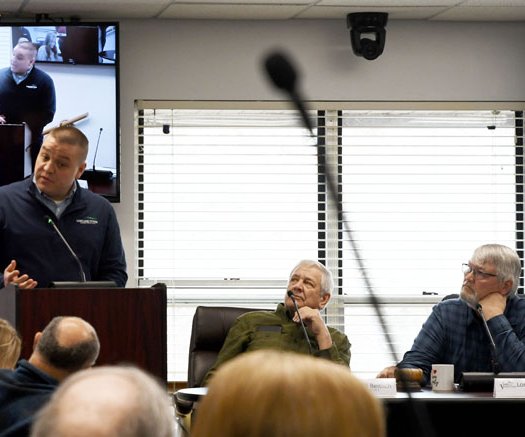
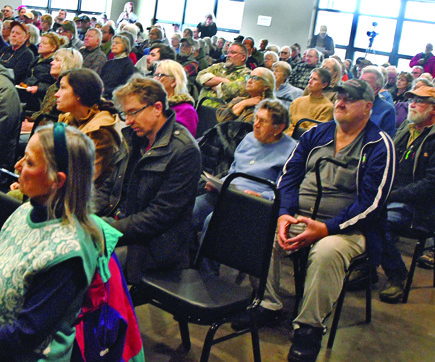
At their Tuesday, January 13 meeting, the Crawford County Land Conservation Committee unanimously approved a resolution asking Dairyland Power Cooperative for more information about the MariBell 765 kV transmission line.
The committee recommends passage of the resolution by the Crawford County Board of Supervisors at their February meeting
That line, which if built, would be the largest in the State of Wisconsin, is proposed to run from Genoa to the substation in Bell Center. The same 199-foot poles that would carry the 765 kV wires transmitting power to the Columbia substation near Portage, and then to the Illinois state line, would carry rebuilt 161 kV lines, which supply power to our local area. The massive new lines would follow the existing 161 kV line easements through Vernon and Crawford counties.
The poles currently in place at 70-feet tall, and the existing easement is 100-feet wide. The MariBell project would increase the height of the poles to 199 feet, and the width of the easement from 100 feet to 250 feet. Many local landowners are concerned about how this expanded easement will impact their properties and homes.
Resolution text
WHEREAS, the Midcontinent Independent System Operator (MISO) and Dairyland Power Cooperative have announced intentions for a 765 kV transmission line known as, "LRTP Project #26, North Rochester- Columbia;" that is designated to pass, in part, through Vernon, Crawford, Richland, Sauk and Columbia Counties and in Vernon, Crawford and Richland Counties with an additional, double-circuit, 161 kV transmission line; and,
WHEREAS, LRTP Project #26 proposed to pass through our area would be part of a 765 kV transmission "backbone" system continuing from Columbia (Portage, WI) to another regional electricity market that serves Chicago and points east; and,
WHEREAS, a transmission line of this size and characteristics has never been considered or constructed in Wisconsin, to date; and,
WHEREAS, the cost of Project #26 that would be assumed by ratepayers has been estimated at $10.6 billion; and,
WHEREAS, within MISO's most recent FAQ, the regional utility interests' estimate of costs and benefits from the Tranche 2.1 expansion lines (including a potential 765 kV project through our area) would lead to an expense of about $13.50 per month for an electric customer using 1,000 kWh per month; and,
WHEREAS, Public Service Commission of Wisconsin staff engineers have found that upgrades of existing transmission lines can provide the same benefits at much less expense to ratepayers; and,
WHEREAS, the official, Independent Monitor of the MISO wholesale electricity market and MISO transmission planning, Potomac Economics, has found that MISO's Tranche 2.1 transmission lines, including the Project:
• Assume a view of the future that is "extremely unlikely."
• Forecast potential benefits to the customer that are "overstated" or "invalid" in five of eight key categories.
• Would lead to "uneconomic investment (that) will raise costs and undermine investment in resources, storage and other alternatives to transmission."
• The MISO Board should "postpone approval of Tranche 2.1 transmission lines;" and,
WHEREAS, MISO's Tranche 2.1 transmission expansion planning requires a very large buildout of wind and solar facilities which, traditionally, have relied on very substantial federal tax credit incentives that are now scheduled for elimination in 2028 as determined in the July, 2025 Federal Reconciliation Budget Bill; and,
WHEREAS, use of electricity and summer peak demand in Wisconsin have been statistically flat over the last 10 years; and,
WHEREAS, An Environmental Impact Statement jointly authored by the Wisconsin Public Service Commission and the Wisconsin Department ofNatural Resources found that even smaller 345 kV transmission lines "may result in negative affects to property values, tax credits and heritage tourism": and mentions studies showing devaluations from 10 to 45% depending on the proximity, visibility, size of parcel and whether sited in an industrial or natural setting; and,
WHEREAS, Crawford County's Comprehensive Plan and Land and Water Resource Management Plan both reflect the inherent and economic value of natural resources and farmland of the town; and,
WHEREAS, the karst geology of the region is unstable for extremely heavy development such as the transmission towers, and vulnerable to potential ground water pollution during construction; and,
WHEREAS, LRTP Project #26, North Rochester-Columbia as designed would add hazardous obstacles for migrating and resident raptors, water fowl and songbirds that routinely utilize the Mississippi River Flyway; and,
NOW, THEREFORE, BE IT RESOLVED, that The Crawford County Board of Supervisors hereby requests that Dairyland Power Cooperative provide the following information either in written, electronic format or through an in-person presentation before our Board before March 15, 2026:
1. A map of eligible, existing transmission line routes for the considered 765 kVI 161 kV transmission line Project through Vernon, Crawford and Richland Counties.
2. Images of the types of towers that might be used for the transmission line Project in Vernon, Crawford and Richland Counties.
3. The range of the heights of these 765 kV/161 kV transmission towers, in feet.
4. The range in total easement widths that these 765 kV/161 kV transmission towers would require, in feet.
5. The name(s) of the entity or entities that would be the owner(s) of the Vernon, Crawford and Richland County sited portions of the 765 kV/161 kV transmission line.
6. Estimated date that the 765 kV/161 kV transmission line is expected to be proposed to the Public Service Commission of Wisconsin.
7. Estimated total cost of Project #26, North Rochester-Columbia transmission line that includes the 765 kV /161 kV segment in Vernon, Crawford, Richland, Sauk and Columbia Counties.
8. Estimated total cost of regional generation additions in the Electric Generation Expansion Analysis System (EGEAS) for MISO's Long Range Transmission Planning (LRTP) Tranche 2.1.
9. If the costs of Project #26 would be shared with electric customers in other states, provide a list of those states.
10. Estimated capital cost per month per customer in Vernon and Crawford Counties over 20 years for the Project #26.
11. Give documentation of the acreage of additional land used for the right of way of Project #26 in Crawford County. List acreage of forested land lost.
12. Give documentation of how Dairyland has mitigated the issue of the cracked and unstable karst geology in other 765 kV lines. If that's not ever been done, give thorough analysis of how 200' towers will be stabilized and built on karst geology. Give documentation on how surface and ground water will be protected during construction.
13. Give documentation of the acreage amount of wildlife habitat that will be lost, how birds, raptors and waterfowl will be impacted in the Mississippi River Flyway, and how the bird impact will be mitigated.
14. Documentation from MISO that accounts for considering the use of carbon composite conductors when alternatively rebuilding the avoided transmission facilities, and "reliability issues" in long range transmission planning.
15. A list of the "significant economic development benefits" that the Project would deliver to the local economies adjacent to the proposed project through Vernon, Crawford, and Richland Counties.
16. Documentation explaining MISO's calculation of a net monetary benefit for Wisconsin residential electric customers if the estimated cost of the Project is around $27.50 per month, while returning only $10 to $14 per month to ratepayers.
17. Documentation from MISO planning that estimates of the percentage of electrical power assumed to be provided from distributed solar and distributed storage resources in years 1, 10, and20.
18. A list of prior, combination 161 kV and 765kV transmission projects the expected developers of the Project have installed, with their locations.