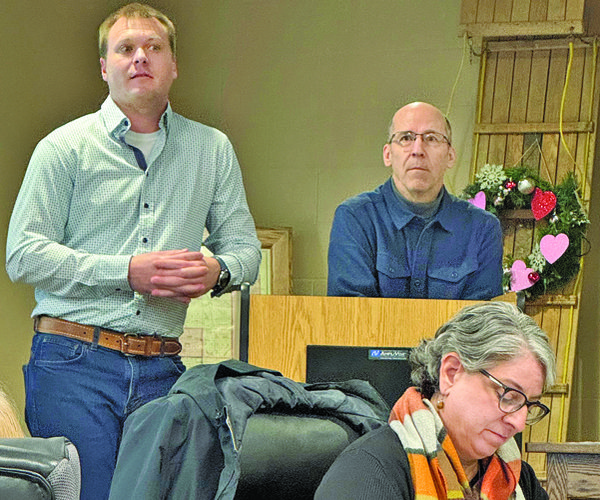
At their December 9 meeting, the Crawford County Land Conservation Committee (LCC) voted to extend their decision-making timeline on the two applications for a county livestock facility siting permit from Gruber Livestock North LLC and Gruber Livestock South LLC. County Board Chair Tom Cornford attended the meeting, and committee member Kate Krachey was absent.
The two permit applications are from Gruber Livestock South LLC, and Gruber Livestock North LLC. The applicant for the proposed south facility is Mary Hrycyk of Bolingbrook, Ill., and the applicant for the proposed north facility is Dennis Gruber of Homer Glen, Ill. Each gilt (replacement sows) development facility would house 999.6 animal units (2,499 hogs), and generate 1,023,896 gallons of manure each year. The facilities would be located in Marietta Township.
Wisconsin DNR requires agricultural producers operating livestock facilities with more than 1,000 animal units to apply for a WPDES permit. Crawford County requires a permit for operations with greater than 500 animal units.
Crawford County’s Livestock Facility Siting Ordinance is identical to the state statute ATCP 51, except that Crawford County voted to begin the threshold for requiring a permit at 500 animal units.
Discussion ensues
Committee chair Supervisor Gary Koch said that both permits could be discussed at the same time, but that if action were to be taken to either approve or deny the permit applications, those votes would be taken separately. He asked Crawford County Conservation Director Dave Troester to summarize where the decision-making process was at.
“Back-and-forth discussions in the last few weeks stemmed from questions and concerns raised during the public hearing for these two permit applications from the public and committee members,” Troester explained. “One topic that raised a lot of concern was the projected yield goal of 250-bushels-per-acre in their nutrient management plan.”
“I talked to Sam Bibby, Regional Crop Educator for UW-Extension, and he said that anything is possible, but what he's typically been seeing is yields in the high 100s,” Troester said. “He said if you get all the right conditions -, good weather, no pests, limited deer or damp – you might get that kind of yield. I believe the county average, based on USDA statistics. was right around 155. My question is, how do we know if what's put in the plan is accurate?”
Troester posed the question, what would happen to the nutrient management plan (NMP) if a lower yield goal were used? How would that affect the nutrient uptake, and would it lead to nutrients building up quicker?
“We just decided that we should have an agronomist review the nutrient management plans for the facilities, so I made a couple calls to some plan writers recommended by the farm business manager at Southwest Tech, and found one that had time,” Troester explained. “He did a review, which you've all hopefully seen. He had various concerns and brought up some topics that I hadn't even considered.”
Troester said that as a result, last Friday, when he received the final report from the agronomist, he sent it to committee members and to the two applicants, who have responded.
“So if you've seen that in your e-mails, it had the plan review and responses from the applicants and/or their plan writer,” Troester said. “What jumped out at me was that changing the yield goal didn’t necessarily result in more phosphorous build up, but rather resulted in more soil loss because of having less soil biomass. The other issue was that portions of the fields where manure would be spread and crops grown are near the edge of the forest, and probably couldn’t hit those yield goals.”
Troester said that Mary Hurcyk had responded, but the response had been received just a short time before the committee’s meeting, and he’d not yet had time to review every response.
“DATCP did give a review of the engineering plans, and everything meets the NRCS standards for the construction. We've looked at the odor score, and the five components of the application that, if they are met, you must, must approve the application. So really, the biggest thing is wanting further discussion of the nutrient management plan.”
Kuhn’s questions
Committee member Supervisor Mary Kuhn said her nutrient management plan writer told her that some fields locally had achieved yields of 230 bushels-per-acre with improved growing conditions in 2025.
“The last several years, it's been droughts. So you can't say you can't hit those yields. And again, it's high fertilizer cost - who's going to push the limit and see what they can get, or try to target higher yields when the costs are so high? So you fertilize to what you want to achieve,” Kuhn stated. “A NMP is a working plan. It’s not a requirement to have to hit the goal. It's a goal, right? Everybody can set goals, and should have goals in life that you want to achieve. Is hitting the goal required to get a permit? No.”
Kuhn said she had concerns about areas of the fields where ditches had been filled in, where the potential for erosion is higher. This, she said, could affect the tolerable soil loss or “T.”
She also asked about a specific boundary for what she described as ‘Field 12’ and ‘Field 13,’ which are listed in the NMP for one or the other of the two facilities.
“Is there specific enough division between those two fields that if they were spreading, and haven't finished cleaning out one barn, is there enough division that they’ll know they have to put more on the one field, because they can't go over there?” Kuhn asked.
Kuhn also noted that the pH in some of the fields is low, which can impact nutrient uptake by the crop, and potentially leave more unused nutrients in the soil.
“The question becomes, on those fields that only have a pH of 5, are you over applying nutrients in order to get the additional bushels? That's my concern,” Kuhn said. “I'm trying to understand how this works, because your soil tests show close to 100 acres at a pH of 5.1, so either it was improperly tested, or that is the actual result. You can't get away from the fact that at that low level, only 60% of what you put on is available. So even if you fertilize for 220 bushels, you're losing so much in the nutrients. Are you fertilizing based on soil pH? How are you choosing how to fertilize?”
Childs weighs in
Crawford Stewardship Project’s Working Lands Program Coordinator Joe Childs shared a document with committee members which outlines USDA-NRCS’ Standard 590, which defines when a nutrient management plan can be considered complete.
“Standard 590 sets forth a nutrient criteria for all sites to develop and implement an annual field-specific Nutrient Application Plan to account for the source, rate, timing, form and method of application for all major nutrients. Those major nutrients are nitrogen, phosphorus and potassium (NPK). That is what their definition is,” Childs said. “All of Gruber Livestock’s fields are over on nitrogen. The 590 standard says that all major nutrients, including N, P and K, must be within the standard in order for a plan to be deemed complete. So, saying it doesn't matter if we hit our goals is not true. It absolutely matters if you hit those goals, because if you're only producing 70% of what you say you're going to produce, that's 30% of the nutrients that you're targeting to get those goals that aren’t being used.”
Sime’s thoughts
Committee member Chad Sime reported he’d spoken with the nutrient management plan writer he’d worked with for the last 20 years about the Gruber NMPs. He said that his plan writer said there is a lot of variance in NMPs, with a lot of what goes in being subjective.
“I realize there may be concerns on the most objective part. Yes, it's an important part of this plan, but I personally can't see disapproving an entire plan based on this. As a whole, I personally can't disapprove a whole plan based on things that are extremely subjective, and will be addressed moving forward.”
Objective decision
“I think we need to get the information right, because once we approve this, we can't go back,” Troester said. “If it's approved, it's going to happen. I just think this plan needs to be more accurate.”
Troester pointed out that two years from now, it’s possible that nobody currently at the table might be here.
“So, you want to have a document that's what the Land Conservation Committee approved,” Troester said. “Right now, we have e-mails and back-and-forth, and I think at some point you have to get to yes, this is what we're going to approve or deny, and go from there. I think we have to get to a point where we have an agreement on the information.”
“I always used to say, when I was a city administrator, that I knew enough about wastewater treatment plants to be dangerous, because I had to know a little bit about everything,” Koch said. “I think that hiring a plan reviewer who actually does this work is a reasonable way to have a question answered.”
“What you're describing is exactly what a CAFO Operations Ordinance is,” Childs pointed out. “You're saying you have questions, and want you to show the proof of how you're going to operate, what you're going to do. This is exactly what an operation ordinance does - it takes the gray area and tries to have more clarity.”
“I understand that, Joe and we may get there, but we're not there now,” Koch responded. “We've got applications before us, and we have to do our due diligence with what we have.”
Extension
Troester said the county’s ordinance allows the committee to request an extension because more information is needed.
“E-mails are not sufficient to say what your plan is. And, the other thing too is, some of these things are subjective, right? So this plan writer looks at it this way, and the other plan writer looks at it a different way. Well, how is the committee then going to take those two things that are subjective and make an objective decision?” Troester asked.
Mary Hrycyk of Gruber Livestock South LLC said that it seemed like the committee was pitting their plan reviewer against Gruber’s plan writer.
“I don't think we're pitting two planners against each other. Most of the committee members don't know how this is done, and we wanted to see if the plan was right,” Troester said.
“Obviously, that's what any of us would do if more information is needed, Hrycyk said. “As long as you’re operating within how your ordinance is currently written today is what's most important.”
“I realize a lot of the information we’re discussing came in late, but I think we need to set a definite timeline so it’s fair,” committee member Chad Sime said.
Troester asked the Gruber Livestock applicants if they could supply the committee with an amended plan, incorporating the changes put forth in their e-mail messages, in a week? He said this would give the committee time to review the information before their next meeting on January 13.
“So, do we have to have the plan approved by both your reviewer and our plan writer?” Hyrcyk asked.
“No, it’s your plan, but it’s the committee that will decide to approve or deny your application,” Troester said.
The committee voted to extend the decision-making timeline to their January 13 meeting, with all questions from the committee requiring answers to be submitted to Gruber Livestock LLC by Friday, Dec. 19, and the Grubers to furnish an updated NMP to the committee by Friday, Jan. 5.