A tour last week of the Dane County Landfill with members of the Monroe County Climate Change Task Force demonstrated how a landfill can be operated as sustainably as possible. Part of that reach to mitigate and offset the potential negative impacts of solid waste disposal, of course, requires the kind of financial resources a municipality like Dane County can bring to bear.
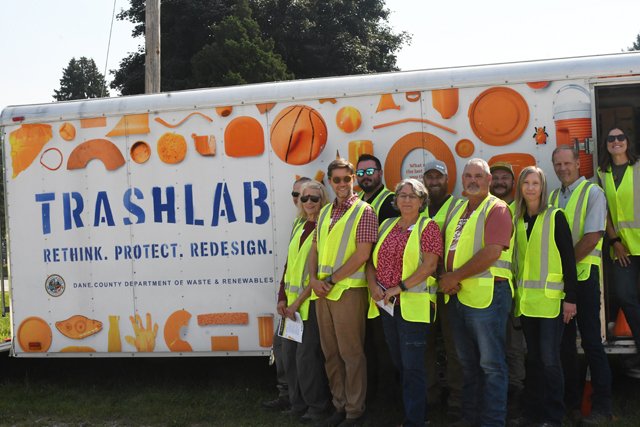
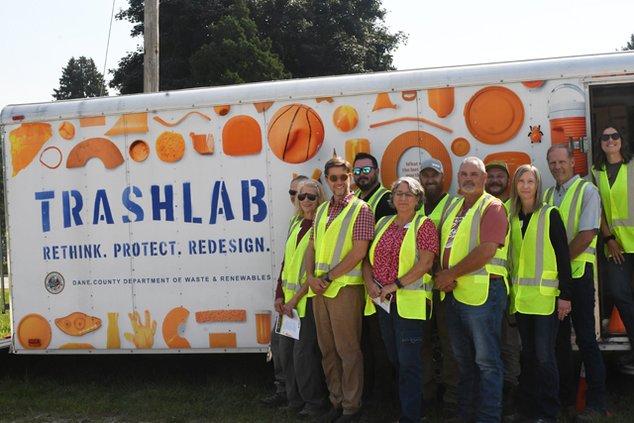
Tour participants saw the Mobile Trash Lab used for community education, the landfill itself and the methane wells, the electronics recycling center, the hazardous waste disposal area, a household products exchange area, and one of the new community composting kiosks.
“We’re in the last few years of accepting waste at this landfill site, which started in 1985,” Education Program Coordinator Hannah Kohn said. “In preparation for ceasing to accept waste at this site somewhere around 2028, we’ve purchased a property just across the highway which was the Yahara Hills Golf Course.”
Kohn said that the new landfill site will include a “sustainability campus” which will be used for community education. As the tour group drove from the ‘Hope Park’ launching site to the landfill, Kohn pointed out the black tubing around the landfill perimeter designed to prevent odors, as well as a tall fence intended to prevent litter from blowing off the site. Portions of the landfill no longer active were planted in native prairie plants.
“We are planning how we will use the sustainability center on our new campus, and thinking about having a community space where people can come in to provide workshops, host a makers space, and do different activities,” Kohn explained. “We’re getting feedback from people in Dane County about what they would like to see the space used for, but also looking for different potential businesses that want to come in and do specified waste diversion, for instance mattress recycling. So different kinds of things are in the works right now with thinking about how we can provide space for people to be able to divert materials and keep them out of the waste stream as much as possible, and keeping them in use through repair.”
Kohn pointed out the native prairie in full bloom, and said they had been the first landfill in the state to re-vegetate with native prairie. She said they’d made this choice to be good stewards for native pollinators – the birds, the bees and the butterflies.
Scales and charges
The first site the tour group saw was the landfill’s scale area, with brisk but orderly traffic moving in and out.
“All the vehicles that come to drop waste here are getting weighed,” Kohn explained. “That's because we need to keep track of how much material we're getting here and have good metrics, but also so that we can charge people for the materials they bring to the site.”
Kohn said landfill customers range from individual citizens, to smaller operators, contractors, and large waste collection companies like Pelliteri Waste Systems. A scale house next to the inbound and outbound scales holds representatives that oversee actions, and electronic kiosks placed lower, and higher up for larger trucks, allow haulers to check in.
“The trucks are getting weighed, and they're using the kiosks to enter in what kind of materials they're bringing,” Kohn explained. “And then, on their way out, they get weighed again, and then they're charged for the difference. Mixed trash is charged at $55 per ton of materials.”
Kohn said that separate areas are set up to receive yard waste, construction and demolition materials, and shingles.
“The site brings in about 300,000 tons of solid waste every year that heads up to the landfill,” Deputy Landfill Director Roxanne Wienkes told the group. “We're also bringing in between 50,000 and 80,000 tons of construction and demolition material for recycling. We process it through the construction and demolition facility, with residuals going to the landfill.”
Wienkes said that marketable materials will get ground up into wood chips and sold. She said that it had been a crazy year for shingles because of hailstorms.
“The hailstorms resulted in a lot of insurance claims and contractors coming to the area, which has really increased the demand for that service,” Wienkes said. “We’re on track to take in about 25,000 tons of shingles this year, and, for comparison, last year, we brought in 15,000 tons.”
Other recycling
Kohn pointed out a dumpster where metal materials are placed in order to divert them from the landfill. She said they don’t charge to accept metal, but just collect it to keep it out of the landfill. She pointed out that they don’t see a large volume of metal because there is a market for it. She also pointed out dumpsters for individual citizens to deposit their trash so they don’t have to drive all the way up to the landfill site.
“You can also see a cool little program we have for bicycle recycling,” Kohn pointed out. “If we see people coming in with bicycles or strollers, we let them know that they can pull them over there to that rack, and then those are all free for anybody in the community to take. They're in various states of disrepair. But if people have the knack, they can come and take them and fix them up and keep them in use. We also have a number of nonprofits that come and select bicycles, fix them up, and distribute them out into the community.”
Kohn then pointed out the construction and demolition recycling area. She said that Dane County Waste Renewables owns the building, and Green for Life (GFL) operates inside the building.
“In addition to metals, we also accept unpainted, untreated wood aggregate as well as well as cardboard,” Kohn said. “They get all the materials - so think a dumpster at a construction site or for a demolition project. It's all co-mingled, and when it's received here, the process is pulling it up on a line, screening it, and then whatever materials don't get screened out during that process by size get hand sorted on a conveyor line by individuals that are pulling the different materials into the different bins for recycling reuse.”
She said the wood gets ground up and used for animal bedding, the metal is melted down and used for new metal products, and the cardboard can be pulped and turned into other cardboard products or paper as well. She said the materials that are screened out in the process, and aren’t recycled, get used on the landfill site for things like road base or alternative daily cover.
Composting
Kohn pointed out the composting kiosk, and said that the county has recently established ones in McFarland, Verona, Middleton, the Henry Vilas Zoo, and Warner Park. The program is named ‘Scrap Stop,’
“It's very specific, targeted items that we’re focused in on, based on what materials the City of Madison is accepting for their different compost drop offs,” Kohn explained. “So really fruit and vegetable scraps, coffee, bulk tea, and not specifically things like flatware, tableware, not paper, just really specific items that we're looking to target to just divert, to keep them out of the landfill.
“The scraps are going to Purple Cow Organics. We have a route set up where we bring those materials to them, for them to turn into a soil amendment and compost,” Kohn explained. “Yard waste and smaller wood materials are also going to Purple Cow Organics, and it's a really great way of just keeping all of that stuff out of the landfill, stuff that's technically banned from the landfill.”
Kohn pointed out a pile of bigger brush and logs, which she said are chipped up. She said the chips are very useful on the landfill site for managing roads and maintaining different operations. She said that some of it goes out as needed to different county projects, like the zoo if they need something such as those wood chips or mulch.
“We make good use of it, keeping all the materials that we get on site and making the most of the waste,” Kohn said. “We hire a chipper to come in once or twice a year and chip all the materials. We charge $40 bucks a ton to receive the materials, which pays for the cost of chipping it.”
Monroe County Conservation Director Bob Micheel asked what their early sense is of how the community composting program is working?
“I'm shocked by the numbers that they're bringing in for a new program,” Wienkes responded. “Right now we're out in six community locations. On each route, we’re pulling in about two tons a week of food scraps. The numbers are remarkable.”
Wienkes said that there's a lot of requests in the area to go to these drop-off style kiosks because it's so much less cost to pick it up. She pointed out that if a community has to provide a third bin for compost for all their residents, it costs communities a ton of money, and you deal with extraordinary contamination issues, because you have all of these people trying to do it, and it can be kind of complicated.
“That's one of the reasons we're keeping it very simple, but contamination has been very low, and participation has been awesome,” Weinkes said. “We've got over 1,000 registrants - you have to pre register to get the lock code – and that's another way to reduce contamination. It's been remarkable, and I'm super impressed with the community's reception and our team's outreach. I think it's a great success.”
Weinkes said they are hiring for additional support with the community compost program, and they also have commercial customers like restaurants that they're connected with to help them divert those materials as well. She said that the staff member who has built the program is currently working to get more restaurants on board with their wasted food plans.
One tour participant asked how much of their total volume at the landfill is the kind of organic waste targeted in the community composting program?
“In 2020, we worked with DNR to do a ‘waste sort,’ and discovered that organic waste is about a third of it, which is consistent with data for landfills nationwide” Weinkes responded. “That was a really a big impetus to put the diversion program in place. Knowing that a third of it is organic materials, we know that what we're doing is making a big impact and making a dent in the things that are coming into our site.”
Jack Zabrowski, planner with Mississippi River Regional Planning Commission, asked if the county found Purple Cow Organics or if the company had reached out to them?
“We did a kind of a two -prong request for proposals, and we didn't know if we were going to find a partner that was going to give us a good deal to process the compost, or if we needed to build our own compost facility,” Weinkes said. “So we requested bids for either taking the materials and composting it or for building us a compost site, or designing it, or designing and operating it. We got all the bids back, and Purple Cow’s was by far the most appropriate. They've been a really good partner.”
100% renewable
On the way up the hill to the landfill site, Weinkes pointed out the landfill’s solar field, which generates electricity. She said that between the solar, and the compressed natural gas manufactured on site from methane coming from the landfill, the county was able to achieve a ‘100% renewable’ milestone.
On top of the landfill hill, with trucks dropping waste, workers spreading and compacting the waste, and gulls swooping in for tasty treats, Weinkes pointed out the natural gas wells scattered over the site.
“All of the gas that's produced from the landfill is being collected, and those gas wells are part of a system that's pulling them under vacuum over to our renewable natural gas plant,” Weinkes explained. “About 50% of the gasses produced are methane, which is a really important thing we're regulated to have to capture, but we're also processing it and turning it into energy. Specifically, it's used for vehicle fuel. Almost all of our compressed natural gas is purchased by Kwik Trip, and they use it for the fueling of their compressed natural gas vehicles.”
“You know, the overall level of greenhouse gas emissions that are attributed to landfill, right?” Weinkes said. “So, the gas that's being generated here in this landfill is about 2,000 standard-cubic-feet-per-minute (SCFM). We're a medium-sized landfill, and that's a medium-sized landfill gas collection rate.”
Weinkes said it's estimated that between, 50-90% of the gas the landfill produces is actually collected, so the rest is fugitive emissions, depending on, what type of cover you have and what type of gas collector you have.
“And so, when you're talking about greenhouse gas emissions reductions and climate change work, the needle can be moved a lot at the landfill,” Weinkes said. “You can spend a lot of money on automated landfill gas collection well heads at $60,000 a pop, or $20,000 a pop - it's very expensive. All the monitoring equipment - there's a solar panel, there's an automated valve, there's gas sampling equipment, all at the wellhead. And the point of that is, if the gas quality is good, you want to pull more so that it's not escaping into the environment. If the gas quality is bad, you can tune it down, and that helps gas plant operations.”
Weinkes said the gas plant likes steady flow and quality, so there's a lot of different justifications you can use to spend the money to put these expensive pieces of equipment on each well head.
“But honestly, every talk I give on climate change and CO2 emissions, it always comes down to the basics of having good staff that know the well field, and know how to maintain the well field,” Weinkes said. “Even after adding on automated well heads, we install gas wells early in the form of horizontal gas wells. So this is all stuff that is literally landfill gas 101, and it's just doing landfill gas 101 that is the biggest way you can put a dent in your fugitive emissions.”
Weinkes said they have to traverse the landfill once a quarter by hand, and any time they find a detection of over 500 parts-per-million of methane gas, then they have to come back and correct the issues on a certain timeline, or the DNR will make you expand the well field.
“There's a lot of regulations in place to try to make landfill owners and operators do this work, but there's always ways around it, right?” Weinkes said. “There's always ways to make the data look the way you want it to look, or whatever. But if you do it right, and you actually think about why you're doing some of it, there's a lot of good regulations in place.”
Monroe County Landfill Director David Heser said the rules for the county’s landfill, only one-tenth the size of Dane County’s, are different, and they only have to monitor their gas levels once per year.
“Our workplace area, I would say is maybe a 20th of the size of yours, and it's interesting to see how it scales up,” Heser observed. “So, I'm taking it in, and thinking about at what point would we need to start doing things differently. Our tonnage is very steady and not expanding our gas production, and our flare at 67-91 SCFM is not anywhere near to where any gas energy project is viable.”
Weinkes responded that she had recently identified a gas energy system that is suitable for lower gas emissions volumes, which she said Dane County is looking into. She promised to forward information about that system to Heser.