At their February 26, 2026 meeting, the Crawford County Land Conservation Committee (LCC) Chair, Supervisor Gary Koch, broached the topic of resurrecting the CAFO Study Group for reconsideration of the CAFO Study Group Report. That document was presented to the Crawford County Board of Supervisors in October of 2020.
At a December 17, 2019, meeting, the county board voted 10-7 in favor of enacting a one-year moratorium on permitting of new or expanded livestock facilities with greater than 1,000 animal units.
Part of that moratorium was to convene a CAFO Study Group composed of county board supervisors, Land Conservation, Public Health and UW-Extension staff, the Roth Feeder Pigs II nutrient management plan writer, LCC committee member and farmer Kim Moret, and Forest Jahnke of Crawford Stewardship Project, as an advisory member.
The CAFO Study Group was charged to present a report to the Crawford County Board by October of 2020. Due to the COVID-19 pandemic, there had been delays in the ability of the group to meet, with Public Health completely diverted to pandemic response.
Pandemic delays
Despite delays due to the pandemic, in September of 2020, the Crawford County Land Conservation Committee (LCC) voted not to recommend extension of the CAFO Moratorium for an additional year.
At their last meeting on October 9, 2020, the study group finalized their report to the Crawford County Board. The LCC approved the report at their October 13, 2020 meeting, and County Conservation Director Dave Troester presented the report to the county board at their October 20, 2020 meeting.
Since then, the report has languished. Livestock Facility Siting Permits have been issued for the Roth Feeder Pigs II CAFO (recently rescinded by the LCC), and most recently, permits for Gruber Livestock LCC North and South, large hog operations which skated just one animal unit under the threshold of 1,000 animal units, which would have required them to seek a water quality permit from the DNR.
Due to staying just under the CAFO threshold, the County Land Conservation Department will be in charge of monitoring compliance with the county Livestock Facility Siting Permits issued to the two Gruber facilities.
Report reconsidered?
At the February 2026 Land Conservation Committee meeting, Koch expressed the belief that it might be in the best interests of the county to pick the study back up and review it. The intent would be to see if there are any elements that could be brought forward to better regulate large, confined, animal agriculture operations in the county, and better address the comments of the citizens that have presented at public meetings hearings.
“My idea is to have a similar sort of membership that we had in this study report,” Koch said. “And, I really don’t think that it’s going to take a whole lot of time and effort, because the effort and time was spent on doing this report in 2020.”
“My idea is to try to reinstitute a committee structure to review the report, bring in any additional information that they have, and make some sort of recommendations to the to the Land Use Committee and the county,” Koch explained. “We are getting some pressure from some of the towns in the northern part of the county that are going through the comprehensive planning process, which the whole county will be doing in the not too distant future. That issue is a big issue in their process, and they’re looking for some guidance or some contribution from the county as to where we’re headed. So, I think it’s timely for us to for us to take a look at it.”
Committee member Mary Kuhn had a comment about Koch’s proposal, which she said would “not probably be well received.”
“I have had a lot of farmers that will not comment on any of these things, because once they do, their name is out there and have a target on their back,” Kuhn said. “So, to get a farmer’s perspective on this, other than those farmers who are part of this, to get the ones who are going to be affected most by this, you’re not going to get any comments because they don’t want their names published. They don’t want people to know who they are, because then all of a sudden they become a target.”
Kuhn said that a farmer told her, “I can’t wait to read the Independent and see who they fire bombed this week.” That perception is out there that this is just to go after bigger farmers, and whether it be fact or not, that’s the perception.
One-sided input
“So, whatever we do is going to be one-sided, because we’re not going to get the input from those that would be most affected,” Kuhn stated.
Koch responded that “I think that’s their problem.” He said that if an open forum is provided, and they are unwilling to make their voice heard, then that’s on them.
“Chad’s retiring from this committee, and I asked him if he would be willing to serve,” Koch said. “We have farmers on this committee, I don’t care how big they are or how small they are, that gives us some credibility as far as anything that we come up with. For me, it’s science. I heard it from Wisconsin State Representative Travis Tranel, when we met with him. He’s a farmer, and he isn’t exactly a fan of ordinances or any regulations that would regulate farmers, because he’s a big farmer. But he did say, ‘if science proves to me that we have a negative effect on the environment or our neighbors,’ he’s willing to take a look at that.”
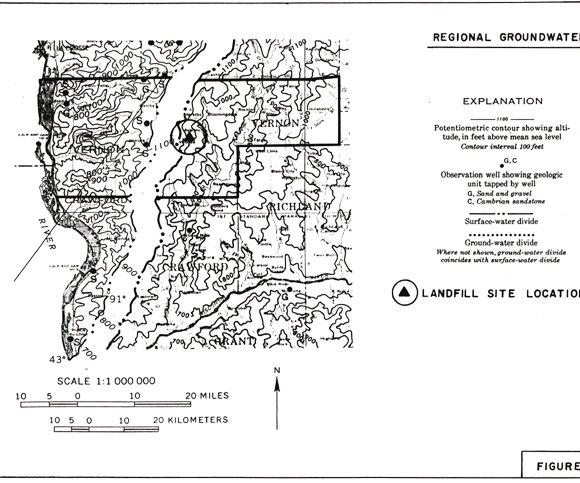
Koch pointed out that a lot of the citizen comments that came in public hearings and forums were about the county’s geography, geology, and the importance of protecting drinking water in the county.
“That’s part of our Driftless Area Water Study (DAWS),” Koch pointed out. “We’re accumulating scientific facts about the water quality in our county, and our charge is to protect the land and the water. So, I don’t think it hurts to discuss it. I don’t think it’s an issue that’s going away, and I hope our county never has to face the challenges with water quality that we’ve seen in other counties.”
Kuhn said that when the moratorium was in place in 2020, she’d had farmers come up to her at Johnson’s One Stop and say that there was no way they were going to speak because they didn’t want “that group” to come after them because of what they’re doing to make their farm profitable.
“I say it’s a big room. Bring them, bring everybody in. That’s what I’ve always said,” Koch responded. “I don’t want to exclude anything. I want everybody in the room, everybody. I don’t care what they think. It’s better to have them in the room than outside.”
Sime offers perspective
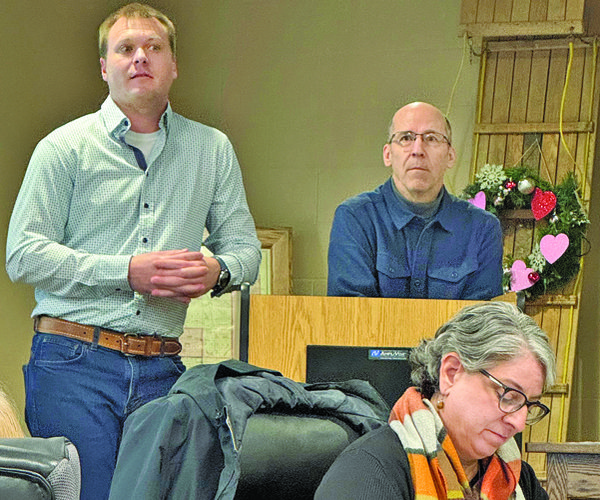
Retiring committee member Chad Sime spoke on the topic.
“I do see or know where you’re coming from Mary and Gary,” Sime stated. “You need to be part of this. I mean, you look at the country as a whole, the farming base gets smaller every year. So, if you’re not willing to at least partake in the discussion, that doesn’t necessarily mean you have to take a known stance one way or the other, but to not be part of the narrative or the discussion, nobody’s going to know where you’re standing. And essentially doing nothing is going to get your voice lost.”
“I’ve got a birthday coming this month, and I’ve hit the halfway point. I mean, there’s a lot of things that aren’t going to affect me,”
Sime said. “I have one kid, if not more, interested in farming. That will be affecting them, or, for sure, the grandkids. So, farmers have to realize that they need to be part of the narrative on this, whether it’s taking a stance one way or the other. If you have a multi-generational farm, it is going to affect you.”
“I’d like to try to come up with a group of people who would just convene, talk about the issues, and go through the report and see if there’s something that we want to do to address some of the questions and some of the concerns that a lot of residents have voiced,” Koch said. “David and I can sit down and do that. It’s kind of kind of mirror of the previous committee - there was a public health representative, there was an extension representative, there was a farmer, there was Crawford Stewardship Project. So, the group would take some sort of a similar formula, unless we come up with somebody who’s really interested, or has a different view, or can provide different information. What we want to do is get as many voices into the conversation as possible.”
Troester told the committee that the Town of Freeman had requested he attend their March 16 meeting.
“They’re kind of debating what they can do, having those discussions, and are wondering what they could do to encourage Crawford County to do something,” Troester said. “So, they were hoping I could come to talk to them about that.”
The group agreed to bring the topic up again at their March meeting.
Transmission Line
The committee had approved an information request resolution for recommendation to the Crawford County Board at their January meeting. At the February meeting, Troester proposed the resolution contain one minor amendment before coming before the board at their Tuesday, Feb. 17 meeting, which starts at 10 a.m. There is a Zoom link available for those that can’t attend in-person.
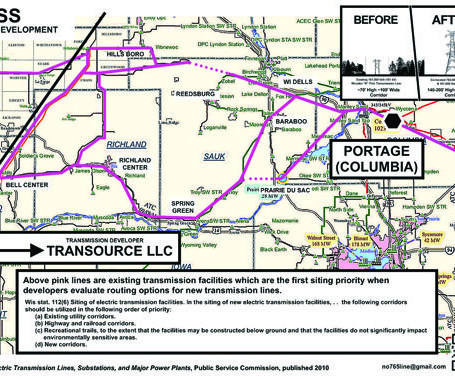
“We passed this resolution last month, and just a few days later, it was announced that Transource had gotten the bid to do the project running east from Bell Center, to the Columbia substation near Portage, and then to the Illinois state line,” Troester said. “This isn’t going to be an exclusively Dairyland Power thing. So, we’ve amended the resolution in case a transmission developer, other than Dairyland is considering siting a 765 kilovolt transmission line in Crawford County. We asked for a detailed map to be submitted to the county within 30 days after it’s known to Dairyland Power.”
Koch pointed out that the resolution is not taking a position on whether the line should be constructed in Crawford County, but is simply seeking information. He reported that he’d heard “all sorts of support for the resolution.” The committee voted to recommend the amended resolution to the county board for approval.
Troester pointed out that Dairyland Power had asked to make a presentation to the Vernon County Board on Thursday, Feb. 19, starting at 9:30 a.m. The Vernon County Board meets in the county board meeting room at the Vernon County Courthouse. He said Crawford County had also received a request from Dairyland to make a presentation to the county board, and a date for that was currently under consideration.
“They must be getting scared, because all of a sudden we have these flurry of meeting requests from Dairyland Power that wasn’t happening before,” Kuhn observed.
Troester shared with the committee that he and Gary Koch had participated in a virtual education event for municipal leaders on January 27, with a presentation by Rob Danielson. He said that he understood that many townships, as well as Vernon and Richland counties are considering passage of similar resolutions to the one that will be considered by Crawford County.
Koch explained that the Crawford County Board would hold a special meeting on Tuesday, Mar. 10, to approve phase three funding for the Crawford County Jail. Because the agenda for that meeting will be light, he says he’s invited Danielson to provide an information presentation to the board. He said Dairyland Power is talking about addressing the board at the April meeting.
Ellen Brooks also reminded the committee that a public information meeting about the transmission line is planned in Gays Mills at the Community Commerce Center for Sunday, Feb. 22, starting at 1 p.m.
“It’s put on by the No 765 Line folks, and Danielson, is going to speak on organizing attorneys on rights of potentially affected landowners, a naturalist on the impact of the lines on wildlife, and a forensics appraiser on the impacts of power lines on property values,” Brooks said.
Troester said he’d also heard that Dairyland Power will be holding public information meetings about the proposed line on March 10 in Gays Mills, and March 12 at the Retreat Sportsman’s Club.
Editor’s note:
Dave Troester and Gary Koch spoke during the por-tion about the transmission line. The resolution passed unanimously.
Rob Danielson is sched-uled to give a presentation about powerlines to the board during the special meeting, which is taking place March 10 instead of March 3. Also, reps from Dairyland are expected to be at the board meeting in April to speak to the supervisors.
“We tried to come up with something that was fairly neutral,” said Troester. “Not trying to say we don’t want it, but we are essentially asking for in-formation to show us why they ended up drawing the route the way that they did.”
Troester said the resolution also requests information about the effects on utility rates and expenses to local residents.
“The emphasis here is to get information. They have not been very forthcoming even for private landowners requesting information, so the thought was that if the county asked, that might have some more impact,” Koch said.