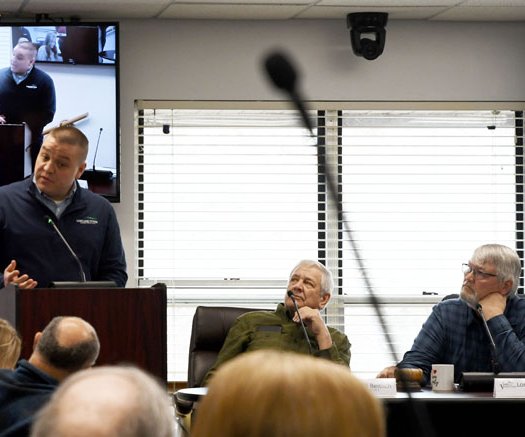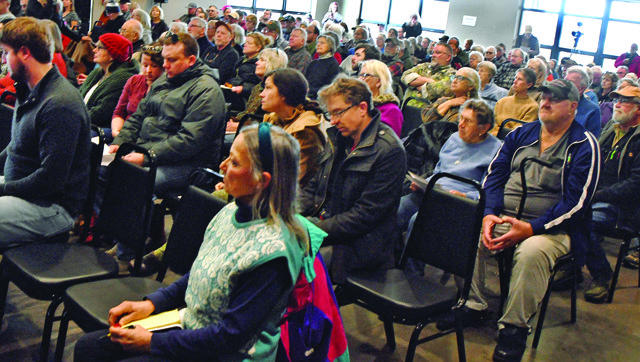
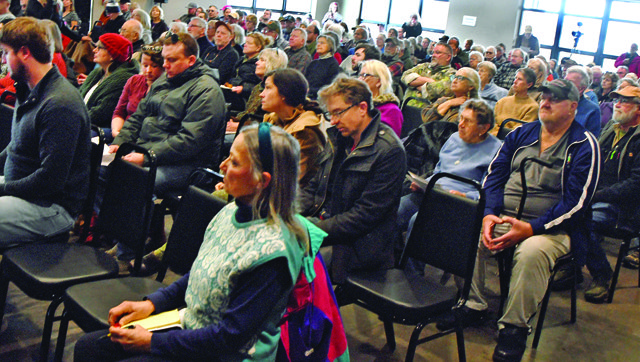
‘No 765 Line,’ a group formed to oppose placement of the state’s largest 786 kilovolt (kV) bulk electricity transmission corridor in the Driftless Region held a public information meeting in Gays Mills on Sunday, February 22, 2026. Three impactful speakers helped hundreds of citizens learn about the line, how need is calculated by developers, and about what they can collectively do to oppose the line, and individually do to protect their properties.
When surveyed, raised hands indicated that among the hundreds of concerned citizens present were individuals from Vernon, Crawford, and Richland counties in Wisconsin, and from impacted counties in Southeast Minnesota.
Danielson asked if there were any representatives from Dairyland Power Cooperative present, and no one responded.
The three speakers at the event were:
• Rob Danielson - potentially impacted landowner in the Vernon County Town of Stark, and a ‘No 765 Line’ educator
• Kurt Kielisch, experienced forensic appraiser, senior appraiser with Forensic Appraisal, 920-558-4638
• Andrew Weininger - attorney with Eminent Domain Services, LLC, 608-807-1829
The three presenters explained the process whereby the MariBell developers, Dairyland Power Cooperative and GridLiance, would obtain a permit to build the line from the Wisconsin Public Service Commission (PSC). They said the process is currently in the public information phase, prior to the developers submitting their application to the PSC. After that, they said there would be an opportunity to submit input to the PSC, and to become intervenors in the process. If the developers receive a permit from the PSC, then the next phase would be individual negotiations between impacted landowners and the developers.
Prevent the line
“When you have an engaged, well-organized group of people like everyone here, there is a great opportunity to either stop the project, to move it, and to do any number of things,” Weininger told the group. ”We're still very early in the process, and by coming together as a group and as a team, and having a complete commitment to the goal, being the best possible outcome that we can get to, then you really do have a lot of power.”
Weininger emphasized that once the application is submitted to PSC by the developers, there will be an opportunity for public comment, and then there'll be an opportunity to intervene.
“We have represented property owners as intervenors, either individual property owners or a group of people, and help work through the PSC proceedings,” Weininger said. “It would be the most efficient for us to form a group. We typically give it a name. Everyone would be a member of the group, and the group would work together through the PSC proceedings. As a group, with the eminent domain side of things, it's more of an informal group, because the compensation proceedings are individual to each property, whereas the PSC proceedings, we can actually form one cohesive group.”
One member of the audience expressed the opinion that the “eminent domain side of things” won’t be an issue, because the goal is to prevent the line from being sited in the Driftless Region. That sentiment received rousing applause from citizens present.
Another citizen from the La Farge area in Vernon County observed that talk of ‘eminent domain’ reminded him of the process where landowners were removed from their properties to make way for the U.S. Army Corps of Engineer’s flood control dam on the Kickapoo River north of La Farge. That dam was never completed, the property owners still don’t have their properties, the tax base of the affected municipalities has never recovered, and the property is now the Kickapoo Valley Reserve.
No need for line
Rob Danielson has explained to multiple different groups of potentially impacted landowners, at meetings in Retreat, Viola, Ferryville and Gays Mills, as well as to county and town boards, that Wisconsin ratepayers do not need this line to have affordable, reliable electricity.
A video of the presentation Danielson provided recently in Gays Mills is available at: https://bit.ly/765links.
Danielson said that the energy industry regularly puts out demand forecasts that prove to have been exaggerated – nationally, on average, as much as 17%. He pointed out that despite a prediction of a 2.5% per year increase in the time frame, according to the PSC Strategic Energy Assessment in 2024, between 2005 and 2024, Wisconsin energy use has been flat or declined slightly. According to data from the U.S. Energy Administration, actual Wisconsin electricity sales in 2005 were $70,335,683, and in 2024, $68,291,424 – a three percent decline.
Now, in 2024, the energy industry is forecasting an annual 5% increase in demand, according to information found in the ‘PSC Strategic Energy Assessment 2024-2030.’
Danielson pointed to the report generated by MISO’s (Midcontinent Independent System Operator) own independent evaluator, David Patton, the 765 kV line is not needed, presents an undue burden to ratepayers, and should be delayed until all 345 kV lines already approved come on line.
MISO is the non-governmental regional utility market that does the demand forecasting, identifies the projects the industry says they need to produce affordable and reliable electricity, secures investment for those projects, and selects developers to build them.
“The independent monitor for the utility planning has provided an extensive, widely distributed analysis that convincingly demonstrates that the regional utility energy planning fails to meet need,” Danielson stated. “Dr. Patton has said, delay all 765 kV layers until the 345 kV layer is built. It's an energy market. You have to evaluate the impact. So when you change the system, we say build this first, because the assumptions you're making are not realistic. So delay, delay, delay.”
MISO actually appealed to the Federal Energy Regulatory Commission (FERC) to have Patton’s report disregarded. FERC denied MISO’s request.
One meeting participant pointed out that she believes that in order to decarbonize our electrical grid and get coal plants offline, and to service the exploding demand from data centers, construction of new transmission lines is necessary.
Danielson responded that this idea has been planted in people’s heads by the energy industry in order to secure support for their transmission expansion projects.
“Depending on the source, you hear that data centers in Wisconsin will increase electricity demand by 2,000-4,000 megawatts,” Danielson said. “But, we already have a 7,000 megawatt surplus over actual demand compared to what the energy industry predicted, which amounts to a 56% surplus. The MariBell line is not needed.”
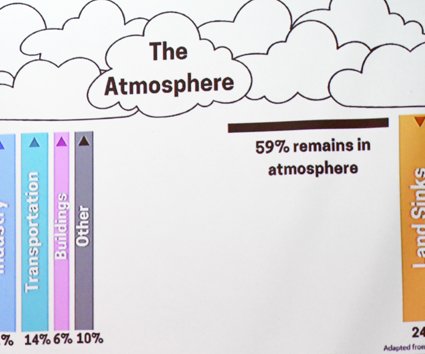
Danielson concluded by pointing out that, between 2005 and 2022, 60% of the decarbonization of Wisconsin’s electricity use was accomplished by ratepayer reductions in energy use through energy efficiency improvements and general frugality. He said that of all U.S. states, Wisconsin uses the 10th least amount of energy. He also pointed out that the states that use less have made much greater investments in programs like Focus on Energy, which helps ratepayers to implement energy efficiency improvements.
Our loss
Two big buckets of loss have been brought up in discussion of the impacts of building the proposed MariBell Line through the Driftless Region. First are the economic losses that individual landowners and municipalities will suffer in their property values, and in their ability to continue to enjoy their property. The second bucket relates to the Driftless Region itself, a region that escaped millennia of glaciations to emerge as a sensitive and globally rare environment.
Residents attending the meeting expressed fear that squandering this natural capital for the purpose of bulk transmission of electricity is not viewed as being in the best interests of the region. It can impact the region’s ability to recruit new residents and increase the tax base, and to develop it for recreational tourism.
“This is a 765 line, and there are no 765s in Wisconsin,” forensic appraiser Kurt Kielisch told the group. “The only ones that we can study are in Illinois and Iowa. A 765 line is a whole different ballgame, so what a 345 line does is the minimum compared to what a 765 would do. If a large economic impact draws down property values, that is something the appraiser has to look at. But going to other communities, going to Illinois or Iowa or some other communities, unfortunately, those aren't going to be communities comparable to you. You've been in Illinois, right?”
“Wisconsin Realtors Association has gone on record as being opposed to these big lines,” Danielson observed. “If you get a group of three or four real estate agents in the area to go to the association, they can make some hay, because this is a whole new game. This is a whole new scale of invasion that we have never seen before.”
Kielisch is an experienced assessor who took over the business from his father, and specializes in eminent domain proceedings. He has twice taken cases up to the Wisconsin Supreme Court, and won both times.
“Every property is very unique,” attorney Andrew Weininger said. “We're not talking apples to apples. To say the 161 kV line that’s there now is similar to the 765 kV line on steel lattices - it's just a totally different situation, and in my mind, much more impactful.”
One meeting participant expressed a strong personal opinion.
“This is the first of the 765, lines in Wisconsin,” he said. “Nobody knows exactly what the health effects of this are, or what the land value effects of this are. This is unique. We are being used as guinea pigs.”
Their gain
So, the question that is frequently asked in all forums where citizens gathered to discuss the MariBell line, “What do we get out of this to offset our losses, and what do the developers gain?”
“Utilities don't make money by selling power - they make money by putting steel on the ground,” Danielson stated. “Why should a utility in Indiana or Ohio pay a utility in Iowa or Minnesota to put steel in the ground? That's why we're seeing all of the solar power plants being built in utility-owned service territories. It’s because they don't have to pay as much in transmission costs, and they get the guaranteed return on their investment. They're proposed by out-of-state merchant, non-regulated utilities, built and then sold to investor-owned utilities, and they get the guaranteed return.”
“My understanding of eminent domain is the sacrifice of the individual landowner for the benefit of the many,” one citizen observed. “But what is that number? What is that percent?”
“The taking of land through eminent domain is typically the government's power, but it's something that's been granted to utilities by the legislature under Chapter 32 of statutes,” Weininger responded. “So, the real question is if this is needed at all, and that may be raised to the PSC, but I guess ultimately, it's not sure. Use of eminent domain is supposed to be for a public purpose.”
“There's no formula. It's the pure discretionary judgment of the personal commissioners on the PSC,” Danielson responded. “And, the courts give the utilities and PSC great deference.”
Danielson also referred to the all-fired rush the MariBell developers appear to be in to get the line permitted. He compared it to experiences he’s had with other developers on other projects throughout the state.
“Why is it that Dairyland is doing this in a year? The answer is deregulation. Our lawmakers passed laws at the turn of the century that took all of the teeth out of our energy laws. They put all of this frilly language on top about how we do this or that to allow these merchant power plant developers in, and they just gutted our rights. There is no accountability,” Danielson said. “Citizens opposing the Cardinal-Hickory line had three years to go through the process, and in an Excel Energy project up north, I saw the developers show up to their public input meetings with maps, prepared to sit down and talk with landowners on the spot.”
To our knowledge, no landowner that has submitted a request to Dairyland for information has heard back from them, according to Danielson.
Not a done deal
“This is not a done deal. Opposition is making substantial gains towards winning in the court of public opinion, and in increasing the utilization of rights given to us as individuals under state law,” Danielson pointed out. “There are 17 expansion transmission lines that have been stopped in the United States, some due to intense landowner opposition. But, as the history with Cardinal-Hickory demonstrates, the challenge for us in Wisconsin is really severe.”
He pointed to the history with that Cardinal-Hickory line where PSC staff had come up with a $900,000 alternative to construction of the $632 million Cardinal-Hickory Line. Legislators such as Jon Erpenbach, Howard Marklein, Dave Considine, Diane Hesselbein, Todd Novak and Travis Tranel all requested that the PSC select the option from their staff, and the commissioners instead voted for the line. When the decision was appealed in the courts, the judge quoted MISO’s demand forecasts, and upheld the PSC’s decision.
“To some extent, every living and ancient thing in our corner of the Driftless Region faces unnecessary threats from this line,” Danielson said. “As my neighbor put it, ‘this ain't just another big power line - no, this would be a place changer.’ Many of our precious assets will be placed at undue risk if Dairyland Power Cooperative fails to act on our urgent public input over the next four-to-seven months of the Public Information phase.”