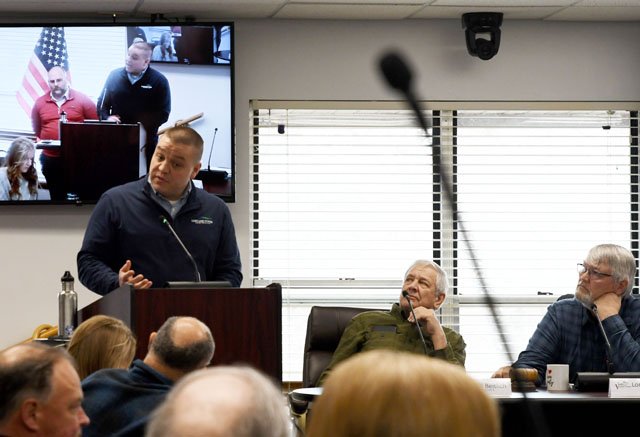
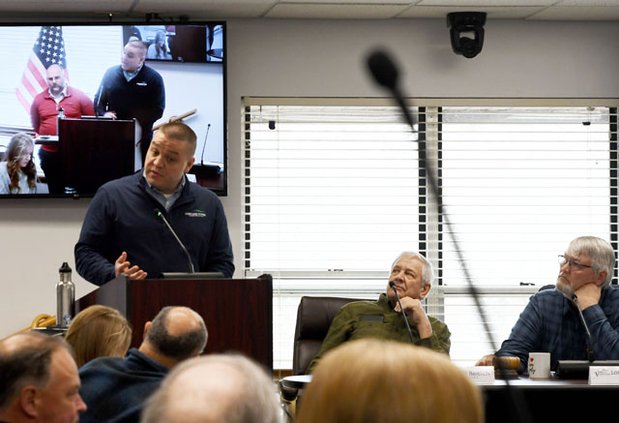
The Vernon County Board of Supervisors met just days after the Crawford County Board of Supervisors and unanimously passed an information request to Dairyland Power Cooperative about the proposed MariBell 765 kV transmission line. At their February 19 meeting, the Vernon County supervisors roasted Dairyland representatives with tough questions and passionate appeals.
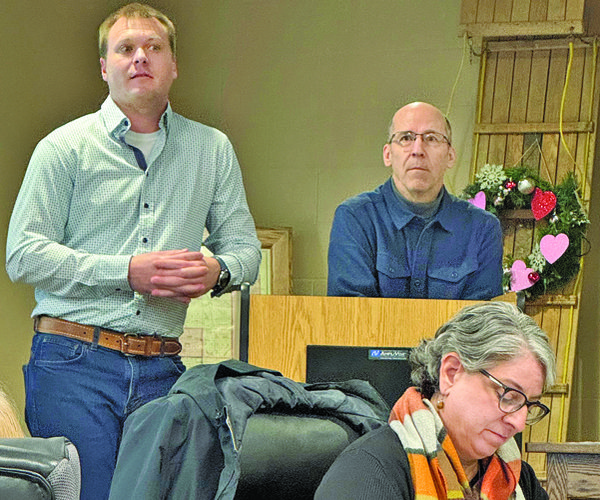
Luke Fuller of Dairyland Power Government Rela-tions led the presentation alongside Land Lead Rob Maly and Project Manager Dylan Alitz. GridLiance representative Laurie Dun-ham also joined remotely.
Vernon County Supervisor Dave Strudthoff took them to task about what their purpose was in speaking to the board, and whether they would do anything with the input they received.
“The impression that most people are getting in here is, you're going to put this line through, and there's not a damn thing we can do about it,” Strudthoff said. “I would take out the word public input that implies that we are actually having an effect, or we can change something. You should probably just put in public information. I hope you can prove me wrong.”
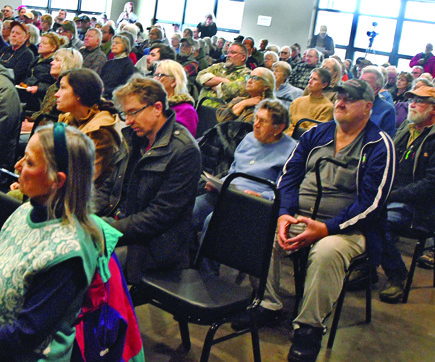
Almost 100 citizens packed the room to hear what power company representatives had to say, and to demonstrate their opposition to the project.
Monica Matos of Viroqua was one of the speakers that offered public input.
I wanted to thank the supervisors for so passionately working to protect this area and the community interests. Clearly, there's a trust issue here because, as a general rule, corporations and utilities don't have a great track record for protecting human and environmental health and choosing people and planet over profits,” Matos said She went on to provide a long list of harmful products originally listed as safe including cigarettes, PFAS, asbestos, DDT, heroin, oxycodone, BPAs, and Agent Orange.
“The Driftless Region is unique in that unlike most of the Upper Midwest, it was never flattened by the last continental ice sheets,” Matos said. “The Driftless Area is essentially a geologic time capsule, and its protection supports biodiversity, clean water, sustainable agriculture and outdoor recreation. You can't recreate an unglaciated landscape.”
Outspoken
The Vernon County Board of Supervisors were either outspoken or quietly opposed to the massive transmission line project – the first of its kind in the State of Wisconsin. Rural Westby District 8 Supervisor Dave Eggen summed it up.
“My name is Dave Eggen, and just this morning on the news, I was listening to how the huge AI data centers are crawling the country, looking for land. They're looking for farmland with loose zoning and close proximity to high energy existing transmission line corridors and waterways,” Eggen said. “We got the Mississippi to the west and the Kickapoo to the east - if we let you in, that's going to be the trifecta. We're going to have the water. We're going to have the high transmission and the land. How would MariBell react if Vernon County passed a simple resolution preventing you from entering Vernon County?”
Later in the meeting, Eggen announced he would do just that. Supervisor Mary Henry, District 12 in Viroqua, announced she would join Eggen in drafting the resolution. That resolution will be brought before the Conservation and Education Committee at their Thursday, March 12 meeting. If adopted, the resolution will be recommended for passage by the Vernon County Board of Supervisors at their Thursday, March 19 meeting.
Supervisor Mary Henry offered a diverse range of feedback to the power company representatives. But in the end, it boiled down to, “this power line will cut through our landscape and affect us and our property tax, our animals, our health, our wildlife, our beauty, and our clear streams - we don’t want you here.”
Houston County
The sparks seem to have blown from the west on the prevailing winds. At their Tuesday, February 17 meeting, the Houston County Board of Commissioners (Minnesota) unanimously approved a resolution ‘Opposing the Proposed 765 kV Gopher to Badger Link Transmission Project within Houston County.’
According to reporter Kaita Gorsuch of the Caledonia Argus, the resolution came after months of discussion with Houston County residents and landowners, who would be affected by the project. Gorsuch described the amendments made to the resolution passed as follows:
“[Houston County] Commissioner Cindy Wright proposed several edits to the resolution to make the language more specific.
“Wright’s first edit was under Section 1. Opposition. How the draft reads currently:
“The Houston County Board of Commissioners formally oppose the proposed routing of the 765 kV Gopher to Badger Link transmission facilities within Houston County unless and until it is conclusively demonstrated through the (Minnesota Public Utilities Commission) process that:
• the Project is the least-impactful alternative
• no reasonable lower-voltage or non-wires alternatives exist
• the Project fully complies with Houston County’s Comprehensive Land Use Plan
• local environmental, agricultural, and socioeconomic impacts are minimized to the maximum extent practicable.
“Wright suggested adding a statement such as “explicitly proven to provide the residents of Houston County with direct benefits.
“What I'm actually asking for is some subjective information that says, ‘These are the direct benefits we are providing for the residents,’” she said, “because a lot of this discussion has been about how this is a transmission line through the county, not for the county.
“Under Section 3. Information Requested from Applicants, Wright suggested an official deadline for the requested information to be provided in written and publicly accessible form. The commissioners agreed the information listed in the resolution should be turned in by April 30, 2026, giving the MariBell team 60 days.
“Also in Section 3, part of the requested information includes documentation of Minnesota residential rate impacts, which Wright suggested adding “resulting from this project over 20 years.”
Wright’s final amendment was to change request 8 under Section 3 to read “Road use agreements, construction practices and infrastructure protection to minimize risk and damages.”
Fragile ecology
Vernon County Supervisor Mary Henry brought up the Driftless Region’s “fragile ecology” and flooding issues in her comments to the Dairyland Power representatives present.
“I'm opposed to your power lines on the basis of we have a very fragile ecology around here that is a big economic impact to our area,” Henry stated. “I understand that your poles and electrical lines are aging out. That coincides with our fragile landscape of the Driftless Area, with our (flood control) dams aging out. They were both infrastructures that were built about 50 years ago, and we are in the middle of having our dams decommissioned, and we need our landowners to work on ways to slow the water down. And if you are doing a 200-300-foot swipe on our area, and then you are putting herbicides under those power lines, you are actually doing the opposite of what we need our landowners to do, to hold that soil, because our trout streams and our fresh water are a huge tourist industry in our area.”
Henry went on to cite the reproductive harms that could ensue to humans, livestock and wildlife from the magnetic field of a power line of this unprecedented size.
“You will cause harm to reproduction, to humans and to the wildlife migration and patterns of our wildlife in our area, and disturb us,” Henry stated. “This [power line] isn't something that Vernon County is going to use. We're a pass-through. Use the interstate. It's already ugly.”
Local revenue
Supervisor Bruce Kilmer asked about what financial benefits local municipalities would enjoy to offset the loss that siting the lines would entail.
“So, for the revenue or the taxes, what that is going to be primarily about is what's called an environmental impact fee that the state legislature and the Wisconsin PSC require transmission line owners for any line above a 345 kV to pay to the local communities that hosted,” Dairyland Power’s Land Lead Doug Maly responded. “That is determined by line-miles, and then cut in half. Half will go to the county, and half will go to the townships. There's two fees. The first one would be 5% of the total construction cost as a one time fee. And then there is a perpetual fee of 0.3% of the total cost that is again split out the same manner, that would last for as long as the line is in operation.”
Studies
Supervisor Alycann Taylor noted the Dairyland representatives had cited the extensive environmental impact studies for the project that were ongoing.
“You do say that you do extensive environmental studies to make sure that you are looking at the negative impact it could be,” Taylor said. “Can you tell me a time where your environmental studies actually changed course, and didn't go on to disrupt the community, the ecology and the place that you were proposing to build, or is this just a study? Tell me a time where that actually influenced what you did.”
“There is very extensive environmental analysis,” Maly responded. “All of that information is considered by the PSC, who would make that final determination. Now, for specifics of what you're talking about, rerouting an entire line, I don't know of any. But, I know that it does adjust. Sometimes it's referred to as ‘micro-siting,” where actual structures go or like access paths that you take to a place to a different path…that would be less disruptive.”
“So, you can recall no time that you acknowledged the disruption and then changed your course?” Taylor pursued.
“This is the first 765, in this in this area. And because Dairyland is an electric cooperative, we do not have to go to the PSC for our lower voltage lines, our 69 kV lines, which is the majority of our system, or for our newer 161 kV lines,” Maly responded. “So, in my experience, no, we have not, but there are plenty of other situations out there that I am not aware of that I cannot speak to.”
Grid reliability
Taylor went on to explore Dairyland Power’s justification that the line is needed to support ‘reliability.’
“You talk about not having reliable power? Is our area in jeopardy of not having reliable power, or is this new line to ensure that more populated areas have reliable power?” Taylor asked.
“A lot of the reliability studies they are talking about are for MISO (Midcontinent Independent System Operator) generally,” Maly responded. “For instance, in the winter stormmin January, MISO hit a max-generating event, which we have not hit since 2009, and that is primarily due to a lot of the changes that are happening in the grid right now.”
“I believe that Vernon County's power reliability is not at the root of this. And so with that thought, I would strongly recommend that you not disrupt our ecosystem and find a path that circumvents that,” Taylor stated. “What you're asking us to do is to take the burden for power in areas that are having reliability issues. I would imagine if I polled the room, and asked them to raise their hand if they’re for this project, I'm gonna guess it's almost 100% saying they're not for it. I am hoping that the exercise of public input is not just an exercise, and that you are taking that seriously.”
Luke Fuller, Dairyland Power’s Governmental Relations staff (who left working in energy policy for the Legislature two years ago), responded to Taylor.
“The idea that the reliability of any given community near this line is not benefiting from the construction is not the conclusion that I would reach, looking at how the electric system works,” Fuller responded. “The benefits are diffuse and spread out over a large geographical area. Thus, the cost of the line is spread out across those users as well. As that mix gets diffuse and gets spread out, we need additional transmission resources to ensure that we can move it around.”
How to oppose?
Taylor joined other supervisors in asking Dairyland Power what counties like Vernon County, and directly impacted landowners can do to stop the line.
“The question is pretty simple, can we as a county affect you not doing this?” Taylor asked.
“We don't decide the route. We propose two routes to the Public Service Commission (PSC), and they make the final choice,” Maly responded. “They also decide the need for the project, that is the other major portion of the Certificate of Public Convenience and Necessity. It's not our needs, it's their needs. It's the Commission's needs.”
“I'm saying the impact on Vernon County is going to be huge, and it's not going to help us as much as it's going to help these other communities that it's going to,” another supervisor responded. “You're asking Vernon County farmers to give up their land and do things for other people, which, hey, we're all about being together, but our impact is going to be greater because of our situation here in Vernon County. And you could easily go down the highway, but you want to take the shorter route, because it's cheaper.”
“What is the profit to Vernon County, and to our areas like our Amish, who don't use your power?” Henry asked. “That's a whole big area you're going through, along with our Reserve and the the wildlife there. You're proposing a whole area of people that don't even use electricity, that is going to affect them greatly. I always look at the pros and the cons. I am just not seeing a pro here. I have a whole bunch of cons, but I don't see the evidence of pros. In my mind, you haven't given me any supporting evidence that this is a great thing for Vernon County, and we should be all on board on this. It's not being presented that this is a positive thing for us.”
In response to questions about what the board could do to fight this, DPC’s Fuller told the supervisors that once the application is submitted in the third quarter of 2026, PSC will create a ‘docket.’ He said that then, concerned citizens could submit comments or choose to become ‘intervenors’ in the process.
“Vernon County Corporate Counsel Nikki Swayne is online,” Vernon County Administrative Coordinator Cassie Hanan interjected. “She says she'll be able to provide some guidance to the board if you should choose to be an intervenor in the PSC process.”
Joining forces
Another supervisor asked if Dairyland Power representatives planned to also meet with the Crawford County Board of Supervisors. Fuller responded that such a meeting is scheduled for April 7.
“We need to have bigger than Vernon County involved in this if we're talking about changing anything,” the supervisor stated. “It's just that's the way it works in Wisconsin. So, if we know others that are going to be impacted, that would be very helpful as we start to talk about colleagues.”
Buried lines
Supervisor Lonnie Muller from the La Farge area stated that he believes the line should be buried.
“I'm unaware of anyone building an underground 765 kV line anywhere in the country,” Fuller responded. “It's never been done to my knowledge. What innovator is often a code word for is expensive. It’s also a pretty significant environmental disturbance to dig a trench, bring in the equipment, and disturb the local wildlife, go under a river, that sort of thing.”
Muller stuck to his guns, and pointed out that a buried line would be more resilient in the face of weather events such as high winds or tornadoes.
“My general impression of lower voltage lines that have been buried is you're generally not talking about a 2X for cost. You're generally talking a much higher multiple, but it’s certainly something we can look at,” Fuller said.
“If you bury the lines, wildlife and humans are still affected with that stray voltage and that magnetic field,” Henry responded. “You will have wildlife and cattle jumping everywhere trying to avoid it. So, whether you put it in the ground or you put it up in the air, it exists and it's going to affect their reproduction, and ours as humans.”