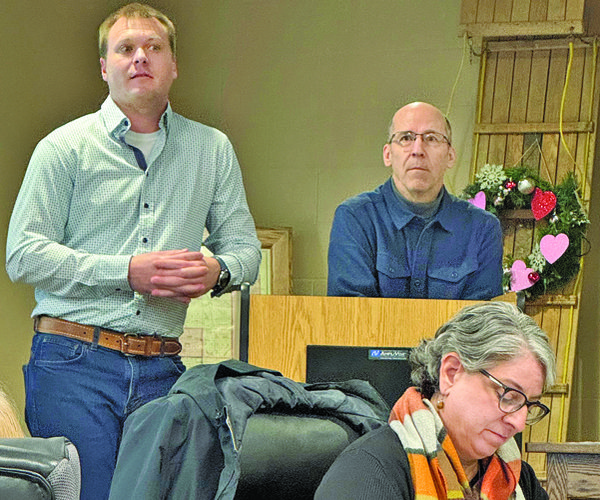
Two guest speakers enlivened the proceedings of the September meeting of the Lower Wisconsin State Riverway Board (LWSRB). Those two speakers were DNR Forest Ecologist/Silviculturist Brad Hutnik, and Ben Moffat of the Crosscurrents Heritage Center.
LWSRB Executive Director Mark Cupp introduced Hutnik, and explained that he would offer an educational tour for Riverway board and staff and Ho-Chunk Nation forestry staff in October. On that tour, participants would see the progress made in implementing forestry climate change adaptation research in its first two years.
In January of 2023, Hutnik had provided the board with an overview of the ‘Driftless Area Adaptive Silviculture for Climate Change’ project he was part of launching. The project is led by Miranda Curzon of Iowa State University, with Iowa DNR, Minnesota DNR, Wisconsin DNR, Northern Institute of Applied Climate Science (NIACS), U.S. Forest Service, and CSU.
In the Driftless Region, the project is taking place at three sites in Minnesota, one in Iowa at the Yellow River State Forest, and in the Lower Wisconsin State Riverway. Ho-Chunk Nation Forestry Manager Brandon Bleuer is named as a partner.
Hutnik explained that sustainable forestry is the practice of managing dynamic forest ecosystems to provide ecological, economic, social and cultural benefits for present and future generations.
Hutnik listed the projected climate change impacts on Wisconsin’s forests:
• longer growing seasons
• carbon dioxide fertilization
• increased drought risk
• extreme weather
• less frozen ground
• increased fire risk
• species range shifts
• increased stressors.
Hutnik described three forest adaptation strategies that are being investigated in the study. Those are resistance, resilience, and transition. He explained that those three exist on a continuum that ranges from ‘managing for persistence’ to ‘managing for change.’
When managing for persistence, that means that ecosystems are still recognizable as being the same system. When managing for change, that means that ecosystems have fundamentally changed to something different.
Research strategies
The resistance strategy means maintaining relatively unchanged conditions over time. Tactics in this part of the study include invasive shrub treatment and mid-story removal, thinning to about 70% stocking, prioritizing white oak, northern red oak and black walnut, and repeated thinning to maintain the stocking level.
The resilience strategy means allowing some change in current conditions, but encouraging an eventual return to the original conditions. In this part of the study, researchers will work with a continuous cover irregular shelterwood silvicultural system. Tactics will include invasive shrub treatment and mid-story removal, prescribed fire or other site preparation, underplanting of native intermediate, fire-adapted species, establishment cutting creating three-quarter acre openings, planting additional native seedlings including those intolerant of shade, removing the overstory with retention in patches with cover reduced to 40-50%, and thinning to 70% cover in the retained patches.
Resilience species will include Chinkapin Oak, White Oak, Northern Red Oak, Black Walnut, Bur Oak, Shagbark Hickory, Black Oak and Black Cherry.
The transition strategy means actively facilitating change to encourage adaptive responses. In this part of the study, researchers will clear-cut areas, leaving reserves. Tactics will include invasive shrub treatment and mid-story removal, site preparation, clearcuts retaining a 20% overstory in clumps (clear-cuts will be 1.5 acres within each 10-acre stand) plus some dispersed, quality mature trees prioritizing white oak, and planting of future-adapted species after harvest.
Transition species will include White Oak, Northern Red Oak, Black Walnut, Bur Oak, Shagbark Hickory, Mockernut Hickory, Pignut Hickory, Shumard Oak, Post Oak, Tulip Poplar, and Shortleaf Pine.
Project update
Hutnik discussed why the project is of interest to LWSRB board and staff, DNR staff managing forested properties in the Riverway, and potentially private landowners.
“Lands within the Lower Wisconsin State Riverway are involved in this new project,” Hutnik said at the LWSRB’s September 2025 meeting. “It's part of a network of sites across the country and in Canada that are looking at ways to look at adaptation to expected changes in in the climate. Because what adaptation will look like isn’t necessarily straightforward, this network of sites is designed to try and figure out if there things that we can do that will set our forests up for greater success.”
Hutnik said the project is actually unique in that every place else in the country, in Canada, they're actually at one property whereas, in the Driftless they have a series of these sites. Hutnik said that in the Riverway, research is taking place at the Douglas Hallock Demonstration Forest and at the Millville Bridal Trail.
“What we're going to see on the tour is three different treatments that were designed as part of our study to test resistance, resilience and transition in the face of climate change,” Hutnik explained. “What we're going to do is go out there, take a look at these treatments, and actually see what they look like on the ground, look at the planting success from this past spring and from two springs ago to see if we are actually finding seedlings in the understory. And then, we'll also hear from a number of the researchers involved about the other things that we'll be learning on these sites.”
Crosscurrents
Ben Moffat, who along with his brother Bruce, has founded the Crosscurrents Heritage Center on his family’s farm near Port Andrew, updated the board about what’s been happening at the Center, and what is in development. The two Moffats are descendants of Richland County’s first European settler, John Coumbe.
“My brother Bruce and I in 2023 set up two nonprofits to run Tippesaukee Farm and Crosscurrents Heritage Center,” Moffat told the board. “This is a model we heard of from the Schumacher Family Farm in Waunakee, where you have a bit of checks and balances. The Friends of Cross Currents Heritage Center is the one that sponsors events, and we hope, in the future, will manage day-to-day activities, and then the second one is Tippesaukee Reserve, Inc., which is a reserve fund, and we hope to build it up to be an endowment.”
Moffat explained that the mission of Crosscurrents Heritage Center has three legs, if it's a stool, to preserve and celebrate the natural history, the indigenous people's history, and the Euro-American settler history of the property and area.
“Last year, we started having public events in October. The first one was with Dr. Eric Carson, who is a geologist with UW-Extension, and he gave a talk in our 1861 barn about his theory, which is now generally accepted, that a river flowed where the Wisconsin River flows today a million-and-a-half years ago, from west to east instead of east to west,” Moffat said. “The second event was called ‘Camilla, Lonnie and Mary, Our Guiding Lights.’ That event was about the three women who inspire me and my brother Bruce to do what we're doing with Cross currents Heritage Center. Camilla is our grandmother, Lottie, her sister, our great aunt, and Mary, our mother. The third 2024 event was by my wife, Janine Oshiro, who was born and raised in Hawaii. Her storytelling presentation was called ‘Old Seeds, New Growth,’ and shared Hawaiian tales and local stories about trees seeds and growing strong. She told stories about botanists in Hawaii who are doing what we're trying to do at Tippesaukee Farm - combat invasive species and support and encourage native species.”
Moffat said that in the course of his family living on the farm for five generations, they’d accumulated a lot of ‘stuff,’ which he and his brother are still sorting through. He said that one of the things they’re finding is old tools, some of which are puzzling to them. They’ve been posting them on Facebook to see if people know what they are, and what they were used for.
Moffat said their 2025 season kicked off in April, again with Dr. Eric Carson. He said Carson did a walking tour of the property, re-capping his theory about the river flowing the opposite direction, and took participants over the grounds and into the wood lot, which he said is “quite remarkable” because it has never been clear-cut.
“On May 18, we had our largest event to date. It was Ho-Chunk dance and music by the Wisconsin Dells Singers and Dance Troupe,” Moffat continued. “It was the first time in at least 187 years that Ho-Chunk music and dance has taken place on the property. So it was a very emotional experience for me, and my brother. And it was, as the paper said, a momentous event.”
Now, Moffat said, they’ve kicked off their third season of events with a presentation by Casey Brown, a member of the Ho-Chunk Nation, who was raised in Black River Falls, went to the UW-Madison, and now lives in Chicago. Moffat said his talk is called ‘Shuffling Many Worlds - How Being Ho-Chunk is Being Modern.’ Then, the following weekend, on Sunday, Sept. 21, they will offer a walk and presentation by Colleen Robinson called ‘Sensing Forests Within Us: A Walk of Reconnection.’ To register for the September 21 event, go to the Crosscurrents Heritage Center website.
“Next year, we're planning to have tours of the downstairs of the old house and the grounds, and this is a tour that I am designing. It will be multimedia, experiential and to some degree interactive,” Moffat said. “We also recently had a meeting of our education committee, and we are reaching out to educators and administrators. Our goal is to have Crosscurrents Heritage Center be an outdoor, off-site classroom. We are hoping to have field trips on a regular basis, so kids can learn natural science and history on-site, but also so that they can develop pride in where they live.”
In other business
In other business, the Lower Wisconsin State Riverway Board:
• re-elected Gigi LaBudde as board chair, Randy Poelma as vice chair, and Kim Cates as secretary
• approved a letter of support from Cupp for a donation of land from Mississippi Valley Conservancy to the DNR of 196 acres located just east of Woodman Lake
• agreed that as the Sauk Recreational Trail Bridge across the Wisconsin River is a DOT project, they do not require a general permit from the LWSRB
• learned that the recreational bridge contractor had moved two barges into place at the construction site which narrow the navigation channel, and force paddlers to the Dane County side of the river where there is a dangerous eddy
• approved a management permit for DNR to do work in the Town of Marietta in Crawford County, for a timber harvest/tree thinning project in the Town of Troy in Sauk County, and a permit for a timber project by the Savanna Institute in the Town of Troy in Sauk County
• learned that the Fall Equinox takes place on Monday, September 22, but that an observance will be held at Frank’s Hill on Saturday, Sept. 20
• learned that Friends of the Lower Wisconsin Riverway (FLOW) president Timm Zumm has participated in a meeting at the Town of Wyoming School to brainstorm ideas for use of the Wintergreen property should Driftless Area Land Conservancy acquire it
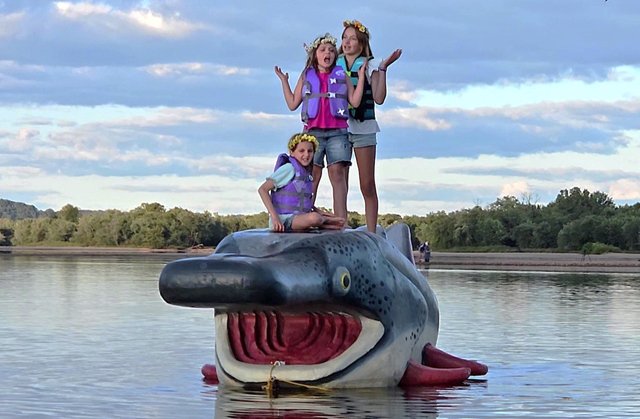
• learned that Zumm had worked with students and the Children’s Film Academy of Madison out on the river to make a film – ‘The Legend of the Paddlefish.’