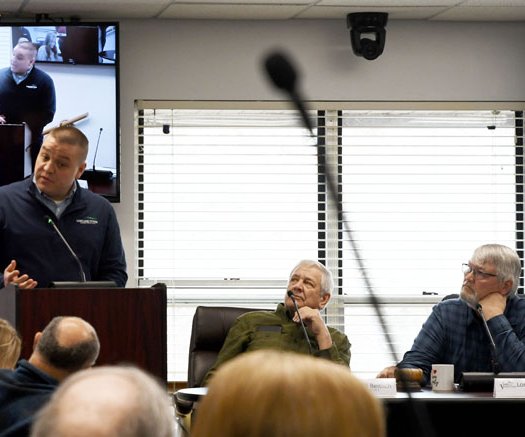
Dairyland Power Cooperative (DPC) once again addressed the Lower Wisconsin State Riverway Board (LWSRB) at their March meeting. Their topic was updates to the Wisconsin River crossing as part of their project to upgrade to the 69 kV transmission line running from Bell Center in Crawford County to Lancaster in Grant County.
DPC has formally submitted an application for the crossing project to the LWSRB. The board chose to defer a final decision on the permit applied for to their May meeting, pending further information.
Dairyland Power Cooperative Power Delivery Services Manager Sarah LeMoine provided an overview of the project for the board, as well as updates on information requested at the board’s January meeting.
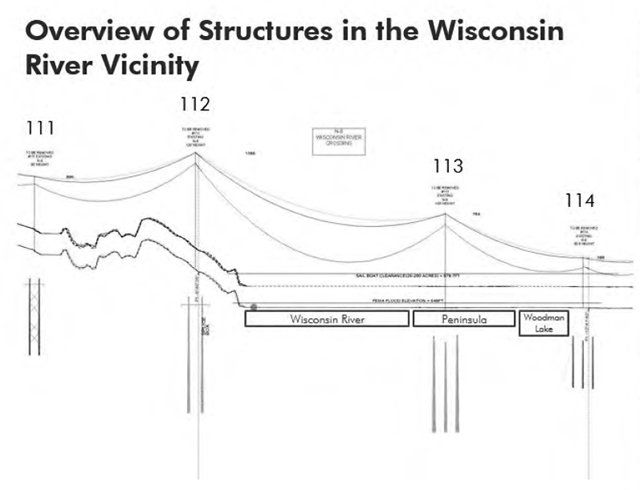
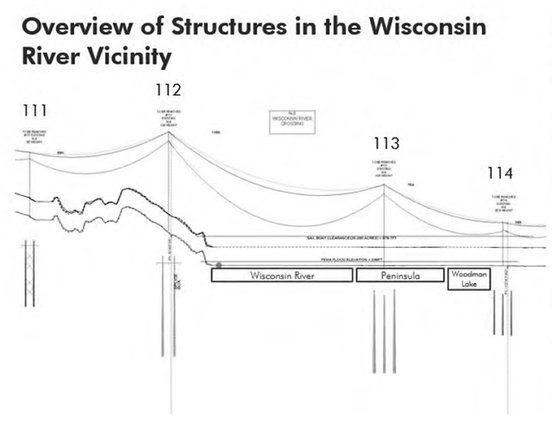
Within the boundaries of the Lower Wisconsin Riverway, the area under the board’s jurisdiction, there are 14 power poles. Those were described as poles 108-123. Many of the poles are simple replacements, with no change in height or pole type. No permit is required for this type of routine maintenance, even within Riverway boundaries.
Poles 110 and 112 on the north side of the river near Boydtown will be replaced with steel poles. Pole 113, currently located on the peninsula between Woodman Lake and the river will be eliminated, resulting in an easement shift to the east, and an updated vegetation management agreement with DNR. Pole 112 on the north side of the river, and pole 114 to the south of Woodman Lake will be replaced with taller steel poles.
At the January meeting, the board expressed concern about the amount of the height increase of pole 114. That pole will be significantly increased in height, from 56.5 feet to 140 feet, to accommodate the span over the river with pole 113 removed.
The board is concerned about pole 114’s height and impact on the aesthetic viewshed of the river. They were told that the height was required to meet the National Electrical Safety Code on all navigable waters to accommodate tall-masted ships. At the January meeting, the board asked DPC to pursue a waiver of the code because the Lower Wisconsin River has never been suitable for navigation of tall masted ships.
“In planning this project, one option that was looked at is reviewing the structure heights,” LeMoine reported to the board. “As part of the proposed project, they did look at a conductor that reduces the height of structure 114 by approximately 20 feet [to 140 feet]. So we did get some benefit by looking at that.
“I talked with both our legal and our lead design and to their knowledge, no one's ever gotten a variance or asked for it because it's a code requirement,” LeMoine explained. “And frankly, legal told me, as a Power Cooperative, we won't take that responsibility.”
LeMoine also reported on board member’s request to investigate the possibility of undergrounding the wires for the crossing.
“Looking at an underground installation, that was pretty cost inefficient, being about 5-10 times more costly to install underground as opposed to overhead,” LeMoine shared. “There's also high maintenance costs trying to repair any line work that's underground, and it takes longer and is more complex when the repairs come about. And, it actually does require a wider right-of-way than it would if it was overhead.”
Tall-masted ships
Board members Randy Poelma and Kim Cates pressed Dairyland on pursuit of the waiver of the clearance for tall-masted ships requirement. LWSRB executive director Mark Cupp explained that this project is presenting the board with a novel aesthetic issue under their jurisdiction, and that further documentation of the effort to pursue the waiver in writing is needed to demonstrate that the board had done due diligence in exercise of their statutory responsibilities.
“The issue is that a sailboat will never be on the river,” Poelma explained. “That tower is going to be very obtrusive to the view, and we're concerned about that.”
Board member Richard Ten Pas stated that the current wood pole on the peninsula is not nearly as offensive from an aesthetic point of view as the tall steel pole proposed to accommodate its removal.
“It's already offensive. When you look at the whole surrounding, what's being proposed, is even more offensive,” Ten Pas said. “We should be looking at how do we make this less offensive.”
“I really appreciate your aesthetic impact minimization measures that you took to heart to have the low growing shrubs on the bank of the river and Woodman Lake. That was much appreciated,” Cupp told the DPC representatives. “The issue that I think Rich Ten Pas has really nailed was the fact that you're trading off removal of the structure on the river bank for a structure that on the south side of Woodman Lake was not visible at all.”
Cupp stated that he was very disappointed in the visual depictions of how that taller structure south of Woodman Lake would look from upstream and downstream on the river.
“What I was hoping for was from a point on the river, upstream, downstream, and then on the river between Boydtown and Woodman Lake,” Cupp said. “We've asked for this in the past from other applicants, and have been able to receive that rather than just a kind of a Google map type of presentation.
“The Riverway Board's perspective, which we have tried to pursue on these power line crossings, is to the greatest extent possible, minimizing that visual impact,” Cupp stated. “And this is a precedent setting one, because we're now moving the power line out of the existing right away. The other pole, 112, that is increasing in height is not in our jurisdiction because Boydtown is not included in the Riverway. But then, you're going from structure 114 at 56.5, feet to 140 feet. If you’re coming downstream, and you've got a pole that's 140 foot, you're going to see for quite some time. For the last 36 years, what the board has tried to do is have no net degradation of the aesthetic integrity of the river, whether you're building a house or doing a timber harvest or a road project or utility facility crossing. And that's what we're really struggling with here.”
Cupp pointed out that none of the bridges crossing the Wisconsin River are required to maintain clearance sufficient for a tall-masted ship to pass underneath them.
LeMoine emphasized that DPC’s goal is to remove the pole on the peninsula that has presented significant maintenance issues for them. She said she understood the board’s concerns, and promised to bring documentation of the attempt to obtain a waiver of the tall masted ship requirement, as well as improved visuals to the board’s May meeting.
In other business
In other business, the board:
• heard a presentation from Travis Anderson, a wildlife biologist, on DNR wildlife management in the Riverway, and learned that removal of pine plantations and restoration of grassland and oak barrens habitat is a big goal within the management plan, and that prescribed fire has been a key tool within their portfolio
• learned that Cupp is looking for board member candidates to recommend to the Crawford and Sauk county boards, to be forwarded to the Governor
• approved an application for change in a structure in the Town of Wyalusing, for a timber harvest in the Richland County Town of Orion, and seven management extension permits for the State Natural Area’s crew.