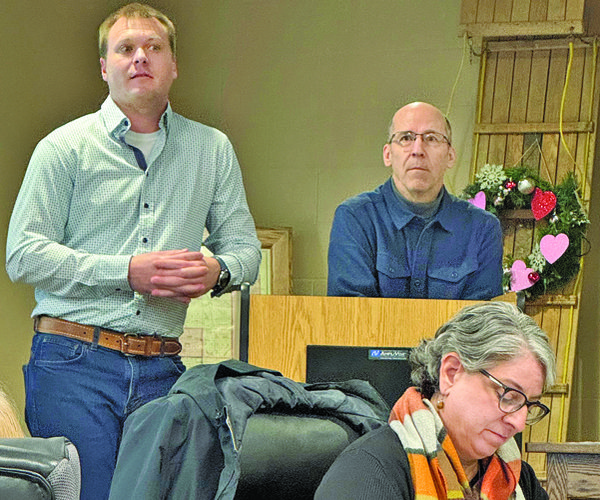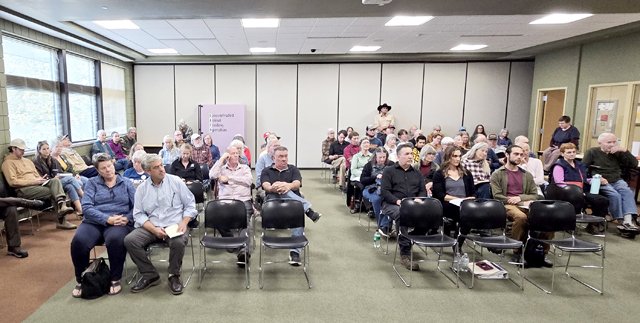
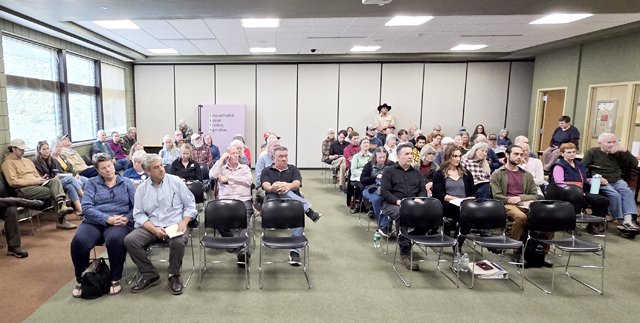
The Crawford County Land Conservation Committee held a public hearing regarding the application for two large, confined, hog operations in Marietta Township on Tuesday, Oct. 14. Seven people spoke in favor of approving the application, and 118 opposed approval. A total of 40 people provided in-person testimony and 85 people provided written comments.
The two permit applications are from Gruber Livestock South LLC, and Gruber Livestock North LLC. The applicant for the proposed south facility is Mary Hrycyk of Bolingbrook, Ill., and the applicant for the proposed north facility is Dennis Gruber of Homer Glen, Ill.
Both of the cookie-cutter identical gilt development unit (GDU) barns will be located on one of the 15 parcels owned by Gruber Ridge Farms LLC located in Marietta Township off of Plainview Road. Both will house 999.6 animal units (2,499 hogs).
This number lands just below the 1,000 animal unit number where a Wisconsin Pollution Discharge Elimination System (WPDES) water quality permit is required from Wisconsin DNR. Because Crawford County’s Livestock Facility Siting Ordinance, which is in all other respects identical to the state statute, requires a water quality permit for operations with greater than 500 animal units, this will put the burden of regulating the hog operations on County Land Conservation Department staff.
Gruber South’s application states that the facility will produce 1,023,896 gallons of manure each year, with the manure storage structure for the facility sized for 372 days of storage. That manure, according to their application, will be applied to 222.6 acres of cropland, providing 0.223 acres available for each animal unit.
Gruber North’s application, identical to Gruber South’s, states that the facility will also produce 1,023,896 gallons of manure each year, with the manure storage structure for the facility sized for 372 days of storage. That manure, according to their application, will be applied to 223.8 acres of cropland, providing 0.224 acres available for each animal unit.
Crawford County Conservation Director Dave Troester outlined the approval timeline for the permit applications. Troester said the applications on July 24, and had 45 days to determine if the applications were complete. On September 2, he notified the applicants that some items were still missing. The applicants responded on September 14. On September 19, Troester notified them the applications were complete. Crawford County now has until December 18 to either approve or deny the permit applications.
Favoring approval
The seven speakers favoring approval of the County Livestock Facility Siting Permits were facility owners Mary Hrycyk and Dennis Gruber, Marietta Township residents Robert Atkinson, Jeff Robinson and Bob Mitchell, Executive Vice President of Wisconsin Pork Association (WPA) Keri Retallick, and Morgan Warwick, an Iowa County hog farmer operating a facility similar to the two proposed.
Hyrcyk shared the following remarks with the committee:
“I understand there are strong feelings with this type of project. We all want the same things, clean water, healthy air and land that will be here for the next generation. I feel the same way.
“This barn doesn't fit the CAFO label. It's now being called industrial, The reality is, demand for food is increasing, not shrinking, and if we want it raised responsibly and sustainably by local farmers, we have to allow modern farms to operate, not push them away.
“These farms don't threaten the community. They strengthen it through local investment, new tax revenue and keeping farmland productive instead of being paved over. Your concerns about smell, water wells and roads are understandable - I care about them too. Technology, management practices and oversight have come a long way in recent years, and I think it's important everyone has a clear picture.
“It's a modern, efficient animal feeding operation, built under today's improved standards for safety, sustainability and environmental protection. The size was chosen carefully to align with the nutrient needs of the land, the logistics of the site, and to maintain strong bio-security. The design intentionally stays below capable thresholds to fit the land, coordinate where the gilts go next, minimize impact, and ensure responsible management.
“I followed every regulation, gone beyond requirements, and placed the barn in a remote location at additional cost, out of respect for neighbors and to minimize impact. This project wasn't designed carelessly. It was designed with today's science and stricter environmental oversight that didn't exist decades ago. Responsible livestock management, when done right, has proven to improve water quality, soil health and even habitat.
“My intention is to generate manure to replace chemical fertilizer being used. This manure will not be applied in industrial quantities, but rather at the same safe levels as the chemical fertilizer used today, which are guided by soil tests and an experienced agronomist, and incorporated into the top four to six inches of soil. I came here for to care for the land. My goal is to be a good neighbor, to work collaboratively, to protect our natural resources and help keep farming alive in a way here that strengthens not threatens our community.”
Next to speak was the owner of the other proposed facility, Dennis Gruber.
“I'm not new to farming pigs for this area. I'm the son of a fifth generation pig farmer, and grew up on a farm in Lansing, Iowa. I've completed both a bachelor's and master's degree in animal meat and food sciences. Six years ago, I purchased a farm on Plainview Ridge Road, and I've been farming it with my family ever since. It's not a corporate venture, and I'm not a financial outsider. It is and will remain a family operation.
“And excuse me, this barn won't just be about farming that will generate tax revenue, support local services and create jobs that strengthen this community. And here's something I've come to understand – when the farms disappear, so to does the care for the land. When ground is left unmanaged, it gets overrun and the next time, neglect can turn dangerous as we've seen in California, Hawaii and even Canada.
“I've spent close to 20 years working with barns like this across the river in Allamakee County, which has the same karst geology we have here. In that time, neither my brother nor I have had any issues with spillage, contamination or anything else. I've heard that barns like this will hurt your property values. In fact, the average land value in Allamakee County is higher than Crawford County, due in part to the strength of the agriculture.
“I've heard concerns from many about manure slurry and groundwater. To be clear, manure isn't waste. It's organic nitrogen, phosphorus and potassium, the same N, P and K that's already being used, along with valuable micronutrients. The difference is that manure slurry also adds organic matter. Through the exclusive use of slurry manure, our farm in Iowa emitted 500 fewer tons of carbon dioxide compared to conventional practices. That's the equivalent of removing 97 cars from the road. And, it also saved 306 tons of topsoil from erosion, equal to 19 dump trucks per year. And, 137 tons of carbon was sequestered, and nutrient losses were reduced by five tons of nitrogen and one ton of phosphorus. These results show that with careful management, livestock operations can not only maintain but enhance soil health while reducing environmental impact.
“I have every reason to protect this land and this water. My neighbors drink this water, and the livestock and animals I care for, love and raise depend on it. Stewardship isn't just a word to me. It's my responsibility, and this isn't just about today. It's about ensuring that this land and this water is here for the next generation.”
Robert Atkinson told the committee he was born and raised on Planview Ridge, and had hauled a lot of manure on that ground.
“The way Dennis wants to do it is safer, more efficient. My sister's property needs it. My son-in-law rents it. Chemical fertilizer is much more expensive. He doesn't have a lot of money, and it's safer. I'm much prefer natural. I was raised that you spread your manure on your ground. Old days you spread it 365 days a year. Now you can contain it, and you can put it when and where it's needed. So other than that, I'll promise all of you, I will not let anything happen.”
“I would like to see these applications approved. I've been in the industry for 40 years,” WPA’s Keri Retallick said. “My husband and I also have a farm down in Grant County as well. We are about a mile away from a sow farm as well, and I would say that they have done a wonderful job implementing all the practices that they have. These two projects deserve to be built. They have done all the work necessary to apply for the permitting process. They are not looking to be bad neighbors. They are concerned about the environment. They want to be sustainable. We need protein to feed our people, and I think it's very important that we allow these individuals that have done all of the work, who have the land to spread the manure, not utilizing chemical synthetic fertilizers, and being able to produce protein that is efficient and nutritious.”
Morgan Warwick is a lifelong resident of Iowa County, a representative of Wisconsin Pork Association, and describes herself as a proud pork producer.
“My family built a pig barn similar to the proposed one a year ago. While navigating the permitting process, I was surprised and impressed with the standards that we had to meet from both the state and county level,” Warwick told the committee. “Initially, my neighbors had questions about our barn and reservations, as anybody would. But after nearly two years of open conversations and collaboration, we can all agree that my family's pig barn has actually united our small, little neighborhood. Our neighbors have been open minded, and we've been an open book. We've all worked together to monitor the water and the environment in our area, showing them our practices and explaining the science behind them has been great experience for all of us.”
Jeff Robinson is a cow-calf rancher in Marietta Township. He moved here 30 years ago from Waukesha County because “Crawford County was 100% agriculture.”
“At that time, 30 years ago, we had a beautiful farm. We had 400 cows with creeks running through it. Well, now that's all golf courses. I wanted to go somewhere where nobody was going to complain when we spread manure, and nobody complained about when we weaned calves. We found a beautiful spot, just probably five miles away from Mary and Dennis's place. When Mary and Dennis first came here, they contacted me immediately, and it was just going to be for hunting.
“None of the buildings were maintained. Everything was falling apart. All the waterways - there were none. They were all eroding. All the beautiful contour strips that were put in at one time were washed out and growing up in Box Elder trees, and the dams were all blown out. They hired me to come and fix it all.
“These folks, their word is golden, and if they say that, they're going to do everything exactly right. They're going to do it above and beyond what the requirements are. I spent weeks over there working. They didn't want to cut any corners. They wanted to put in the best hoops. They wanted the contour strips that would hold water, and divert the water into the ponds. I'll guarantee you that they will build the best manure pits.”
Opposing approval
A total of 118 items of public input were received from citizens opposing approval of the two permits. Issues cited by them included:
• Concern about endangering land, water, and air, karst geology, and both water quality and quantity (61) citizens
• Concern about quality of life, property values, health and well-being, tourism and the local economy (51 citizens)
• Concern about lack of DNR oversight, the regulatory burden placed on county staff, and calling for a moratorium and development of an operations ordinance (48 citizens)
• Distrust based on a perception that the operators are deliberately trying to skirt state water quality protection laws (44 citizens)
• Concern about safety and wear and tear on local roads (15 citizens)
• Concern about animal welfare and whether the CAFO method of production is cruel and inhumane (7 citizens).
Land and water
In comments both in-person and written, 61 citizens commented about fears of threats to water quality and quantity were the two proposed hog operations to be approved.
A citizen from rural La Farge who grew up on a mink farm shared his family’s experience with nitrate contamination of their water.
“My dad started raising mink in the 1950s, and in the summer of 1967, we lost over 1,000 animals. I drove a couple of carcasses to UW-Madison, and a necropsy revealed they died from nitrate in the water. We had to drill further down to get away from the nitrate contamination. My mother also spent two days in the hospital because of nitrate poisoning, and almost perished. I’m not an attorney, but if these farms go in, I think neighbors should get their water tested every year, so they have a benchmark for what the nitrate levels were before the farms go in, and how the levels might be changing.”
Ryan Buus, an angler from Rochester, Minn., weighed in on the connection between groundwater and cold water trout streams.
“Crawford County’s geology and landscape make its groundwater and rivers especially susceptible to pollution from the vast amount of waste produced by industrial hog operations. Nutrient runoff and contamination damages private wells and prized trout streams. If water quality declines, residents will be harmed, and recreation-driven visitors, like myself, will spend time and dollars elsewhere,” Buus said.
David Rosenheim is a landowner in the Steuben area.
“I am deeply concerned about the possible approval and building of the two Gruber CAFOs. Crawford County is a beautiful place, and these facilities pose a real threat to our clean water and air,” Rosenheim stated.
Chris Froeter is a Chicagoan who travels to Crawford County for its cold water streams.
“What happens on the land surface quickly finds its way into our groundwater, springs, and creeks,” Froeter said. “Spreading that waste on nearby ridges and fields above these watersheds poses a direct threat to our trout streams and to the families who rely on private wells. Nutrient runoff, bacterial contamination, and sedimentation will degrade water quality, smother spawning beds, and alter the delicate balance that makes these streams so productive. Once contamination enters a karst system, it can travel miles underground and resurface unpredictably—making clean-up virtually impossible.”
Flo Sandok and Jim Basset live in Franklin Township in Vernon County.
“We have the example of CAFOs in neighboring Iowa that have proliferated, leaving behind enormous costs for water cleanup. Iowans will spend up to $333 million on nitrogen removal from drinking water systems over the next five years, according to the Iowa Environmental Council. The Iowa Cancer Registry 2023 report found that the rural state ranked second in the nation for overall cancer incidence. Iowa’s portion of cancer cases is 150% greater than its portion of the national population. A 2019 report by Environmental Research showed that more than 300 of Iowa’s yearly cancer cases are attributable to nitrate exposure.”
Edie Ehlert lives in rural Ferryville, and is the chair of the board of Crawford Stewardship Project (CSP).
“In May of 2000, a Crawford County committee, informally known as the ‘poop group’ presented a draft ordinance proposal with reasonable and effective regulations for CAFOs in the county. This useful document points out that this issue has been a concern in Crawford County for 25 years,” Ehlert pointed out. “Then in about 2006 when we in the fledgling Crawford Stewardship Project heard of the first CAFO application in the county, we sought out the esteemed retired Wisconsin State Soil Scientist, Dr. Byron Shaw for advice. He made the statement that the Livestock Siting Law and rules allowed ‘Too much manure on too little land.’ Added to the point is this is anaerobic liquid manure slurry, not ‘dry’ manure. And here we are 20 years later, with ongoing 15 years of scientifically based water quality monitoring under our belts in CSP. And we see increased pollution in streams, likely affected by the large amount of waste spreading.”
Harriet Behar, an organic farmer from Clayton Township, shared her views on the topic. She was part of a group developing ‘Crawford County Feedlot Performance Standards,’ prior to the passage of the Wisconsin Livestock Facility Siting Law.
“The construction of the manure lagoons must include review of the geology in the area, and to protect from damage caused by the compromise of the lagoon’s integrity due to its extreme weight on the fractured bedrock, a secondary confinement area should be put in place,” Behar said. “There are numerous issues that need to be addressed to protect public health. There could be monitoring wells for groundwater oversight, especially since known sinkholes are within two to three miles of the facilities, illustrating the significant fractured bedrock which can allow manure to reach shallow or deep groundwater shared by neighbors within hours or days. Monitoring for hydrogen sulfide and other air pollutants associated with these operations could be put in place, and when the levels become of concern, the county would notify neighbors so they can take appropriate actions.”
Annie Coleman, owner of Red Clover Ranch in rural Soldiers Grove, discussed the impact of clean water on her business.
“The foundation of our tourism is the clean water and the natural environment, especially the world-class trout streams of the Driftless Area. The recreational trout-fishing industry alone generates over $1.6 billion annually across this region. If we permit CAFOs to spread, the direct impact on our watersheds will destroy the very assets that support this massive economic engine. We are too close to areas like Iowa, where widespread water contamination and foul air quality are the proven results of this type of farming.”
CSP Executive Director Amy Fenn discussed the vulnerability of karst bedrock to pollution.
“Crawford County sits on karst geology, where the underlying bedrock is made of soluble limestone and dolomite. Over thousands of years, water has dissolved this rock, creating a vast underground network of caves, sinkholes, and fissures. This unique geology means that what happens on the surface can quickly impact the groundwater below,” Fenn stated. “This is not a theoretical risk. Fifteen years of stream-testing near another industrial hog operation in Crawford County has recorded E.coli and Total Phosphorus both regularly above levels safe for recreational contact, as well as detecting MRSA (Methicillin Resistant Staphylococcus aureus) associated with industrial livestock operations. Because of our karst geology, the water flowing through the county is uniquely interconnected. Because nearly all county residents rely on groundwater wells for their drinking water, the risk of contamination from slurry, and threat to the surrounding community's health, is very real.”
Crawford County grazier Joe Childs shared his input.
“These operations are spreading in the same exact watershed of Boydtown Creek as Roth Feeder Pig I,” Childs pointed out. “This creek is already highly polluted as shown by 15 years of data. The DNR has it listed as an impaired stream. That stream dumps directly into the Wisconsin River, which is one of the biggest tourism attractions and sportsman retreats in our area.”
CSP’s Forest Jahnke also had some input about water quality.
“Both Gruber applications, when accounting for total acres divided by animal units, propose to use only 0.22 acres/animal unit. This is alarmingly low, and is likely to result in overspreading, rapid phosphorus build-up in fields, and potential nitrate contamination of local surface- and groundwater. This scenario has been observed and documented over 15 years around nearby Roth Feeder Pig I spreading fields and surrounding wells and streams, which has historically operated between 0.4 and 0.5 acres/animal unit, twice the acres/animal unit proposed by Gruber Livestock North and South.”
Property values, tourism
Jude Hartwick is a landowner just below the proposed hog operations.
“Certainly, a study by the Crawford County Land Conservation Committee seems appropriate to determine the impact this cluster would have on the landscape and water quality of Marietta Township and watershed areas. If nothing else, it would allow individuals time to sell their vacation homes/cabins before the pig farms lower the valuation of their land. It seems recreational use and tourism are not the driving force, but rather the raising of pigs.”
The owner of Driftless Angler in Viroqua discussed the impacts of approving the permits on tourism in the county.
“On behalf of the fly fishing community in the Wisconsin Driftless, I hope I do not have to tell you how short-sighted and detrimental to Crawford County it is to continue to approve these giant farms. The negative impact these places have on the environment, community, infrastructure, and reputation of Crawford County are well known and well documented. Neglecting an existing major income stream to the area is rarely mentioned. Anglers are already starting to call Crawford County ‘CAFO County,’ and choosing to spend their time and money elsewhere.”
Vincent James said, “I am a Crawford County resident, and am appalled to learn about the proposed pig farms, which I understand will house one animal short of being officially designated as a CAFO. In addition to the serious moral questions surrounding factory farming, the presence of factory farms are antithetical to the organic nature of our region and will destroy residential and business property values.”
Moratorium/ordinance
CSP’s Forest Jahnke says that deficiencies in the operations’ nutrient management plan would constitute a sufficient reason for permit denial. Jahnke worked with a professional nutrient management plan reviewer, who had the following to say about the Gruber applications.
“Both applications’ plans list spreading rates that would over-apply nitrogen, in violation of NRCS Standard 590, even for a corn-on-corn operation and if spreading evenly across all available acres. All nitrogen applications are over the UW recommendations by at least 20-28 pounds/acre. All fields could come into compliance by reducing fertilizer applications. The permit application documents only present 2026 information, where typically four-year projections will be shown. After the first year there will be 22 pounds of nitrogen carryover credits from the manure that will need to also be taken into account. There should be at least one more year of cropping and manure data going into 2027, and ideally a four-year rotation should be included, as 2024-2031 was used to calculate their Phosphorus Index (PI) values. The county should ask to see all the reports from 2024-2031 to ensure PI is being calculated correctly.
“All manure applications in the plan are listed as occurring in spring, however the narrative mentions fall and spring applications will occur. Gruber Livestock must have a plan for following N restrictions on bedrock soils with fall manure applications under 590 section IV, B. Criteria to Minimize Entry of Nutrients to Groundwater.
“Yields listed for both operations are quite high, at 240 bushels per acre. This needs to be accurate in order to account for nutrient removal credits. The narrative states that they are projecting for higher yields as the justification for including field 05 Fall Rest (Gruber Livestock South), implying that 240 bushel yields have not yet been achieved.”
Town of Marietta resident Gary Porter joined others in calling for a CAFO moratorium, and development of an operations ordinance.
“Doesn't it make you wonder why Gruber ‘farms’ (factory) is avoiding regulation by dividing it's operations into 999.6 units (Let's be honest and call them hogs), and applying for two permits? What if not only Gruber but other CAFO interests skirt the law this way? How can they be stopped without a moratorium and rewriting county regulations, to stop them from spreading their manure over fields with sensitive karst geology that will quickly transmit their toxicity to area groundwater (wells), streams and rivers? Who will compensate neighbors when their wells become polluted?”
CSP’s Amy Fenn pointed out that development of industrial hog facilities comes in clusters. Those clusters typically include one farrowing operation generating piglets, two GDU like the ones proposed in the Gruber applications to generate replacement sows for the farrowing operation, and then as many as 30-50 smaller finishing operations where the piglets are sent to be raised to market weight.
“If we permit this, we're not just doing a one-off thing. We're basically giving a green light to an entire industry and cluster to move in. And I ask if that's the sort of development that we want to attract to this area, and what will be the effect of that on our ability to attract other types of development that might come here with cleaner industries that are looking for a high quality of life?”
Edie Ehlert shared some sage advice with the county.
“Since the county livestock siting ordinance adds burden to the county, I implore the county to put a moratorium in place for livestock confinement operations from 500-1000 animal units. Then use the great materials gathered from your own 2019 CAFO Study Committee and adopt common sense ordinances that require large industrial operations to operate as good neighbors, in a way that protects the health and safety of all citizens. These legal ordinances, which are being passed in increasing numbers of Wisconsin towns and counties, require basic, reasonable elements that would address some of many issues with these operations, like a fire plan, a road use plan, a water use plan, etc., all prepared by the operator in order to obtain a permit. This balances the workload and expenses, some for the county, and some for the operators.”
CSP’s Ellen Brooks followed up on Ehlert’s comments.
“The regulations governing Concentrated Animal Feeding Operations or CAFOs in Wisconsin were put in place in part to protect rural communities. In our county, which is already operating with a severe shortage of funds, these Gruber livestock operations will add the responsibility of oversight of these new facilities to our currently overworked and understaffed Land Conservation Department with no help from the state agencies. They have avoided state regulations by sizing each of their operations at 0.4 animal units less than the state definition of a CAFO at 1,000 animal units. The owners have shifted the burden of protecting Crawford County residents from a joint effort of the county with the Wisconsin DNR and Department of Agriculture, Trade, and Consumer Protection (DATCP), and placed it solely on the county Land Conservation Department - a department consisting of two staff members with one clerical assistant addressing conservation issues.”
Clayton County resident Harriet Behar said “the county can put a moratorium in place to give the public and county board time to review and implement an operations ordinance. This type of ordinance is in effect in numerous counties in our state, and legal challenge has found them to be within the power of the local units of government to regulate. An operations ordinance addresses areas where the current State of Wisconsin Livestock Siting Law is mute. The issues that can be addressed are of great importance to our county, with our tight budget, our fractured bedrock which provides a direct conduit to ground and surface waters for manure and other pollutants, and the strong community disapproval of CAFOs in our county. A minimum of an 18-month moratorium is needed to do the research necessary to put in a place an effective and comprehensive operations ordinance, dealing with our specific county issues.”
A Marietta Town resident had this to say about who should pay the costs of increased regulation for operations that are skirting state oversight.
“The one thing that hasn't been addressed costs. You want your facilities, that's fine, but you're going to have to ‘pay to play.’ You're going to have to set up a trust fund. That trust fund is going to have to take care of road maintenance and environmental costs for studies. You will pay on an interval basis, and this fund will be set up in an account so that invoicing can be paid, not coming out of the town or the county's budget. This is coming out of your pocket.”
Spirit of the law
Henry Wideman, who grew up on a farm in Utica Township, shared his thoughts on the apparent move to skirt state water quality protection laws.
“I think it's really telling that the permit application was split into two facilities. It's clearly meant to skirt regulations and avoid DNR oversight. And I think if they come to you and say, “We want to dodge regulations,” you should believe them. I also think they've done that because they don't think that the county can develop and enforce effective regulations, and that they'll have more freedom to do whatever they want. And I think you should believe them on that account, too, because I don't think the Crawford County is equipped to deal with the mess that would come if you approve this. I think we should have a moratorium. If somebody wants to build a CAFO, they should call it a CAFO, and they should deal with the DNR.”
Soldiers Grove resident Maura Otis weighed in on what she sees as skirting the state’s water quality protection laws.
“The two applications are just under the 1,000 animal units threshold that would require oversight by the Department of Natural Resources. While this may be a shrewd move by the applicants, it has the potential to be a burden on Crawford County. Does the County have the ability to manage potential problems with runoff on the proposed 2 million gallons of liquid manure slurry that will be produced on these farms? What kind of protections can be put in place to protect neighboring wells from infiltration of contaminants produced by these oversized agricultural operations? How will this affect land values and the quality of life for the neighborhood?”
Jim Bassett from Stump Ridge is not impressed by the appearance of skirting the regulations.
“The number of animals in Gruber’s applications, 999.6 animal units, is ridiculously close to the 1,000 animal unit threshold requirement for Wisconsin state regulation of CAFOs. These are animals, not just numbers. That number can become 1,000 AU and over the CAFO limit, overnight. And who is to check compliance?
“These Gruber applications appear to be purposely designed to avoid the stringent Wisconsin state CAFO regulations that would place these operations under the scrutiny of the Wisconsinn DNR. The 1000+ AU CAFO regulations provide some degree of safety for the public, concerning water, air, and soil pollution, as well as health hazards for the surrounding communities. Logic says these facilities at 999.6 AU are really CAFOs and should be required to meet the WI DNR standards for CAFOs.
Kurt Welke of Utica Township seemed skeptical of the good character of the operators of the proposed hog facilities.
“Frankly, the game of applying for a 999.6 AU facility is a disingenuous play to circumvent responsible permitting compliance that a state permit would require. We don’t need neighbors who contort the process by manipulating arbitrary numbers. Manure, and waste volume and application rate, and location are the issue, not 999 versus 1,000. Be responsible, not evasive.”
Joe Childs seemed very critical of the seeming attempt by the two hog operations to evade DNR oversight.
“The fact that these are supposedly ‘separate’ operations that just so happen to be owned by the same nuclear family and located across the damn street from each other. I mean, come on guys and gals, I know we may be from a little podunk town here in one of the poorest counties in the entire state but we are far from being idiots. Do we really think that these operations are going to NEVER share equipment? Are they going to NEVER share staff? Will these operations never once EVER spread on the same acreage as each other? Any of those things would make them a single CAFO level operation.”
Road damage, safety
Harriet Behar advocated for adoption of an operations ordinance to protect the county and towns from damage to roads caused by the proposed facilities.
“The items covered in the operations ordinance can prevent severe economic losses to various units of government, as well as landowners in Crawford County. The transport of the millions of gallons of manure represented by these CAFOs, might require widening of roads in some cases. Our town and county roads were not engineered to handle the weight of these manure transports. The taxpayers of Crawford County must not be expected to subsidize these operations through the repaving and upgrading of the roads that are traveled by them. An operations ordinance can put fees in place to cover road damage or upgrades needed by these operations. The CAFOs must get approval from the county for which roads they will use, as well as the day and time they will be traveling, to avoid issues with school buses on our narrow roads. This cost to the local units of government is well documented in other areas of the country where CAFOs are found, as well as the great loss of property values of neighboring landowners.
“Should these operations put in place high-capacity wells, monitoring wells can track the effect they may have on neighboring wells as well as surface waters. Our world-renowned trout streams must be protected both for our residents and for those who visit and contribute to our local economy. A fire plan should also be put in place, with funding, to not overburden our local volunteer fire departments and governmental entities.”