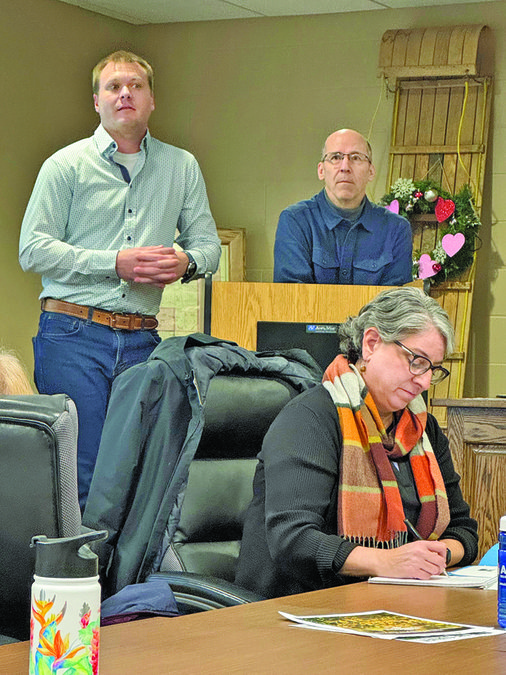
In July of 2025, Monroe County and their project partners Jewell Associates and Emmons & Olivier Resources (EOR) held a kickoff in Leon to launch their PROTECT Grant project. Their county had received a $506,000 ‘Promoting Resilient Operations for Transformative, Efficient, and Cost-saving Transportation’ (PROTECT) grant from the Federal Highway Administration.
The project is dedicated to exploring the best ways to use upland watershed conservation practices to protect public infrastructure such as roads, culverts and bridges from damages from stormwater runoff and flooding. Monroe County selected the flood prone Little La Crosse River watershed for the pilot study, which is attracting national attention.
‘The major tasks for this planning process boil down to studying the problem, understanding what can be done about it, developing a plan over the first year that has priorities for different flood mitigation solutions in different parts of the watershed, and then developing conceptual and preliminary designs cost benefits so that you've got a set of designs that you can prioritize for different parts of the watershed, to implement as funding opportunities arise,” Steve Gaffield, EOR Wisconsin Office Lead told the Task Force.
Monroe County Highway Commissioner David Ohnstad explained what his department’s focus is for the project.
“The threshold design that we use for bridge and culvert designs is a 100-year, 24-hour peak event. Given the hills and valleys topography, when the water starts running in the headwaters, it goes downhill in a hurry, and that's that's nothing new,” Ohnstad stated. “After the 2018 flood, we had people suggesting we change our design standard to a 200-year or 500-year rain event. The cost to do that would have been extraordinary, and the impacts to adjacent properties as well as the environment would have been catastrophic. So rather than try to outbuild Mother Nature, our focus is to work with Mother Nature - to not just live on the land, but to live with the land, and use native or natural mitigation concepts to reduce those flows before they get to where it impacts the infrastructure.”
Time on the ground
Gaffield said that Jewell Associates’s Robert Hanold and his associates had been spending a lot of time in the watersheds, working with the townships to understand where damages are recurring to public infrastructure, getting the lay of the land, and gaining access to historical records.
“We've interviewed all the townships, except for Leon,” Hanold shared. “We sat down, we rode the watersheds, we've talked about the damage. Those are the boots on the ground, right? Those are the supervisors and the town patrolmen that have seen what happens when you get a lot of rain and the water runs off and flooding results. These guys worked hard. They worked with FEMA, and the state and the county, to get these roads fixed as much as they can. The part of that that's interesting is the cost reimbursement through FEMA. We're focused on some of that paperwork, because it's going to play into some of the mitigation techniques for cost-benefit ratios.”
Hanold said they’d also received a large volume of information from Monroe County Emergency Management in recent weeks.
“We're also looking for high water markers so we can train our models hydraulically to make sure that we're correctly modeling these flood events for future mitigation,” Hanold explained. “We've started to focus on the upper water sheds. That's where we're probably going to make the most impacts when it comes to reducing velocities, and that's going to be key.
Gaffield emphasized that the team is looking for outreach opportunities in the watershed. He said they’re looking for flood observations, high water marks, insights into land use trends and climate change impacts. He said they also want to hear from watershed residents about ideas for solutions or good things that property owners are already doing that have shown effectiveness.
“We’re digging into the combination of the flood damage data in the hydraulic modeling to get more information about what size rainfalls tend to cause damages, because that plays into what sorts of solutions there are,” Gaffield said. “The smaller the rainfall, the better the odds of being able to do something to make a dent in it. Some of these Act-of-God events, it's hard to make a substantial decrease in the flooding, but you can do things to get infrastructure and people out of harm's way, and make it more resilient.”
Gaffield said they’d also looked at the Climate Resilience Report prepared for the county by Wisconsin’s Greenfire, and talked with scientists at the State Office of Climatology.
“They always talk about what it’s going to be like in 2050, and it’s kind of shocking to remember that’s only 24 years from now,” Gaffield said. “They estimate that in 2050, the 100-year rainfall event could be 10% bigger and more intense – we need to build that into our plans.”
Types of mitigation
Gaffield to the Task Force that the types of best management practices the project is focusing on include a variety of categories:
• Runoff Reduction: things that make the land a better sponge, including cover crops, other farm practices that improve soil health, contour stripping, and prairie stripping
• Flood Storage with Green Infrastructure: wetland restoration and floodplain reconnection through streambank restoration
• Flood Storage with Traditional Infrastructure: check dams, small dams, in-field sediment settlement basins, and on-road structures.
“It's really using these tools to help plan what sorts of practices can make the most difference. In different parts of the watershed, different things are going to make sense. And not make sense in others,” Gaffield explained. “Over the next six months, we'll be developing conceptual designs about what are the priorities that seem to give you the most bang for the buck in different areas to reduce volume of floods and improve resilience and infrastructure. The end product will be a watershed resilience improvement plan.”
Hanold pointed out that while the results of the planning study would likely focus on areas of the watershed that have experienced the most significant damages, the concepts in the plan would be transferable to all different areas of the watershed.
Costs and benefits
Wisconsin Natural Resources Board Member Robin Schmidt was in attendance at the meeting. She asked Gaffield and Hanold how the costs and benefits of implementing the various practices would be demonstrated to landowners?
“As you can imagine, some of those numbers get a little uncertain, but you can still use some common sense. This grant is coming from the U.S. Department of Transportation, and the Volpe Center is research arm of that,” Gaffield responded. “They're very interested in this project, and they have some cost benefit tools that they want to use in this project.”
Gaffield explained that over the last few months, their team had been working with the Volpe Center to get data from the county. He said they have map-based tools where, essentially through modeling and the damage assessment here, can provide a picture.
“Here's the transportation, here's the roads and bridges, culverts that get impacted in a flood and are out of service for a certain amount of time,” Gaffield shared. “They can then look at the data available in and assign a cost to those damages, not just to rebuild infrastructure, but the opportunity cost of disrupting traffic. So you can start to use those tools that put together that cost benefit picture.”
Ohnstad pointed out that the Volpe Center would use the data, analysis and insights gained in the Monroe County project to assist others across the nation interested in implementing similar projects.
Gaffield specified that the Volpe Center’s analysis would go beyond the Little La Crosse River watershed, and would be county-wide.
Next steps
Gaffield and Hanold ended the presentation by specifying what the next steps in the project would be. He said their team would:
• continue to develop future conditions modeling
• identify and provide preliminary conceptual designs for solutions in urban areas, farmland and valley bottom areas
• continue work with the Volpe Center on a cost-benefit analysis of the potential solutions
• generate a Resilience Improvement Plan with priorities for different parts of the watershed, and a summary of the permitting required, funding potentially available, and implementation recommendations.