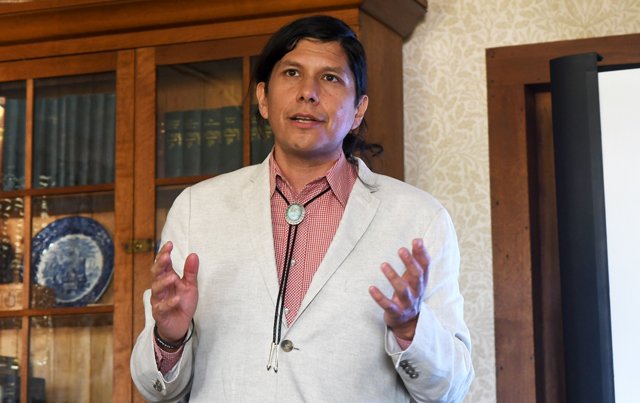
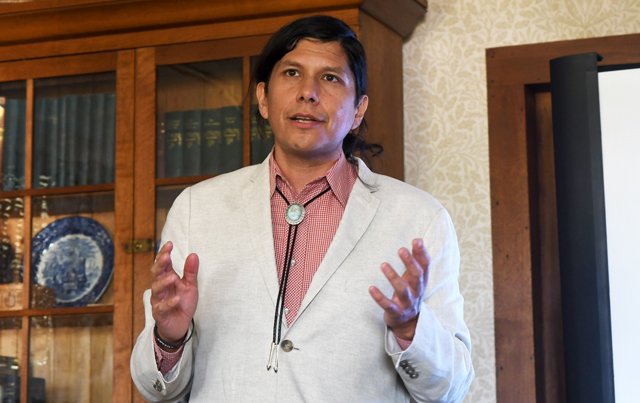
In his talk at the Crosscurrents Heritage Center on Saturday, Sept. 13, Casey Brown described himself as a filmmaker, writer, political advocate, Ho-Chunk Nation citizen, Bear Clan member, and guy that has an Emmy Award. Brown gave a talk about Native Futurism, adaptability, and ‘shuffling many worlds.’
Brown described his background, after college of joining the ‘The Second City,’ a comedy empire based in Chicago that has developed a unique way of creating art and fostering generation after generation of talented comedians and performers. He said that up until the COVID pandemic, he ran a comedy show, with three or four shows every month.
He talked about movie star Graham Greene, a Native American actor, who had recently passed away.
“He was in ‘Dances with Wolves,’ and was a well esteemed actor,” Brown said. “That’s the thing. A lot of modern native folks would say, ‘wow, that's so problematic - it's a white savior role.’ You can always have young, radical natives like myself in college that would just be like, ‘what a sellout role.’
“ What Greene said about that is that as a native man at the time, acting roles were very limited, and you had to adapt,” Brown explained. “But if you get up to his level, you can use that and then change it, which is what he did. That's what you need to do, and that is native futurism.”
Brown said that a key message of his talk was about the adaptability of native people, from their first interactions with non-native people, right up to today.
“For instance, the horse was never on this continent, but as soon as it went out west, those native riders could ride it bareback better than anyone, because they sat and they worked at it,” Brown said.
Truman Lowe
Casey Brown earned an Emmy Award for a short film he produced, ‘Exploring the Artistic Process of Truman Lowe: A Journey Through Native American Art & Education.’ Lowe was a sculptor, woodworker and member of the Ho-Chunk Nation. His artistic works were rooted in Native culture, and showcased the natural world by combining traditional woodworking with more modern techniques, pushing the boundaries of modern art.
“When I was a kid, I was with my father and went with him to a meeting. There was some guy with a bunch of logs and sticks on the back of his little truck. I asked, ‘who's that guy over there?’ And one of my dad's buddies said that's that guy that makes the weird art,” Brown remembered. “I went, okay, I guess I like weird art.”
Brown said he later learned that artist Truman Lowe was a professor at UW-Madison, and curator of the National Museum of the American Indian. While Brown was a student at UW-Madison, he was president of ‘Wunk Sheek,’ a Native American student association. Lowe was one of the group’s advisors.
“So, we were both Ho-Chunk, both from Black River Falls, and so I got to know Truman, who unfortunately passed away in 2019,” Brown shared. “I started as public relations director for the Ho-Chunk Nation during the pandemic, and with the shut down, the work had slowed down, so I went through the mail my predecessor hadn’t dealt with, and discovered UW-La Crosse proposed to name their Center for the Arts after Truman.”
Brown said that Lowe had been a student at UW-La Crosse when it was still Wisconsin State University.
“So I helped out, and wrote as many impassioned things as I could. I went to the regents, and got one of them to tear up. That was, that was a big win because regents aren't necessarily the most emotional people. And it went through. So we got the Truman T. Lowe Center for the Arts, the first building named for a Ho Chunk, and a state building no less,” Brown recounted.
Brown said that the dedication ceremony for renaming the building had been a wonderful event.
“Lots of people came, and we had our drummers there,” Brown said. “I helped to get the whole thing filmed. At the time, I’d been working with our business department, and they’d been doing short, promo films about the casinos. When I came on, they asked me if I’d be interested in doing some promotional videos. I was never going to turn down the chance to work with a video crew, so we produced a lot of film. If you go online with Discover Wisconsin, we made a video about the dugout canoe, and one about Snow Snake, a fun game we play, and another about our language revitalization. These were all made to explain aspects of our culture.”
Brown said that once he and his crew had gotten done with all that, he remembered all the footage he had of the dedication ceremony for the building named after Truman Lowe. He suggested that he and his crew use that footage to make a film about Lowe, his impact, and his legacy.
“Truman influenced thousands of students, and had a very strong impact on native graduate students. He grew up outside of Black River Falls on what's called the Indian Mission, which is a Ho-Chunk community where he was surrounded by extended family and a really close knit community. Ho-Chunk was his first language, and he grew up with a real understanding of Ho-Chunk culture and heritage,” Brown explained. “Truman entered into being an artist through his experiences at Wisconsin State University in La Crosse, where he had a lot of great professors. That's where I think he realized that he could become an artist.”
Brown said that Lowe’s favorite medium was wood. Lowe’s father was an excellent basket maker, and he prepared the wood for the baskets that his mother made.
“His father had this deep, deep knowledge of the properties of wood, which I think Truman sort of took on himself as a sculptor,” Brown said. “He understood those symbiotic relationships of static versus moving, as he often said, in what is liquid.”
Brown said that Lowe considered himself a minimalist, reducing forms down to their very essential. This was epitomized in his work, even though he was working in this fine art, avant-garde modernist tradition. He incorporated the traditional arts and crafts of the Ho-Chunk, and was one of the foremost Native American artists of the late 20th century.
“He really appreciated the opportunity to learn more about himself and the world through higher education, and he wanted others to have that same kind of experience, so he became a real advocate for Native students getting into higher education,” Brown explained. “His life goal was to promote Native art, and to bring it out of the past and into the present. He wanted to have people think about it as a living, breathing, evolving thing.
“Truman and my father, what they really have in common is native futurism,” Brown said. “Native people are constantly evolving. Because of boarding schools, because of relocation, and because of that loss of culture, where 40% of the entire native population was in a boarding school at one point, that's a large swath. That's a lot of loss of language, loss of culture, and loss of traditional ways, but it's not completely lost.”
Brown explained that this native futurism idea is that they don't live in this old society anymore, and they can't go by the old ways, which are, nevertheless, there and very important.
“We have to adapt, and we have to move on, and we have to think about this, not only as ourselves, but as community members now. To think like ‘us versus them,’ or close off the borders of tribal lands - that's not going to work, that just isn't going to happen,” Brown asserted. “Any time in history that these native movements have happened, they fail. They will fail because we are, for better or worse, all in this together, in this melting pot, this great American experiment. And even since the outset, people have been working together. And what we need to think about is how our histories are intertwined, and not how they've been touched up against one another. There's so many other wonderful things we can move forward with and share about Ho Chunk culture.”
Next adventure
After Brown left his position as public relations director for the Ho-Chunk Nation, he began to look for his next adventure. His father, Ritchie Brown, who has been a key player in acquiring properties for the Nation containing sacred mounds, suggested he put his talents to use making a documentary about the mounds.
Brown said his father had worked to identify mound sites from his people’s stories, from old historical accounts of European explorers, and from old maps made by the State of Wisconsin.
“When my father joined the Nation’s Lands Department, he met with all of the elders that essentially comprise what is our traditional court,” Brown said. “They told him, Ritchie, we're going to tell you everything we can remember about where these sacred sites and mounds are. And now that we have the money, here's a checkbook. We want you to go and get them. Don't take no for an answer.”
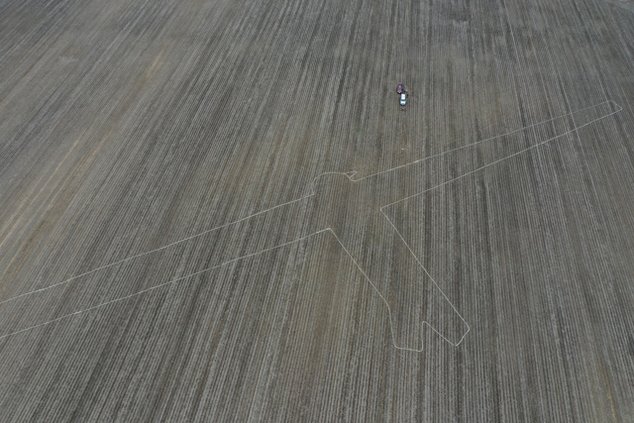
Brown said that his father has been particularly intrigued with the ‘Ghost Eagle’ mound, located in rural Muscoda.
“I remember him talking about this when I was very, very young. There was one farmer who wouldn’t sell, and my father knew what was there, wanted to map it, wanted to see it, and it was no dice, no dice, no dice,” Brown said. “After leaving my job with the Nation, I was in Chicago, and my father asked me if I wanted to put my public relations skills to use to raise public awareness about the Ghost Eagle mound.
“The Ghost Eagle mound is the largest known bird mound in the world,” Brown explained. “So, I started working on this with him. It got in the papers. Word got out, we brought some more people there, and there's been a lot more interest. And, after this happened, it got back in the community, and that's when suddenly the farmer's like, yeah, maybe I will sell this. That's when he started thinking more about it, because he could see that there is a lot of interest in it, and it obviously means something to the Ho-Chunk people.”
This experience led Brown to the project he’s working on now, with his partner Julia Pello, and their company, ‘Thirteen Tribe Productions.’
“So basically, once I started talking with Julia about mounds, she observed that I seem to know a lot about mounds,” Brown remembered. “She's like, if you're thinking about a project to do, why don't you do that? She pointed out that I have my father, I have the tribe, and I have a lot of resources. With that inspiration, I'm like okay, let's start doing it.”
Brown said they’d been filming for about a year-and-a-half now. The documentary is called ‘Indian Mounds in a Year,’ and is essentially looking at the mounds, not from a Western academic perspective, but instead, films various mounds like Frank’s Hill over the course of an entire year in the same spot.
“The film will show the mounds during the solstices and equinoxes, during different parts of the year, and how the mounds are expressed. And you'll see mounds in a line, and then the sun sets right there in this line,” Brown said. “
Brown remembered when he toured the UW-Madison campus with his father as a prospective student. His father told him after the tour concluded that the tour guide had almost stepped on a mound, and said nothing about it.
“My father said that before the UW was there this was the ‘University of Dejope’ - that's what we call it,” Brown said. “It's like all these mounds tell you stories. They tell you about the stars in the sky. They tell you about the histories. They tell you about where water is, where other resources are. These mounds are teaching you something on this hill that now has a university. They just got lucky to also put a university where we've been doing it for a very long time. So, this is what the film is about. In the film, we’re trying to re-contextualize how we talk about the mounds, not as a linear thing, but as a circle.”
Circular thinking
Brown explained that the filming starts out in the spring, then goes through the summer, fall, and winter. He said that in the spring the mounds are burned, and it's ready and fresh for the summer. In the summer, it gets grown up, and then in the fall everything dies. And then you get to winter, and that's story time. And then you get the rebirth in the spring.
“It’s essentially a circular line of thought like native thought. That's how it works. There are things that always happen, and that is essentially what the film is. You can start it over again, and it's the same thing that is going to happen,” Brown explained. “In the same way, the stories that we keep re-telling and keep re-telling, that's why our oral histories are still around, because you're thinking about it and it’s not like it's in the past. What's next? What do we have going on going forward? What we just did, remember it. Talk about it again. Keep on going with it.”
Brown said that the film really is an exercise in Native futurism, because the film doesn't just show the indigenous perspective. He said there's lots of people that are non-native that have great stories about the mounds.
“That's one of the things my father always told me. He said, Casey if you sit down like I've sat down and just had coffee with these people, it's not like they were holding onto the mounds or just waiting for to see how much money they could get. These are people that live with these mounds, have lived with these sacred sites and honored them. Some have buried their parents in the vicinity of the mounds - that's how sacred it was. Non-native people get married near the mounds. And, that's the thing that I definitely need to have in the film, is that this is our shared history, and that is the what is so impactful about it is it's not just my history. I want to know the stories of all the people that live with the mounds because you can't discredit someone that has spent their entire life there.”
Next adventure
After Brown left his position as public relations director for the Ho-Chunk Nation, he began to look for his next adventure. His father, Ritchie Brown, who has been a key player in acquiring properties for the Nation containing sacred mounds, suggested he put his talents to use making a documentary about the mounds.
Brown said his father had worked to identify mound sites from his people’s stories, from old historical accounts of European explorers, and from old maps made by the State of Wisconsin.
“When my father joined the Nation’s Lands Department, he met with all of the elders that essentially comprise what is our traditional court,” Brown said. “They told him, Ritchie, we're going to tell you everything we can remember about where these sacred sites and mounds are. And now that we have the money, here's a checkbook. We want you to go and get them. Don't take no for an answer.”
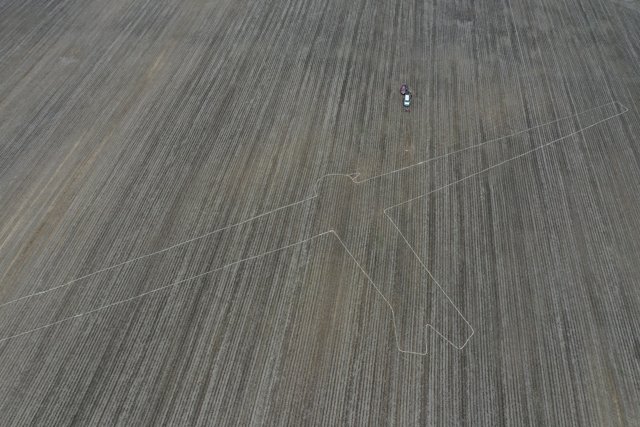
Brown said that his father has been particularly intrigued with the ‘Ghost Eagle’ mound, located in rural Muscoda.
“I remember him talking about this when I was very, very young. There was one farmer who wouldn’t sell, and my father knew what was there, wanted to map it, wanted to see it, and it was no dice, no dice, no dice,” Brown said. “After leaving my job with the Nation, I was in Chicago, and my father asked me if I wanted to put my public relations skills to use to raise public awareness about the Ghost Eagle mound.
“The Ghost Eagle mound is the largest known bird mound in the world,” Brown explained. “So, I started working on this with him. It got in the papers. Word got out, we brought some more people there, and there's been a lot more interest. And, after this happened, it got back in the community, and that's when suddenly the farmer's like, yeah, maybe I will sell this. That's when he started thinking more about it, because he could see that there is a lot of interest in it, and it obviously means something to the Ho-Chunk people.”
This experience led Brown to the project he’s working on now, with his partner Julia Pello, and their company, ‘Thirteen Tribe Productions.’
“So basically, once I started talking with Julia about mounds, she observed that I seem to know a lot about mounds,” Brown remembered. “She's like, if you're thinking about a project to do, why don't you do that? She pointed out that I have my father, I have the tribe, and I have a lot of resources. With that inspiration, I'm like okay, let's start doing it.”
Brown said they’d been filming for about a year-and-a-half now. The documentary is called ‘Indian Mounds in a Year,’ and is essentially looking at the mounds, not from a Western academic perspective, but instead, films various mounds like Frank’s Hill over the course of an entire year in the same spot.
“The film will show the mounds during the solstices and equinoxes, during different parts of the year, and how the mounds are expressed. And you'll see mounds in a line, and then the sun sets right there in this line,” Brown said. “
Brown remembered when he toured the UW-Madison campus with his father as a prospective student. His father told him after the tour concluded that the tour guide had almost stepped on a mound, and said nothing about it.
“My father said that before the UW was there this was the ‘University of Dejope’ - that's what we call it,” Brown said. “It's like all these mounds tell you stories. They tell you about the stars in the sky. They tell you about the histories. They tell you about where water is, where other resources are. These mounds are teaching you something on this hill that now has a university. They just got lucky to also put a university where we've been doing it for a very long time. So, this is what the film is about. In the film, we’re trying to re-contextualize how we talk about the mounds, not as a linear thing, but as a circle.”
Circular thinking
Brown explained that the filming starts out in the spring, then goes through the summer, fall, and winter. He said that in the spring the mounds are burned, and it's ready and fresh for the summer. In the summer, it gets grown up, and then in the fall everything dies. And then you get to winter, and that's story time. And then you get the rebirth in the spring.
“It’s essentially a circular line of thought like native thought. That's how it works. There are things that always happen, and that is essentially what the film is. You can start it over again, and it's the same thing that is going to happen,” Brown explained. “In the same way, the stories that we keep re-telling and keep re-telling, that's why our oral histories are still around, because you're thinking about it and it’s not like it's in the past. What's next? What do we have going on going forward? What we just did, remember it. Talk about it again. Keep on going with it.”
Brown said that the film really is an exercise in Native futurism, because the film doesn't just show the indigenous perspective. He said there's lots of people that are non-native that have great stories about the mounds.
“That's one of the things my father always told me. He said, Casey if you sit down like I've sat down and just had coffee with these people, it's not like they were holding onto the mounds or just waiting for to see how much money they could get. These are people that live with these mounds, have lived with these sacred sites and honored them. Some have buried their parents in the vicinity of the mounds - that's how sacred it was. Non-native people get married near the mounds. And, that's the thing that I definitely need to have in the film, is that this is our shared history, and that is the what is so impactful about it is it's not just my history. I want to know the stories of all the people that live with the mounds because you can't discredit someone that has spent their entire life there.”