Southwest Wisconsin is at a crossroads with its ability to grow stifled by a number of issues.
A lack of available owneroccupied and rental housing in many communities poses problems for that young families who grew up here and want to move forward as well as newcomers coming here for a job.
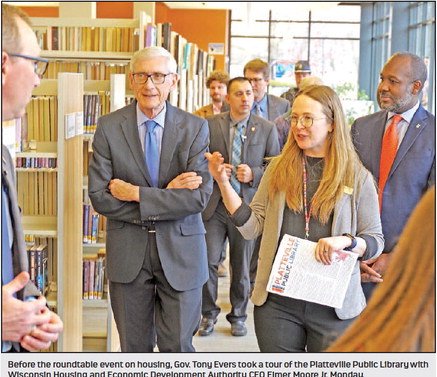
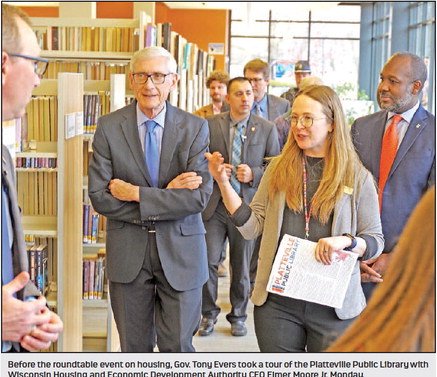
A roundtable on housing was held Monday at the Platteville Public Library, headed by Gov. Tony Evers, and Wisconsin Housing and Economic Development Authority CEO Elmer Moore Jr., to discuss obstacles local leaders face in promoting housing, and whether or not Evers’s proposals in his version of the 2023–25 state budget would be help.
“We understand the importance of housing,” said Moore. “If people do not have safe, adequate, affordable housing, they cannot achieve their professional, educational, or even their family aspirations.”
Moore touted the location of the event, the Platteville Public Library, built as a project that also includes the Holiday Inn Express and fills several needs, showing how public/private partnerships can bring what is needed to a community.
Evers’ proposal includes helping cover the costs of infrastructure for new housing developments, funding for affordable workforce housing projects, and grant and loan p ro g r ams to help both homeowners and landlords make improvements on aging residences.
Moore touted the assistance programs for helping people fix up older homes. He said the purchase of a home can leave owners of older homes with little money to then make improvements and updates.
Platteville Common Councio president Barb Daus welcomed the idea of that kind of program, since Platteville has a substantial number of older homes. Daus said a state program would build upon a city program to take advantage of keeping open a Tax Incremental Financing district open for one additional year to take the higher property taxes generated in the district into housing programs.
Platteville’s program provides assistance for owners of homes built before 1950.
“If there had been a program at the state level that would we could have applied for, we could have gone farther than we have gone now,” said Daus, noting that when city funding runs out, the city program will be done, but the need is greater than the available funding.
Abigail Haas, director of the Platteville Area Industrial Development Corp., said it was important to have a program for rental housing including apartments to help not just property owners but their tenants. Haas said there are very limited rental options because of the tight rental market.
Troy Maggied, director of Southwest Wisconsin Regional Planning Commission, said while improvement programs are good, his focus has been on new housing, because communities will invest in new construction because they can see an impact on property tax revenues and municipal budgets.
Under state-imposed property tax limits, municipalities can only raise their property tax levies based on net new construction. Improving existing housing changes the assessed valuation of the community, but it will not allow their budgets to increase.
New housing also means communities grow, which is important for their survival.
“We are going to see school districts go under; we will see consolidation,” said Maggied.
Maggied pointed to data on previous projects, like a mixed-use TIF project that included housing, in Benton. He said they have data on community population growth, how many children came into the school district, and what it meant in rate of return for the community that invested.
Maggied and Daus also discussed transitional housing — smaller homes for older people who have raised their families and want to stay or move into the community as they reach retirement age, but are far from needing programs like assisted living or a nursing home.
Daus said that kind of housing allows for larger traditional homes to open up. Maggied said older homeowners may no longer want to deal with such chores as snow removal or lawn care.
Maggied said and Evers agreed that transitional housing is popular with people looking to retire in Wisconsin, with Maggied recent developments in the southern part of the county not going to people who have been living here, but transplants.
Ron Brisbois of the Grant County Economic Development Corp. said the word “affordable” gives many a pause.
“When we start talking ‘affordable’ housing, most of my communities will step back,” he said. “We need to address that stigma. It’s got a bad reputation.”
Evers said the emphasis is on the workforce. He recalled a community of approximately 5,000 people whose three major employers came together and spent their own money to build housing so they could bring in new workers.
Evers noted the combined efforts in Door County, which has a major tourism industry, with partners coming together to build housing in Fish Creek for tourism workers.
“They knew that was the cost of doing business,” he said.
Evers talked about working on projects so businesses can get workers in a tight labor market. He touted other efforts like the Child Care Counts funding that helped daycares in Richland Center, which is open at 4 a.m. because of the factory shift changes.
That program was started with federal American Rescue Plan Act funding, and he said “it’s going to be really tough for them” if the funding is not included in the upcoming budget.
Brisbois said daycare programs are important, as housing and childcare are the top two issues he hears from businesses he works with, but he feels changes are needed in the mindset, which are heavy on job creation.
“In this tight labor market, it’s about retention,” he said.
“We need to take a look at that,” said Evers.
John Fick, director of the UW–Platteville Economic Development Administration University Center, noted the importance of creating an atmosphere that will make it easier for people to find homes. He said moving from Dodgeville to Platteville was a nearly impossible task, finding land he could buy to build a home, an available contractor, and dealing with increasing interest rates.
“The land is not there that people are willing to sell so people can build,” he said.
Fick said he found a home only because he knew someone was retiring and moving, .
Daus remarked that is often the case. “If someone is moving out, and you get wind of it, you bought it before he even knew,” she said.
Haas said people need to be more open-minded in housing options, because members of the millennial generation are looking at housing differently, staying in rentals longer, or are interested in multi-residential units, but those types of housing are received poorly by older residents.
Moore said it was important for communities to find ways to improve the housing issue, since housing is preventing people from moving in.
“It’s for families,” he said of affordable housing. “It is for librarians, for seniors, for recent graduates.”
Governor looks to cut past political posturing
After a roundtable at the Platteville Public Library Monday, Gov. Tony Evers was asked statements made state Sen. Howard Marklein (R–Spring Green) and Rep. Travis Tranel (R–Cuba City) about the event and Evers’ budget.
Evers believes in the end he and the state Legislature would all agree to have items like his housing proposals in the next budget.
“The governor’s budget is just a list of ideas,” said Marklein in a press release after Evers’ budget address, which included the housing program. “The Legislature will build the state budget and it will fund our priorities, address our obligations, cut taxes and prepare Wisconsin for the future.”
“That’s a political comment he made; that’s not what’s going to happen,” said Evers. “Every item the Joint Finance Committee looks at, the Legislative Fiscal Bureau puts my piece in there.”
Evers said he just wants people to have a conversation about the issues.
“At the end of the day, we will reach a compromise on a number of issues, and housing is definitely be one of them,” he said.
Evers said many business owners know how important housing is.
“I know Howard, and I know that is part of the schtick that goes on during budgets, but at the end of the day they are going to have my proposal right next of theirs, and that is how it works in the capital,” he said.
“I think we will be fine. We will get some money for housing in Wisconsin.”
Evers noted that in most budget initiatives like Marklein and Tranel’s proposed Ag Roads Improvement Program, they will work together to pass something.
“The vast majority of the bills that pass, I sign them … There are lots of things we agree on,” he said. “Right now, its just a political game.”.
Ano t her newspaper contacted Tranel, who complained he wasn’t invited to the Monday roundtable.
Evers said the purpose of the event was to talk about the people working on this topic daily to get ideas and solutions.
“We wanted to talk to people on the ground dealing with this issue on a regular basis,” he said.
Tranel, who bragged at a recent listening session in Lancaster that he was invited to the governor’s Christmas Party, was given another invitation to talk to Evers directly on the topic, according to Evers.
“Anytime Travis wants to have a conversation, he can give me a call,” said Evers.