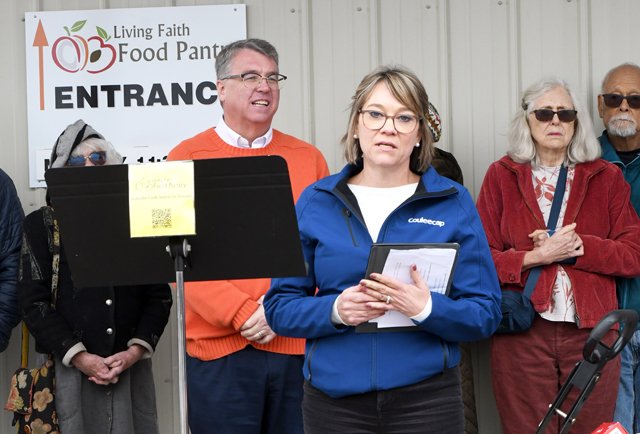
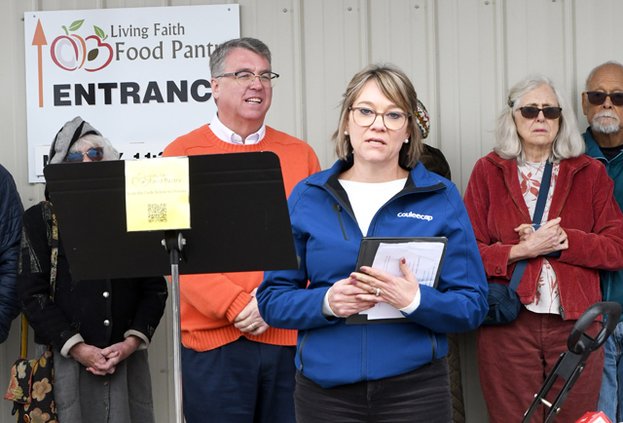
Representatives of Second Harvest Foodbank of Southwest Wisconsin, Couleecap, and Vernon County food pantries like Living Faith and Bethel Buttik, spoke at a press conference called by 96th State Assembly Representative Tara Johnson last Friday. Their topic was the interruption of the federal Supplemental Nutrition Assistance Program (SNAP) funding, scheduled to go into effect the next day on Saturday, November 1.
“It was important to me to make sure that we were holding this event in a rural community, and to make sure that everyone understands that the loss of food, care benefits is affecting everyone, and in the rural part of this state, it has some very profound impacts,” Johnson said.
She pointed out that one of the greatest needs of food pantries is for meat, and that the DNR Deer Donation Program is an opportunity for hunters to help provide protein for food insecure households in this time of need.
“Vernon County Democratic Party Chair Wayde Lawler is a bow hunter,” Johnson said. “This morning he shot a deer, and he plans to take it to the Westby Meat Locker to donate it to the deer donation program that helps to supply food pantries with meat.”
In Crawford County, deer can be taken to the Eastman Locker to participate in the DNR Deer Donation Program. For both Westby Meat Locker and Eastman Locker, you must field-dress, and legally tag and register your deer before dropping it off at the locker. You will need to provide your DNR customer number and registration information and fill out a donation log sheet at the locker.
This sudden cessation of SNAP benefits (or FoodShare as it is known in Wisconsin) nationwide as a result of the ongoing shutdown of the federal government is expected to exponentially increase demand for food at local food pantries. It is unclear if the will be able to service the need.
According to the Center for Rural Affairs, “one in eight Americans rely on SNAP for their food. Nationwide, 42 million people—including 16 million children, 8 million senior citizens, and 4 million people with disabilities—will face difficult decisions about how to feed themselves and their families, when their benefits are no longer accessible. Refusing to fund SNAP will create a hunger crisis for our neighbors who are already doing their best to stretch their dollars as far as they can. Nonprofits, such as food banks and pantries, cannot even hope to offset a reduction in SNAP benefits, as SNAP provides nine meals for every one distributed by food banks.”
Editors Note: since this story was published on Thursday, Nov. 6, the situation with release of November SNAP benefits has changed almost daily. For that reason, this story has been updated with information current as of the morning of Wednesday, Nov. 13.
Governor Evers joined 25 other states in filing a lawsuit demanding that FoodShare contingency funding, approved by Congress to cover the program in a situation like the current government shutdown, be released. A federal judge agreed, and the Trump Administration had, as of Monday, November 3, agreed to release approximately $4.65 billion from a contingency fund.
Since then, the Trump Administration reversed their intention to release the contingency SNAP funds, and appealed the Rhode Island judge’s decision. Then, the Trump Administration was ordered by yet another judge not to release just the contingency funds that were expected to cover about 50% of SNAP benefits, but rather to fully fund November SNAP payments.
On that basis, Governor Evers released the full November SNAP payments. Meanwhile, the Trump Administration asked the U.S. Supreme Court to order states not to release the full November SNAP benefits pending the outcome of his appeal, which request the Supreme Court affirmed yesterday.
Since then, despite being ordered by USDA to reverse the payment of full November SNAP benefits, Governor Evers responded with just one word, “No.” Evers and the state Department of Agriculture, Trade and Consumer Protection is urging retailers to honor Quest card purchases, and threatening to crack down on any associated price gouging.
Today, Wednesday, Nov. 12, the U.S. House of Representatives is expected to go into session for the first time in two months to vote on a bill passed by the U.S. Senate to reopen the government and fully fund SNAP benefits.
Stay tuned.
Local impacts
In Crawford County, this will impact almost 2,000 people, in Vernon County just over 2,500, in Richland County almost 2,400, and in Grant County over 4,600 individuals. Statewide, 700,000 people, including 270,000 children, are expected to be impacted.
“With the SNAP benefits ending, the impact of that cannot be overstated,” Cory of Second Harvest Food Bank of Southwest Wisconsin said. “Our data suggests that for every one meal that a food bank or food pantry provides, SNAP is providing nine meals. So just wrap your mind around that the sheer quantity of food that means.”
Couleecap
Hetti Brown, Executive Director of Couleecap, thanked Wisconsin State Representative Tara Johnson for holding the press conference and the emergency food drive.
“Couleecap operates three food pantries. Our Sparta and Norwalk Food Pantry serves Monroe County and our Prairie du Chien Food Pantry serves Crawford County,” Brown explained. “But Couleecap also administers the Emergency Food Assistance Program, otherwise known as ‘TFAP,’ which provides government food commodities to food pantries across this region.”
Brown said that together with their food pantry partners as part of the TFAP program, in 2024, they served over 12,000 households with over 900,000 pounds of food.
“But that was last year. The demand is much, much higher this year, and while we're here today to talk about how FoodShare benefits are being paused right now because of the government shutdown, I did also want to draw attention to the fact that that is one government program,” Brown said. “The emergency food assistance program is another government program that we have seen steep declines in food resources all year long.”
Brown said that since the beginning of the year, food commodities coming out of the USDA have been declining, and then in May, they got a message that in June, there was a full cancelation of meat, eggs and dairy products from the USDA, without warning and without explanation.
“So, food pantries have been under extreme pressure all year long, without these resources and this FoodShare change is just another striking blow at the same time we are also under increased pressure because of the financial strain that so many families are under, not only with increased food prices, but increased prices of utility bills and car and home insurance and rent prices and all the other costs that families are faced with. At our food pantries, we are seeing people come in where they used to visit us once a month, now they're visiting us every week, and we are seeing recently many, many people who we've never seen before. In Sparta, for example, over the last two weeks, we have seen federal government employees who are now furloughed visit us - we are seeing students and healthcare workers. Last week, we were visited by a veteran who explained to us that normally, between their wages and their veteran benefits, they can make ends meet, but now their veteran benefits did not come because of the government shutdown, and they can't afford their rent, and they can't afford food, and they are visiting us. So, these are the people that we're seeing in our food pantries, already under a strained, resource-scarce environment, and we're seeing more and more people in need.”
Brown said that if the government was doing its job, Couleecap and the pantries wouldn’t have to appeal to citizens in the community to help meet this unprecedented need for food. However, they do need the help.
“We really need meat. We need dairy products and other protein sources, along with the non-perishable items, and then financial resources,” Brown clarified. “If you have it to give, we really need cash resources, because people come to us as that hub in the community for diapers and toilet paper, but also those who are medically vulnerable sometimes need a special diet, and so if we don't get donations to fulfill those needs, we have to purchase those resources as well. So thank you again, and thank you for being here.”
Pantries respond
Becki Rider, Manager of Living Faith Food Pantry in Viroqua, spoke to the pending crisis in food security.
“This is such a wonderful community, and we feel like this is what God has called us to do, is to pull together during tough times,” Rider said. “Living Faith Food Pantry has been around since about 1988, and in 2024, we served 20,978 people and 8,358 households.”
Julie Fraser from Immanuel Lutheran Church in Viroqua, spoke about their ‘Little Free Pantry’ service.
“We have what we call a Little Free Food Pantry in the entrance of our church. We started it last November and maybe filled it up once or twice a week. Now we're filling it up two to three times a day, seven days a week, it is open 24/7, it's in an enclosed area,” Fraser said. “We see people and families, we've seen seniors. We've seen people coming in late at night with their work clothes on to grab enough food. One thing that makes ours a little bit of a challenge is one of the things people ask for the most are can openers or cans that have pop tabs, because we're also helping those that may be living in their cars or living in a hotel or living on the street.”
Courtney Havel of the Bethel Buttik Food Pantry in Westby spoke next.
“Bethel Boutique is a unique three-in-one program. It's a food pantry, a thrift shop and a mission assistance program. Proceeds from items sold in our thrift shop help support our food pantry and mission assistance programs, which provide food and financial support to community members in need,” Havel explained. “Our food pantry is open Monday through Friday, and we're also open select Saturdays. In 2024 we fed nearly 6,500 people, which equates to about 24 people per day that our food pantry is open. We have already served more people in 2025, and we still have two full months to go, and these two months have historically been our highest served months.”
Food pantries
In Crawford County, food pantries operate in Prairie du Chien (Couleecap) and Gays Mills. There is also New Hope Food Pantry in DeSoto, and St. Francis Hermitage, near Gays Mills, which distributes food boxes on Tuesdays from 12-2 p.m.
According to Joann Gonos, who volunteers with the Gays Mills Second Harvest Food Pantry, Second Harvest is preparing to meet the need for food across their network from the delay in November SNAP (FoodShare) benefits.
“At Second Harvest, our primary focus is to provide more food to meet the increased demand in coming weeks. Building on previous experience responding to surges, we feel confident that we can extend additional resources in coming weeks,” their October 29 press release to partners read.
According to a press release from Second Harvest on October 31, they “have activated emergency protocols to purchase and distribute significantly more fresh produce to our network of nearly 300 partners and programs starting November 1, and is expanding our distribution capacity and mobilizing volunteer and donor support now because we cannot wait until the crisis hits full-force.”
According to Renee Salmon from the Gays Mills Food Pantry, they served approximately 85 families in October. The pantry is located at 120 Sunset Ridge Avenue, #122, Gays Mills, WI, 54631, (Gays Mills Mercantile Center), and their phone number is 608-606-1269.
“We have only been open one time on November 1, since the SNAP cuts were announced, so we don’t know what the impact will be on our client numbers,” Salmon said. “We have had an outpouring of donations since the announcement, and we are thankful to our community and especially our Mercantile Center neighbors.”
Neither Salmon nor Gonos indicated they had heard from Crawford County State Representative Travis Tranel or State Senator Howard Marklein about this impending crisis. The Crawford County Independent & Kickapoo Scout newspaper has likewise heard nothing from our two elected representatives in the state legislature.
Crawford County Democrats are partnering with Couleecap to purchase ‘Thanksgiving Meal Baskets,’ at a cost of $35. Individuals can purchase the food items or just donate the funds.
Johnson’s One Stop in Seneca has initiated ‘The Windmill,’ which allows shoppers to purchase a grocery gift card, hang it on the wall, and then anyone in need can take one – no questions asked.
In Vernon County, pantries operate in Viroqua, Westby, Viola, and at 122 Main Street in Viroqua for the Neighbors Helping Neighbors’ food pantry, Tuesdays and Thursdays from 3 to 6 p.m.
Viroqua Family Restaurant, from November 1-10, allows individuals impacted by the government shutdown to request the Community Support Special, which includes a full order of biscuits and gravy or any kids meal (limit one per day per person), between 9 a.m. and 6 p.m. In addition, they will donate $1 from every 2-egg combo breakfast sold between Nov. 1-10 to the local food pantry.
County Seat Laundry in Viroqua is selling $20 pre-paid donation laundry cards. During the lapse in federal funding for SNAP, County Seat is partnering with Bethel Buttick, Cashton Cupboard and Closet, Kickapoo Area Food Pantry, Living Faith Food Pantry, and Vernon County ADRC to distribute laundry cards.
What do donate
Items needed at local food pantries include cereal, oatmeal, tuna, Spam, sardines, canned beef, corned beef hash, Hamburger Helper, peas, baked beans, creamed corn, canned sweet potatoes, canned potatoes, fruit cocktail, canned pears, mandarin oranges, canned pineapple, ketchup, mustard, salad dressing, pickles (sweet and dill), flour, sugar, salt, vanilla, baking soda, baking powder, brown sugar, powdered sugar, cake mixes, corn meal, pancake mixes, syrup (regular and sugar free), crackers, rice (brown and white), pasta, juices, and personal care items. Can openers are also a great thing to donate.
Pfaff wraps it up
Wisconsin State Senator Brad Pfaff, who previously represented Crawford County prior to new legislative maps being drawn (now Crawford County is represented by State Representative Travis Tranel and State Senator Howard Marklein), wrapped it all up.
“In western Wisconsin, we are loving, caring people. We take care of one another. People in this region work hard, they play hard, and they believe in one another,” Pfaff said. “There's a time and place for partisan politics, but not when it comes to feeding one another, caring for one another, sheltering one another. We need to recognize the fact that we need to come together. I request, I hope and I pray, that our policymakers in Washington, DC recognize the fact that it is time to get back to work and help the people that they are elected to serve. We're all human beings, we all have to eat, and we all have a place in today's world.”