“Happy National Ag Day,” exclaimed Randy Romanski, Wisconsin Secretary of Agriculture, at the start of the Wisconsin Technical College Systems (WTCS) Ag Day, held this year on the campus of Southwest Wisconsin Technical College (SWTC) on March 24.
WTCS Ag Day is an annual statewide event that rotates among Wisconsin’s 16 technical colleges and this year, SWTC was selected as the host site for a day of hands-on demonstrations, interactive exhibits, and conversations focused on agricultural education, innovation, and workforce needs.
After a brief welcome from Christina Winch, an academic lead/agriculture instructor at SWTC, opening remarks were given in the Lenz Center of the campus, starting with Romanski, who stated days like Ag Day are “A great part of my job. I get to go around Wisconsin and talk about the importance of agriculture in Wisconsin.”
Romanski pointed out that Wisconsin agriculture is a $116.3 million industry and the occupation for one in 10 Wisconsinites, before declaring that “In Wisconsin every day is ag day.”
“It’s our past, present, and future,” Romanski went on to say referring to agriculture in our state.
Layla Merrifield, WTCS President, spoke next saying it was nice to be back at “America’s best technical college,” referring to the college’s Aspen Award back in April of last year.
In the technical college system, there are 118 ag programs across the state, with students learning the newest agricultural innovations such as drones, GPS combines, organics, etc. “But even with all the innovations, the heart of Wisconsin remains the same, the family farmer,” Merrifield went on to say.
“Wisconsin leads the nation in key commodities,” Merrifield stated, giving examples, of cranberries, beans, potatoes, and corn. “Truly Wisconsin helps feed the world.”
Merrifield also pointed out the ever changing landscape of agriculture, and the need for evolving agriculture education, giving an example of Wisconsin now has 470 licensed hemp producers. “What happens on the farm reflects what happens on campus,” she explained. “Traditional and cutting edge technology can all be found on campuses.”
SWTC Interim President Caleb White stated that “Agriculture is a way of life and is a cornerstone of what we (SWTC) do here.”
“Expectations of our graduates is higher than ever,” White went on to state. “Southwest Tech has the ability to adapt to the evolving needs of our employers.”
Part of that, as White pointed out, was the college’s recent acquisition of 80 additional acres to expand its current learning labs.
“Wisconsin continues to lead across the nation and you’ll see that today,” White went on to state. “We’re building a strong workforce for the future of agriculture.”
Last to speak was Halei Heinzel, the 2024-25 and 77th Alice in Dairyland, who grew up a self admitted, “city slicker,” before getting to milk a cow as a teenager and fell in love with the dairy industry.
Heinzel, now a marketing communication specialist for Cargill, a major supply chain partner for agricultural and industrial customers, gave a brief history on the Alice in Dairyland position, as well as some highlights from her time wearing the tiara, before speaking on how continual innovation in agriculture is creating jobs now, as well as “some that may not even exist yet.”
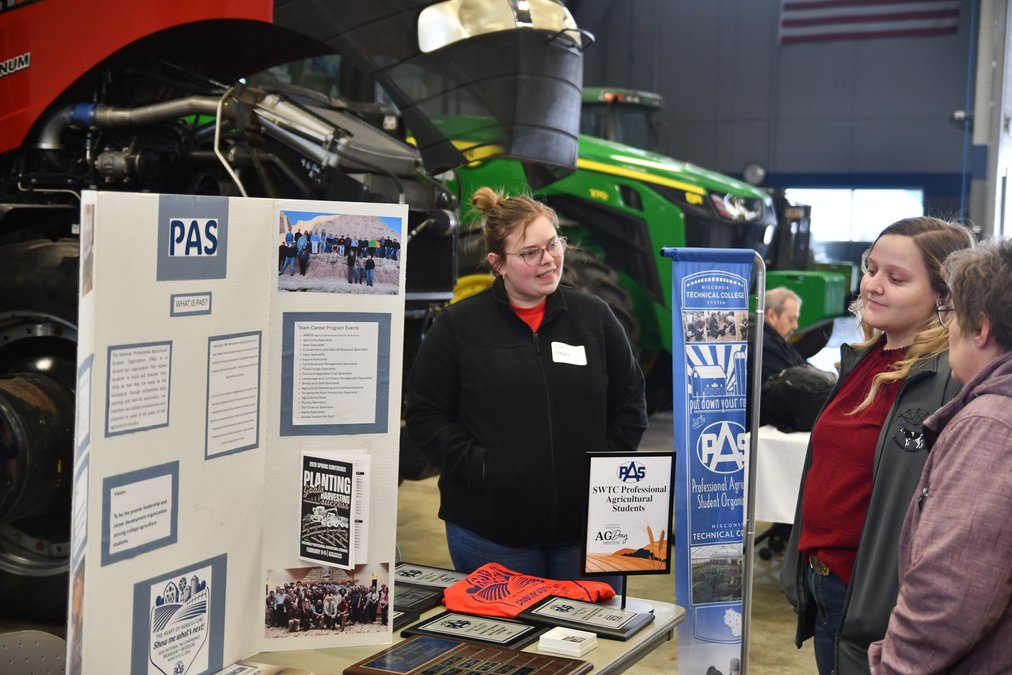
From there, attendees were able to walk across the street to the ag/auto center on campus to take part in agricultural technology showcases from area companies/potential employers such as Nutrien, Premier Co-Op, Sloan Implement, and Ritchie’s, to name a few.
Current and potential students were able to see technology first hand, such as a GPS sprayer, as well as learn about SWTC programs such as golf course management and goat herd management, to name a few.
Evers visits
After a brief lunch break, attendees returned to the Lenz Center for an “unannounced brief visit” from Wisconsin Governor Tony Evers.
Introduced by Merrifield, who referred to Evers as a “champion of Wisconsin’s 16 technical colleges” and someone who “understands the value of lifelong learning.”
Evers congratulated SWTC on its Aspen Prize stating that this was his first visit to the campus since the award was announced last April, referring to Southwest Tech as the “best of the best.”
In his brief address, Evers stated that “Inspiring the next generation of ag leaders wouldn’t be possible without our technical colleges.”
Evers went on to emphasize the $13 million the state has invested into the technical college system through the bipartisan budget, with $3 million going toward student books and other education resources to ease their student expenses. Evers also touted the budget’s $6 million allotted toward state youth apprenticeship programs.
He also referenced the on-going tariff debate, with farmers increasing costs of production such as fertilizer, machinery, and fuel and lower commodity prices stating that “Fighting for the Wisconsin farmer is more important than ever.”
Panel discussion
Closing out the day’s events was a roughly one hour panel discussion with current SWTC students, alumni, educators, and area partners.
Moderated by Ryan Weigel, an agricultural instructor at SWTC, the panel discussion was focused on advancing technology in agriculture and the raise of shared data and AI (artificial intelligence).
When asked how the panel has seen technology change their profession/education, Andrew Dal Santo, also a agricultural instructor at SWTC, mentioned the evolution of drones from a single remote controlled one to autonomous ones.
Owen Gilberston, a current agriculture student, said just in his time on campus tissue samples went from taking the sample and waiting a few days to being able to get results almost instantaneous.
Another student, Carter Burrichter, brought up the installation of GPS in tractors as an example.
From there the discussion of AI use and data sharing was presented, to which Wiegel said AI to educators was a “dirty word at first,” but now view it as a teaching assistant/tool.
Dal Santo stated he viewed data as “a commodity now, having value almost like a currency.” But was wary of AI generating data on its own, stating that “data needs to come from farmers.”
Harlee Harbaugh, a animal science student, shared Dal Santo’s statement saying that when referring to shared data that “farmers should own it, but we can all learn from it.”
Aiden Hoffman, branch manager with Nutrien Ag Solutions from Stitzer, likewise pressed on shared farming data questioning are numbers/data generated from a farmer’s county, state, even nation. “Every farm is different, even right down to the soil.”
Ty Gaffney, a former student, agreed with Hoffman, stating that, “It’s awesome we have the data, but farming backgrounds are different.”
Weigel jumped in from his moderator duties stating that, “Is any answer gospel? No. We still need to do any research.”
Craig Smith, an alumni of the golf course management program and a current golf course superintendent, switched gears a bit saying that golf courses are “constantly collecting data from everything from green speeds to how far balls travel, anything to find peak performance. But the data we collect is ours, and should be.”
Another golf course voice was from current student Garret Glewen who gave an AI advancement example of golf club manufacturer Calloway who recently created a golf club strictly based on AI from monitoring golf swings.
In the forever debate of man vs. machine, automation was next for discussion, with Dal Santo stating that automation has worked well with workforce shortages, but then again, automation then creates a whole new batch of jobs related to the automation technology, referred to it as a revolving door of jobs, saying there will always be human oversight when it comes to automation.
Gilberston brought up sprayer drones saying they will do the work, but not replace a human overseeing them.
Agricultural power student Carter Burrichter chimed in stating, “A computer won’t turn a wrench, but it’ll help you find the problem quicker.”
But not everything can be left to machines, as Harbaugh pointed out when it comes to veterinarians. “When a cow or other animal gets sick, you aren’t sending out a robot to help.”
The discussion wrapped up by asking what are some emerging technologies to be excited for?
Dal Santo stayed with automation, but rather “small automation and see more efficiency on smaller scale.”
Hoffman brought up seed genetics with hybrids making growing crops such as corn and alfalfa more effective and efficient, but right now, the price tags may be a bit high.
Smith stated a common “bad rap” for golf courses is they waste water with constant watering of courses. But water treatment technology is advancing to use recycled water on golf course, while Garrett brought up GPS sprayers that reduce chemical use and labor on golf courses with their accuracy.