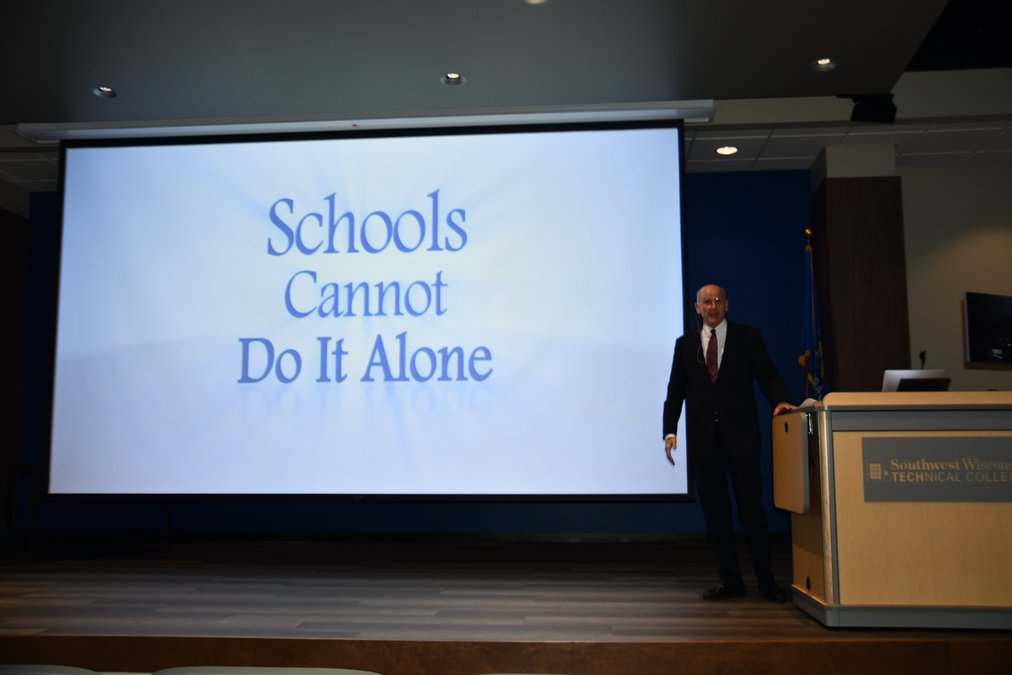
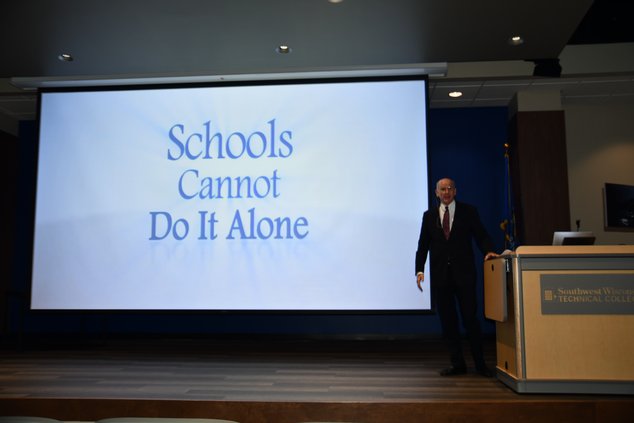
“Schools cannot do alone” was an often used phrase from Jamie Vollmer, president of Vollmer Inc. and one of three keynote speakers at CESA 3’s 20th annual Business and Education Summit held at Southwest Wisconsin Technical College on Jan. 9
Vollmer, a self-described previous critic of public education, has in the last 30 years been a champion of America’s public schools.
Vollmer, who also spoke at the first summit, told a story how he came from being a harsh public education critic to a heavily invested ally.
After being part of Great Midwest Ice Cream Co. in Iowa, Vollmer was invited to be part of the Iowa Business Roundtable, eventually becoming its executive director.
Vollmer said he and his colleagues shared three assumption about public education — that it was failing, the people involved were the problem, and schools should be run like a business.
But fielding a question about blueberries during a teacher inservice during the 1990–91 school year changed his “way of thinking.”
Vollmer explained that teachers had been warned that the “bully was coming to talk” that day. During a Q&A session after his address an English teacher of 27 years asked Vollmer what his ice cream company did when it received a batch of blueberries “not up to company triple A standards?”
Vollmer informed the teacher that they would return the blueberries.
The teacher responded, “We can never send back our ‘blueberries.’ Our ‘blueberries’ come rich, poor, hungry, abused. We take all the blueberries because this is not a business, it’s a school.”
From that point on, Vollmer’s previous assumptions changed.
“Public education is under siege and the solution is to rally reinforcements in the community,” he said describing how schools have changed since that day in the early 1990s, and even more in the last decade with increasing responsibilities placed on educators, bringing it back to Vollmer’s central theme of “schools can’t do it alone.”
Vollmer also referenced a quote from Plato during his 45-minute address to educators, business representatives, and area community leaders in attendance: “Those who tell the stories rule society.”
Many influential voices still carry Vollmer’s previous assumptions and more in our “polarized culture,” he said urging people to “come together and tell the story.”
“People lie and tell stories about public education and sometimes people will believe the fiction. Public education is one of America’s greatest assets, we just have to stay together and tell the story,” or be your school’s ally, and rally around them.
He urged school administrators to give daily examples of “everyday evidence of your district’s successes” to open the community engagement gap.
Vollmer also used the business term Return on Investment, saying that studies show for every $1 spent on education, $7 goes back into the community.
Vollmer pulled out a nearly three-foot-long sheet of paper with a list of mandates schools have added over a 120-year time period.
The list, broken down by decades, increases every decade, with the ’90s and 2000s taking up nearly half of and the 2000s nearly the same length as the previous three decades. Vollmer said not a single minute has been added to the school calendar in eight decades.
“This should be on every fridge in Southwest Wisconsin,” he said. “Parents, teachers teach your children, but you need to raise your children,” calling back to Vollmer’s mantra of “Schools cannot do it alone.”
New neighbor
The second keynote speaker was Scott Knapp, A.Y. McDonald Vice President/Chief Strategy Officer,
Knapp started out his presentation explaining why his 170-year-old company choose to relocate from Dubuque to Dickeyville and build their new state-of-the-art foundry.
A few of the factors Knapp mentioned was the relationship between schools and area businesses: “educators know what to do to prepare students for the workforce”
He also said A.Y. McDonald “knows their neighbors” and “trust the people of Southwest Wisconsin,” and knew the reputation of the workforce in our area as “having pride in their work and care about each other,” characteristics his family-owned business seeks.
“We’ve been made to feel very welcome in the community with open arms,” said Knapp. “We’re here for the long haul.”
Indeed, with their new foundry location expanding from 80,000 square feet to 400,000 square feet.
Knapp also stressed that today “production work is not “dead-end manual labor. There are opportunities for all who walk through our door,” listing area high schools and schools like Southwest Tech and UW–Platteville preparing students.
One of those students, whom Knapp referred to as a “local success story,” is Andrea McDermott, foundry engineer at A.Y McDonald and 2020 graduate of UW–Platteville. She urged educators to help students learn and build workplace traits that go outside of the classroom.
McDermott said employers like to see employees who “give a damn.”
“Skills are great, but behavior such as showing up, being a good teammate and being able to lean in during tough times,” she said.
McDermott said educators should be teaching students to look for the “opportunity to try new things. It’s ok to fall down and brush yourself off and try again.”
McDermott also spoke against the stereotype of manual labor. “Not everyone wants to sit in front of a computer. Some want to work with their hands, so by working together we can normalize the trades through exposure, encouragement, and small experiences.”
Keep our communities thriving
Jamie Nutter, CESA 3 Administrator, spoke on keeping graduating students as part of the workforce and living in Southwest Wisconsin.
Nutter touted the youth apprenticeships program, stating that in the CESA 3 region apprenticeships have increased from 116 in 2017 to more than 700 this past school year.
Apprenticeships consist of 450 hours of paid training that includes instruction that is towards credits at Southwest Tech or UW–Platteville.
“The $1,000 per student schools receive then is invest back into programs such as agriculture, tech ed, etc.,” he said.
Nutter thanked business representatives for “taking them on, and showing that you can be successful in Southwest Wisconsin.”
He also thanked the 31 K–12 partners in the CESA 3 region as well, stating that business and education working together is an “excellent tool available for students and parents.”
Nutter noted declining birth rates in the region, stating that starting in 2020, the area had more deaths than births.
Compounding that was statistics showing a net loss of people younger than 26 in the last decade, with increased migration to Illinois, Minnesota and Florida.
Nutter used as an example the popular children’s book “The Giving Tree,” in which a boy throughout his life takes items from the tree throughout his life until the boy becomes an old man and the tree is just a stump.
For an analogy, Nutter explained the boy was students and the tree was communities.
“We have to work together and give back or communities will become a stump,” he said.
“Students can find success in Southwest Wisconsin,” he stated, using the recently relocated A.Y. McDonald as an example of a community giving back and working together. “We need more economic development and more housing. Small business and start ups too. Community matters in Southwest Wisconsin.
“High school sports aren’t built in high school. They’re built at the youth level. We have to start for today to build for tomorrow.”
Nutter referred back to the theme of the day of schools, businesses, and communities working together to keep Southwest Wisconsin thriving.
“Don’t take success for granted,” he said, referring to A.Y. McDonald’s decision to relocate from Dubuque. “Don’t assume they [businesses] will always be here. Without schools, no jobs. Without jobs, no housing. Without housing, no communities.”