Dairyland Power Co-operative in partnership with GridLiance Heartland have proposed building a 140-mile electric transmission line from Marion, Minnesota to Bell Center, Wisconsin. This transmission line would be a segment of much longer transmission line.
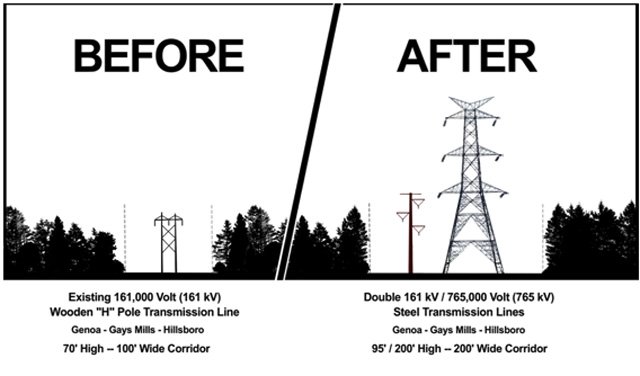
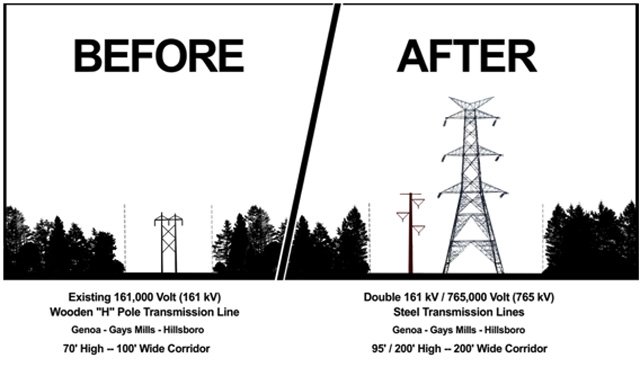
As proposed the project would co-locate a 765-kilovolt (kV) power line with the existing 161 kV power line.
The proposed line would use towers as high as 199 feet, substantially more than the current 70-foot high structures. The proposed project would also call for the expansion of the current right-of-way easement to be expanded from 100 feet to approximately 200 feet. If built, the 765 kV transmission would also carry six time more electric power than the largest transmission lines (345kV) now being used in the state.
Many local residents are apprehensive about the effects this massive transmission line would have on local residences, property values and the environment.
Dairyland explained that this project is part of a larger project identified by the Midcontinent Independent System Operator (MISO), a regional grid operator, to improve the reliability of the regional electric grid throughout the Upper Midwest. Beyond the proposed segment running from Minnesota through Genoa to Bell Center, further transmission lines connecting to the Columbia Substation near Portage and then moving south through the state into Illinois are envisioned.
Dairyland also claimed the project will help meet surging energy demand, unlock access to more energy resources and support the region’s economy.
“In December 2024, the Midcontinent Independent System Operator (MI-SO) included the MariBell transmission line in its Long Range Transmission Plan to enhance reliability, increase access to additional energy resources and help meet growing energy demand,” according to Dairyland spokesperson Eric Jacobsen. “The project is part of MISO’s larger proposed North Rochester – Columbia 765-kV transmission line.
“The proposed MariBell project, located between Marion, Minnesota, and Bell Center, Wisconsin, would help keep power flowing to homes, farms, and businesses throughout the region, support the region’s growing economy, and generate significant economic investment,” Jacobson stated. “In addition, the project would generate $30 million in state tax revenue in Wisconsin over the life of the project that could fund community services and public infrastructure.”
However, some people familiar with the project stated that no power from the new transmission line would be used locally. A substation needed to receive electrical power from the 765kV line and convert it to be run on the 345kV lines would cost about $62 million to build, according to those sources.
“At this time, we are in the early stages of the project and are analyzing various corridors to identify a proposed route,” Jacobsen stated. “The proposed route will be developed with input from landowners, environmental organizations, state and federal agencies, local governments and other stakeholders and interested parties. Ultimately, the Minnesota Public Utilities Commission and Public Service Commission of Wisconsin, after independent analyses and public input, will issue the final decision on the transmission line.”
Local residents and project opponents see things a bit differently. One thing that draws their attention is the sheer height of the structure needed to support the lines. The proposed structures to hold the 765 kV lines would be almost three times the height of the current towers holding the 161 kV lines.
Also, the project will require the acquisition of more private property to double the size of the right of way easement from 100 feet to 200 feet. This will mean some residences and businesses now near the edge of the right of way would fall into the new proposed right-of-way.
MISO Independent Market Monitor Dr. David Patton, from Potomac Economics, takes issue with many assumptions used to justify the project.
MISO’S estimated benefits are 257% larger than Patton’s, according to Rob Danielson, a local opponent of the current proposal.
In his analysis, Patton notes Potomac Economics has been consistently raising these concerns over the past two years and MISO has not addressed them.
Much of the criticism of the proposed transmission line questions some of the sources for the proposed electricity. Particularly, solar and wind, which are not as consistent in remote electric production as they are in nearby production. Some critics believe natural gas and other more consistent sources of power must be present in larger quantities to provide a reliable flow of power.
Critics also question the location of the transmission line so far from where the power will be used. These critics wonder why the users will not seek a closer, more accessible source that they can build and manage.
Aside from the expert analysis of project’s incorrect assumptions leading to a compromised plan, local residents also see problems with the very tall, super high voltage transmission line as proposed.
Danielson, who lives in the rural LaFarge area, could immediately count about 20 dwellings that would be affected by increasing the size of the right-of-way to accommodate larger transmission line. He noted seven would be much closer to that right of way and four would be located inside that expanded right-of-way.
Others like Jay McCloskey, who lives near the current transmission line as it passes through the Seneca area, questioned what it would be like living so close to the giant towers.
“Well what’s that going to do to the beauty of the area,” McCloskey wondered.
Others questioned what it would do to property values going forward.
Some question how safe having that much electricity that close would be for the humans and animals residing there.
“It’s just the wrong location for such a big, massive transmission line,” Town of Freeman resident Edie Ehlert said. “What I’m really hoping to see is Dairyland Power working transparently with the community and the people most affected by this.”
And there are certainly local people who are being affected by this.
Ellen Brooks is one of them. Her peaceful homestead in rural Gays Mills is located just 250 feet from the current transmission line for which there is a 100-foot right-of-way.
“People marvel how beautiful it is here,” Brooks said. “If it goes through, I don’t know. I don’t want to move, but… you know it will make noise. And, there’s always a chance of a tower falling over and just the scarring of the land it will take to erect this line.
“The (current 161 kV) line was there when we bought the land and we thought long and hard about it, but decided to do it,” Brooks recalled.
Incidentally, that original 161kV line will remain in service along with the proposed 765 kV line.
So, Dairyland Power is hosting an open house to discuss the MariBell Transmission Line on Thursday, November 20 from 4 to 6 p.m. at the Westby Community Center 206 N. Main Street Westby, WI 54667