By ASMAA BINT-KHALIL
Remember the Snow Bowl in Gays Mills. Much to everyone's excitement, in January of 1964, a ski hill site was leased from Opal Halverson. The site was a half mile south of Highway 131 on Opal’s Lane near the county fairgrounds.
The idea of the ski slope was the creation of Robert Carter. Thanks to his untiring efforts, work had been moving along nicely for the village’s newest organization.
Coach Ray Lacina headed up a volunteer crew of high school boys, teachers, and townsfolk to clear brush and trees from the slope to ready it for skiing.
A volunteer group from the Crawford County Highway Shop, led by Bob Irlbeck and Tom Welch, had been fabricating a power unit for Recreation Unlimited’s ski tow. When completed, this unit would be placed into operation on the ski hill site.
A seven-and-a-half horsepower electric motor was located at Harris Lumber Company the week prior, which assured a trouble-free power source to pull skiers to the top of the slope.
The Richland Grant Tele- phone Cooperative gifted telephone poles for the tow. Fay Grimm, co-op manager, dis- patched two men to the site to set the poles and install guy cables.
Seven hundred feet of one-inch, eight-strand, non-twist synthetic fiber rope for the tow was ordered. Frame-work material for the tow mechanism and power unit had been purchased, and two heavy-duty industrial gear-boxes were located, as well as a flexible coupling to connect the motor to the drive shaft. The Snow Bowl was going to have a rope tow.
All the legal work was accomplished by local attorney Jack Rath, and bookkeeping was put in the capable hands of Fred Goodsir. Harvey Sherwood mimeographed all the subscription forms, and Crawford County Independent’s Pearl Swiggum and Glenn Hagar were placed in charge of publicity.
On January 22, 1964, ski club officers were elected. Robert B. Carter was elected as a member of the Snow Bowl Board of Directors, along with Robert J. Irlbeck and Arthur J. Amundsen. Then, Carter was elected president, Amundsen as vice president, Irlbeck as secretary, and William C. Carrol as treasurer.
At the same meeting, it was reported that the tow mechanism was completed, and hopes were expressed for it to be placed into operation within a week.
On March 8, 1964, the ski tow made its trial run during the first appreciable snowfall of the year.
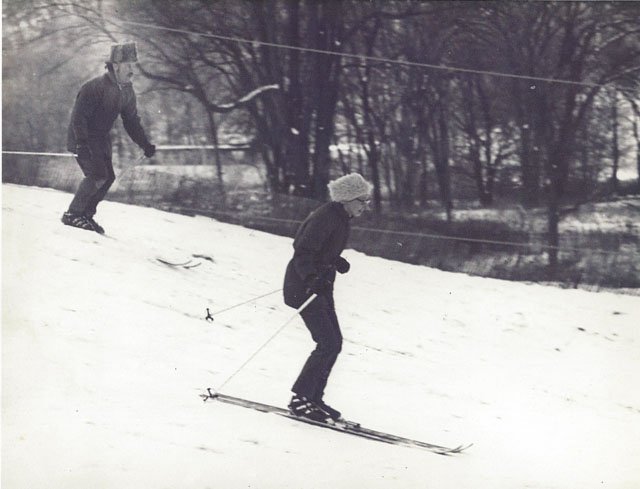
“It worked like a charm”, reported Carter. He and his daughter, Randi, had skied on the slope and tried out the tow.
When December of 1964 rolled around, a group of skiers including Robert, Mark, and Randi Carter, Kay Hines, Terry Kultgen, and Ronald, Jane, and Jennifer McKnight, tested the snow on the slope. They reported it to be in perfect condition and found the ski tow to be in good running order.
Carter said that if snow conditions remained good, the slope would be opened to the public on the weekend. Fees would be $1 for adults, 75¢ for teenagers, and 50¢ for children.
A ski club was even organized at the Gays Mills High School, with around 15 members.
A year later, in January of 1966, the ski hill’s business was booming. Open from 1 to 5 p.m. on Saturday and Sunday, Robert Carter offered a free snowmobile ride with the purchase of a tow ticket.
In November, Carter erected a Snow Bowl Ski sign along Highway 131, with another sign beneath it that read: ‘THINK SNOW!’
Local radio stations boasted about the ski slope, and so skiers were welcomed from Madison, Prairie du Chien, Ferryville, and Viroqua along with the usual local crowd. Ken Oftedahl of Oftedahl Monument in Viroqua said, “I haven’t been on skis for 17 years, but I had a ball!”
On January 10, 1968, a new ski lodge was con- structed at the Snow Bowl. Materials and labor were either free of cost or offered at a much-reduced rate. Local businesses and volunteers all pitched in to make the project happen. Over the summer, the ski slope was also much improved to make the skiing season especially enjoyable.
Many windows of the new ski lodge faced the slopes for a picturesque experience, and new luxuries were put in place, such as a telephone being installed free of charge by the Richland-Grant Telephone Cooperative.
The ski-lodge proved valuable for the Snow Bowl, as the next season seemed to be the most promising one yet, with skiers coming from all around to cut up the slopes. Snacks were sold in the lodge, and ski equipment was offered to rent for those who could not bring their own. Carter spoke of his hope for a bright future for the Snow Bowl, and the slope was dubbed ‘The Place to Go’.
Beginning ski classes were offered at the Snow Bowl, partly sponsored by the Southwestern Wisconsin Vocational and Technical School and partly by the Snow Bowl. Twenty-six adults completed the course in February and reported that they felt much more confident in their skiing skills. Carter taught a 12-hour evening course, spread over a three-week period. The course seemed to be very popular.
Dr. Louis Williams, one of the adults who completed the course, summed up its success by stating, “You know, I never thought I’d see the day when I wished winter would stay awhile longer. But this year, I’m gonna hate to see the snow go away.”
New facilities & restrooms were added to the Snow Bowl in 1970, proving to be much more easily accessible and comfortable than the previous outdated facilities. Also new to the slopes was the installation of a new and larger motor on the tow, and the cleared area was enlarged for the 1970 season.
New season membership tickets became available, which allowed members to not have to pay daily toll fees.
The biggest day at the slopes since its opening occurred on December 16, 1970, when 90 skiers showed up after a foot of snow fell in Gays Mills.
The Snow Bowl snack house began serving light lunches and hot beverages to fuel skiers after they spent the day on the slopes.
Jim Wubbenhorst was hired as manager at the Snow Bowl and reported a change in hours for the 1972 season. He stated that the ski hill was in good condition and had a natural snow base with the longest run at 1,000 feet. For advanced skiers, there was a 110-foot vertical drop at one place on the hill.
In 1973, the Snow Bowl opened for the season with four inches out on the slopes. Rex Whitaker and Lynne Eichinger from Aspen, Colorado had taken over as managers for the season and planned on offering lessons starting in January. A slope was dedicated to the purpose of sledding, and Eichinger and Whitaker spoke of possibilities of organizing a group interested in cross- country skiing.
Eichinger and Whitaker were some of the last people to operate the Snow Bowl.
“We rented some really funky skis and old leather boots,” Eichinger recalled.
“Rex worked outside with the rope tow and I worked inside and sold hot chocolate, pop, chili, hotdogs and potato chips,” Lynne said.
“I worked there one or two years, but I didn’t ski there,” Eichinger remembered. She subsequently gave up downhill skiing and began cross country skiing.
“The skiers were local people and a lot of young kids,” Eichinger said. She remembers a skier breaking a leg and a girl getting her long hair caught in the rope tow. There were warnings that skiers were not to have loose clothing or scarves that could get twisted in the rope tow.
Eichinger remembered some busy weekends and noted the hill had lights.
After a successful 1973 season, the 1974 season was welcomed with a weekend Open House. Season passes were raised to $30 for adults, $15 for those 15 to 18, and $10 for those 14 and under.
“The Snow Bowl ski area is your area, support it by making use of the fine facilities it offers” said Ron Forseth in anticipation of the upcoming event. “Several years ago, a group of interested persons set this up with one purpose in mind- to provide skiing at prices low enough so everyone interested could learn at a moderate cost. Why drive for miles to find recreation, when it’s right here at home?”
Although The Snow Bowl was put on a map that detailed all downhill ski areas of Wisconsin in 1977, as well as being featured in a Wisconsin State Journal article that listed all of Wisconsin’s ski slopes that same year, it seemingly faded out sometime in the late 70’s, presumably around the start of the season in 1978 or earlier.
Bob Carter’s son, Mark Carter, still lives in Gays Mills and remembers skiing at the Snow Bowl fondly.
The topic of the Snow Bowl came up again recently when Cory and Rachel Murphy bought 70 acres of the property from their family that owns the Opal Halverson property, which included the Snow Bowl.
Rachel approached the Gays Mills Public Library and then the Independent-Scout newspaper with questions about the Snow Bowl. Opal Halverson leased the property to the non-profit that ran Snow Bowl for nine or ten years. Cory Murphy is Opal Halverson’s great grandson. The area still has three springs like it did when it was used as the Snow Bowl.
Many local people still look back on the days the Snow Bowl was open with fondness. Sig and Marsha Chestelson spent lots of time skiing there as high school kids and young adults. Marsha remembered skiing every Wednesday, Friday and Saturday including a day when it was 20 degrees below zero.
“There were no sports for girls at the school,” Marsha recalled. “So, we skated on the sloughs, and we skied at the Snow Bowl.”
Kickapoo Orchard owner Bill Meyer was a big sup- porter of the Snow Bowl and used equipment from the orchard to help groom the ski hill. Bill’s son Andy loved skiing.
Andy recalls skiing at the Snow Bowl often as a young boy. He remembered building little jumps on the hill and breaking the tips on several of his skis on the hill’s jumps.
“There was almost always enough snow back then to ski,” Andy recalled.
“Now, it would be impossible,” Andy said. “There’s just not enough snow in general for most winters now.”
Most remaining ski hills, like Mount LaCrosse, use machines to make snow and that can be a costly undertaking.