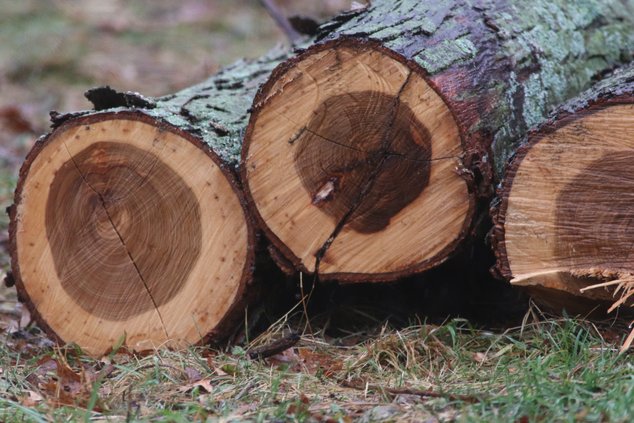
Tree species in deciduous forests of Wisconsin are diverse, but most have a common growth pattern and anatomy.
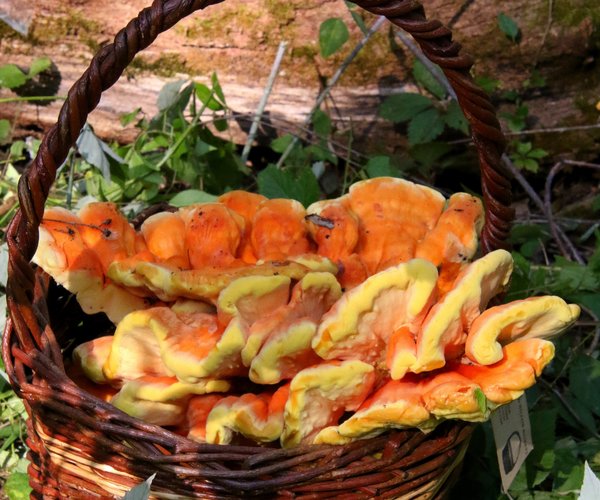
Learning tree anatomy can be helpful if a tree is used for firewood, lumber, tree-fruits, sap, shade, determining strength of a tornado, whether the bole will hold a tree stand, or yield mushroom fruiting bodies in spring or fall.
Trees have indeterminate growth in diameter and height, to a point.
Trees are perennial, but have general species maturity and age expectation.
For the most part, water is pulled, not pushed up a tree. Think about this when a Christmas tree is put in a stand or a sapling is planted or even if flowers are put in a vase.
A fence wire nailed to a tree’s trunk will not move higher as a tree grows, but is likely to become embedded inside the tree’s wood. Tying a tiny flag atop the tree tip will carry the flag upward for a short time as the tree grows.
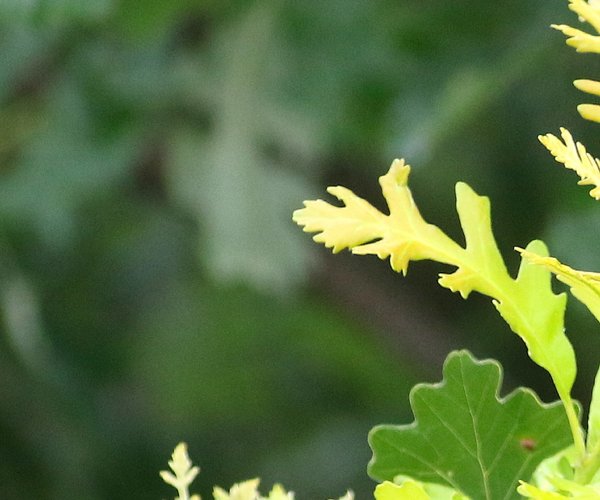
This means there are two general growing regions, or meristems in wood anatomists talk. The apical (tip) meristem elongates to give the tree more height. The lateral meristem, or cambium, gives the tree more wood and more bark increasing the tree’s diameter.
Both of these meristems are delicate and must be protected; the apical meristem by bud scales and young leaves and the cambium by the many layers of bark. The cambium is located between the wood and the bark. It’s most vulnerable to damage when most active in spring and summer.
Pruning the tip meristem results in more side branches, at least in deciduous trees. Evergreens react differently.
Bump a tree trunk with a lawn mower and the bark may pop off part of the tree. A tornado, even an F5, is not likely to pull the bark off a tree in November, but a tree hit by a June tornado may be bare of bark on the side hit.
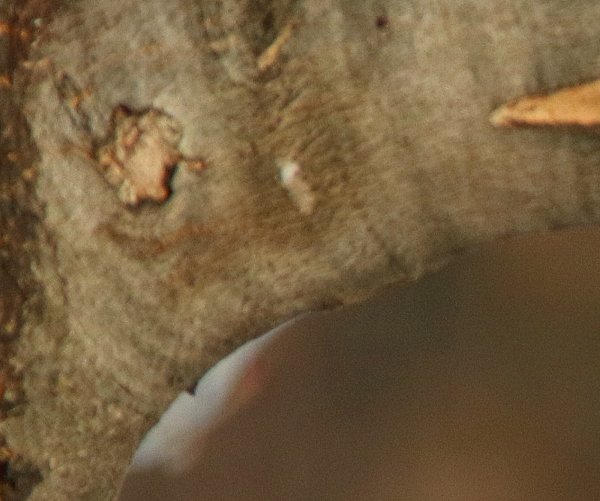
Different kinds of cells make up the wood and bark. Where did they come from each growing season? The cambium cells divided and multiplied and produced thousands of new cells inward and more outward but only the new cells produced inward remain there while the cells in the bark are pushed out and eventually die and are weathered away.
As a result a tree has more wood than bark,
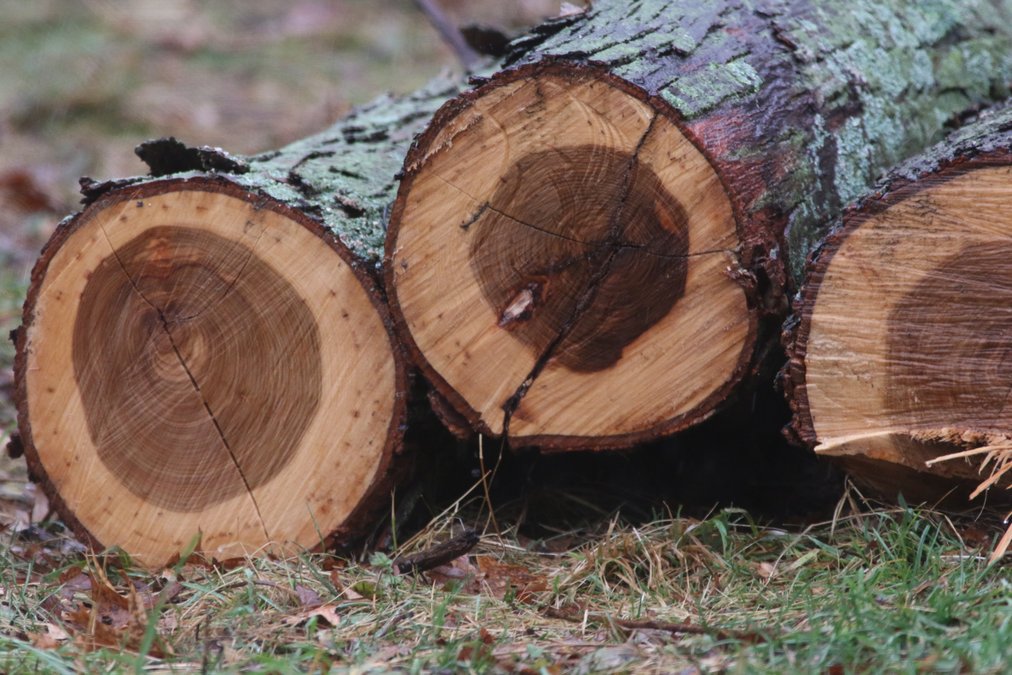
Counting the rings of cells in the wood can determine a tree’s age at that region. The oldest rings are toward the center of the trunk and the youngest near the outer region in the wood. Aging is opposite in the bark.
Only the layers nearest the cambium, wood and bark, are alive and function in moving water and nutrients up and down the tree. These wood regions are called sapwood. The darker, inner wood is called heartwood, and is dead but still supportive. Wood furniture generally shows both sapwood and heartwood.
A tree can be killed by removing the bark or sections of it because exposing the cambium will kill that growing meristem.
Tree wood has density (weight per volume); most wood floats because the density is less than 1. A log with more dense wood, oak for example, will float lower in a river than a pine log.
Wood’s heat value is directly related to density.
Wood can be decayed by fungi that digest away at the cells’ walls thus changing the density, weight, strength and whether a trunk or limb will hold an archer or a tree stand. Symptoms of decay are not always apparent in tree branches.
Chains or wire bands around a tree may kill a tree in time by strangulation. Nails and screws will injure a tree, become embedded in the tree but not kill it.
Not all cells in a tree are organized in perpendicular fashion making some wood, elm for example, very difficult to split as firewood but is still good for lumber uses.
Even a turkey hunter may find knowing tree anatomy helpful. Sitting and leaning against a pine tree may result in a coat becoming stuck to the pine’s resin oozing from the bark. White oaks do not produce resin.
In addition to selecting a tree to lean against April 15 when turkey season opens, hunters may want to get gear, clothing, land permission, calling tools, and decoys in line.
Bonus authorizations, permits, are still available in some zones and the latest time periods. Patron licenses purchased last year have now expired and need to be renewed to be able to print authorizations.
Jeff Fredrick, of Jeff Fredrick Design, Mindoro, Wisconsin, guides turkey hunters, mostly friends and relatives and sees shot misses, mostly turkeys standing at 20 yards, even during a can’t miss situation.
“Dedicated turkey shotguns are never really broken in like a hunting shotgun that is shot thousands of times,” he said. “These guns, most of them, were designed as a pull up and shoot with a hard trigger pull instead of a gun with a four-pound trigger pull. If the triggers were more refined these misses at 20 yards would be reduced.”
Trout fishing continues to get better. Greens are showing. Tree pollen is blowing in the wind, but don’t mistake evergreen pollen clouds for a forest fire. Spring tree pollination can be that intense.
With moisture and warmth, begin checking early morel sites. Watercress and chives are fresh and smelly. Pasque flowers bloomed for Easter Sunday.
Contact Jerry Davis, a freelance writer, at sivadjam@mhtc.net or 608.924.1112.