Squirrels sploot, plants wilt, corn and crabgrass make do with a special photosynthesis path, deer find backyard shade trees, birds bathe, rattlesnakes thermoregulate, and hogs wallow.
These are ways some organisms cope. Others live through it as best they can. Garden pole beans, however, abort their flowers when the heat is too much for pollen. Corn pollen, silk, and seed-development often struggle.
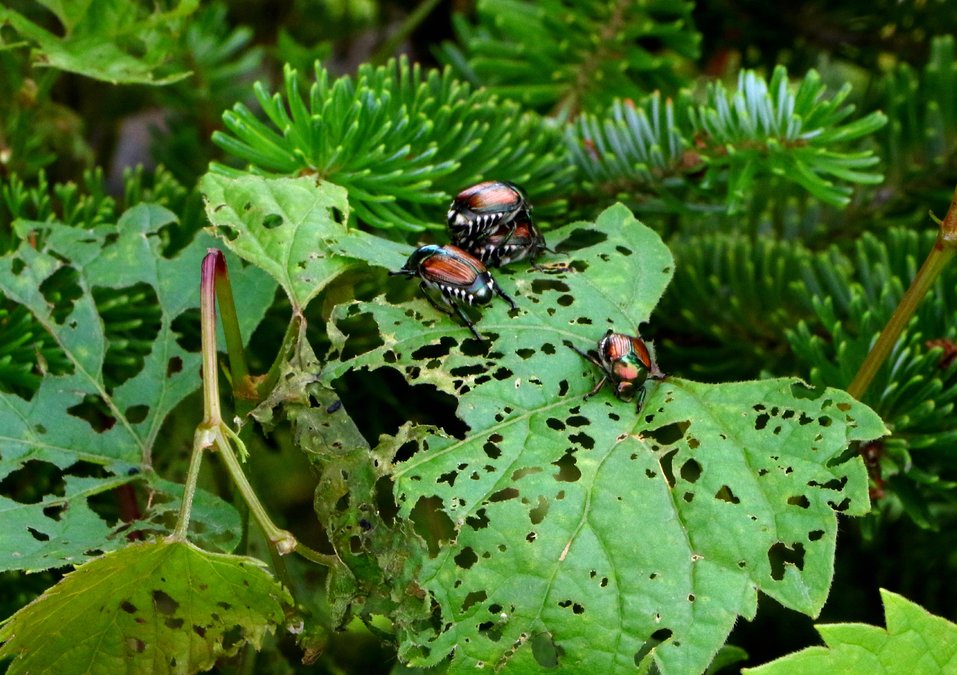
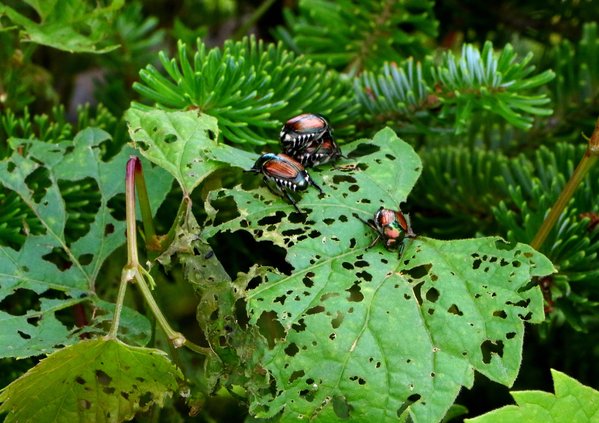
Heat-loving Japanese beetles munch on many plants’ leaves. Small gardens can often be saved by “picking” these and other beetles and bugs into small containers with soapy or bleach water.
Japanese beetles are easy to flick into a container held below the attacked leaf. Their escape technique is to drop to the ground, but will fall into the “poison” instead.
Light sheets can deter some of the sun and save the pollen and flower from “heat stroke.” When the air temperature highs drop the beans may recover, produce more flowers, giving rise to bean pod fruit.
Potato beetles and squash bugs can often be managed in a similar way to avoid using insecticides on food we are hoping to eat.
Ticks, even though not insects, come in contact with us silently and usually after it is too late the control their bites and possibly vector a bacterium into our blood stream. Lyme disease was so named for Lyme and Old Lyme, Connecticut, where it was first discovered and researched, hence it is properly called Lyme disease not lymes disease.
Wisconsin’s deer tick, also called black legged tick, is a carrier of organisms that cause Lyme disease and anaplasmosis when they exchange parasites (bacteria) for some of our blood.
Not all deer ticks are carrying the bacterium that causes this disease but some acquired the pathogen when they first “fed” on mice or deer that were Lyme positive and usually without symptoms. Those ticks that picked up the bacteria then have a likelihood of giving us the bacteria that causes the disease.
The good news is that even a carrier may not give us the pathogen. The tick usually must “feed” on us for longer than a day to infect us. Removing the tick before it gets its sucking parts into us is a good way to prevent getting Lyme or anaplasmosis.
That’s the tricky part for some methods are not helpful because burning or suffocating a tick with Vaseline may traumatize the tick to the point where it vomits the pathogen into us much like a hypodermic needle.
A better way is to use a fine tweezer or forceps and gently pull the tick out after grabbing it as close to the head as possible but with a gentle pull, not a quick jerk.
Another preventative for these diseases is to not go outside when ticks are most active. But how then can a person admire a beautiful mushroom, pick blackberries when they are ripe in two weeks, fish trout, or admire and photograph, beautiful prairie blooms or water lotus flowers?
I was walking a trail through an old cow pasture and noticed what I thought for a split second was a morel mushroom. With sweat dripping, the resemblance disappeared but the interest in what the new mushroom was hung tight.
Many mushrooms are difficult to identify. Most do not have a single character that says, puffball, sulphur fungus or shaggy mane mushroom.
By a unique cap covering I was able to match the mushroom with old man of the wood mushrooms. I was embarrassed when the source said, “Hardly any one is likely to misidentify this species after seeing it once. The wart-like patches on the cap….” a description went on to say.
Another character clue in this case is the cap has pores, not gills and turns orange, then black when cut. Sure enough, it did both.
I was interested in a name not a meal. The edibility statement explained that It is not poisonous but few people like it.
Not all insects that mess with our lives are real. Trout anglers use “flies” better called lures and they can resemble insects, frogs, mice as well as grasshoppers.
When the temperature highs dropped after a string of being in the 90s, Bret Schultz, Black Earth, Wisconsin figured the brown trout had had enough of the heat, too not having fed for several days.
He ventured out in nearby Black Earth Creek and had some fantastic catching and releasing for but a couple hours. “There was a cloud cover and with a couple different flies I had 40 fish, some 16, 17, and 18 inches. As soon as the sun broke through after several hours it was game over,” he said.
Schultz uses water temperature approaching 65 to stop fishing on days like this because catching and fighting a fish is too stressful on the fish. On hot days the better fishing is usually at dusk when the water temperature drops.
One of his best experiences on this day was catching a small trout on a fly that a large fish then struck at but missed. The small trout took the fly and the larger brown, 18 inches plus Schultz figured, came back and took the small trout but eventually let it go. Schultz was able to release the small trout to feed again.
Had enough of the heat? Go lean against a shade tree and feel the cool branches.
Contact Jerry Davis, a freelance writer, at 608.924.1112.