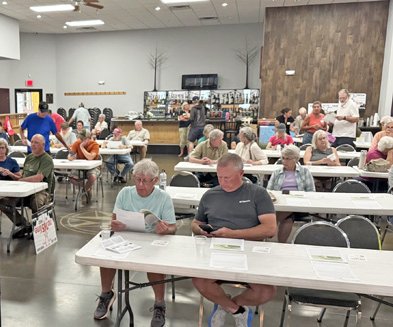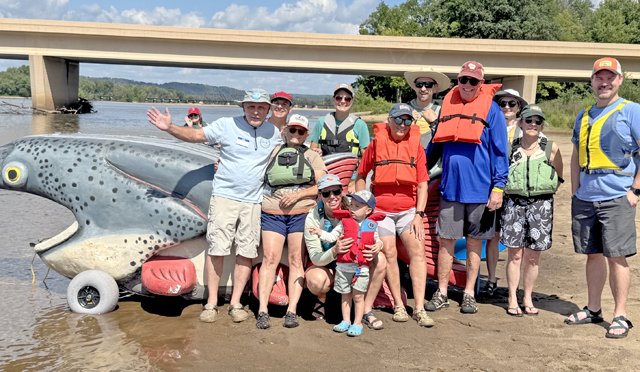
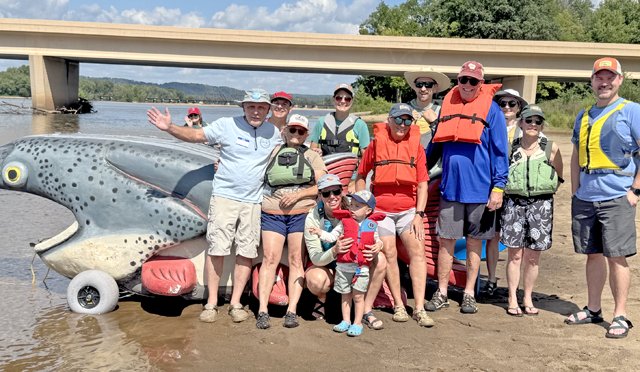
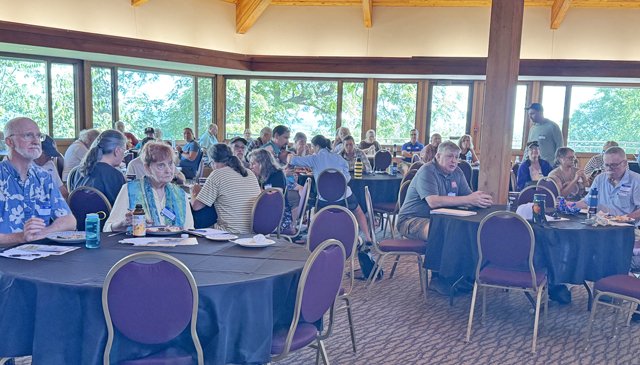
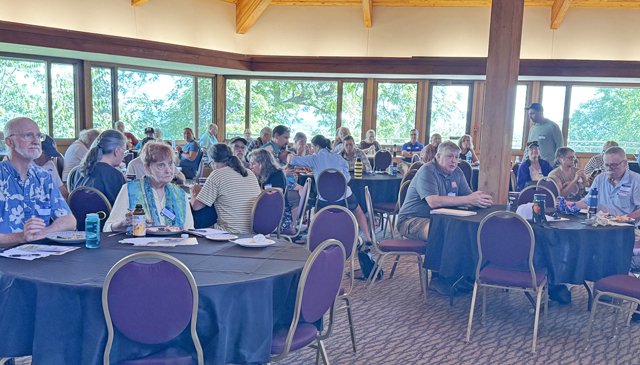
LOWER WISCONSIN RIVER - The Annual Meeting of Friends of the Lower Wisconsin Riverway (FLOW) was held last Saturday at the Wintergreen Resort in rural Spring Green. The event featured an interesting line up of speakers on land preservation, Riverway history, the 765 kV transmission line, mussels rescue, and commemoration of the 200th Anniversary of the Blackhawk War and the Battle of Wisconsin Heights. The meeting was followed by a paddle on the Wisconsin River.
Every year at the event, the FLOW Board announces the Youth Riverway Champion and Riverway Champion for the year. This year, Henry Cupp was named for the youth award, and Frank Doerre and Brian McGraw for the adult award.
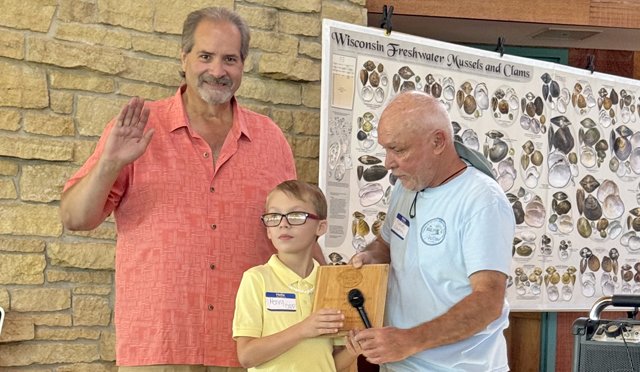
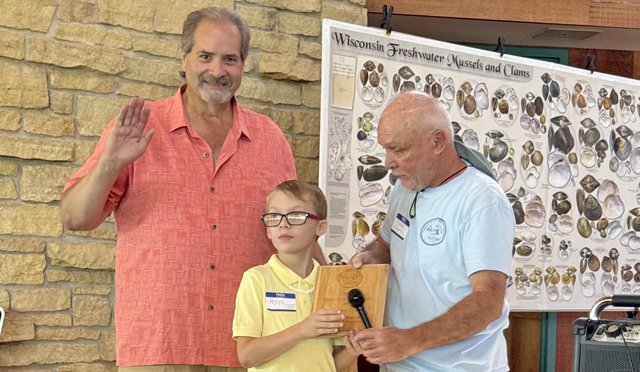
“Thank you for the award, and always remember to wear your life jacket when you’re on the river,” the young Cupp said.
FLOW president Timm Zumm pointed out that just the prior week, Henry Cupp had been seen out at the Fish Trap Flowage with his father Sam Cupp and grandfather Mark Cupp removing the invasive species purple loosestrife.
FLOW board member Allyson Skoien pointed out that another key initiative spearheaded by Henry Cupp with the Lions Youth Club of Muscoda was labeling all of the life vests used in FLOW’s ‘Kids Don’t Float’ life vest loaner kiosks up and down the Riverway.
“Our former Youth Riverway Champion, Grace McDougall, and a friend of hers reached out asked if we had something they could volunteer for. Allyson suggested the lifevest labeling project,” Zumm remembered. “Working with the Muscoda Lions Youth, practically everything we have now is properly labeled as a DNR loaner vest, with instructions to return it to the kiosk and the phone number.”
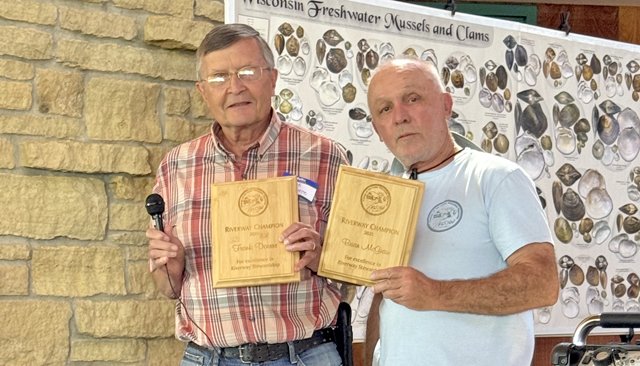
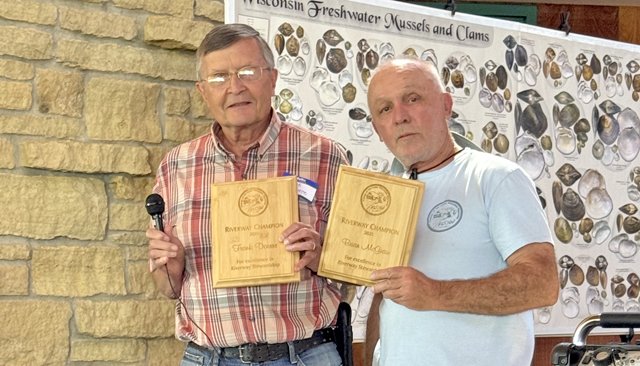
Frank Doerre and Brian McGraw, the two individuals sharing this year’s adult Riverway Champion award are both members of the Three Eagles Foundation Board, which stewards the Frank’s Hill effigy mound site. The two volunteer countless hours in maintaining and improving that site, and also volunteer with the DNR State Natural Areas Crew at their Blue River Sand Barrens site in the Riverway.
“I'm going to accept this award for Brian, who can’t be here today, and for everybody that has ever helped on Frank’s Hill with pulling weeds, spraying weeds, cutting trees and brush, and burning the hill in the spring or fall. This is something that needs to be done every year and constantly,” Frank Doerre said. “Brian is really responsible for how the hill looks today. He's got a vision that he's carried out throughout the years, and I can remember the very first time he asked me to come over and help him. He invited me to come over, get some fresh air, sunshine, and get a little work done. So I got over there, and we were poisoning sumac. I was working along, and I looked up from the bottom of the hill, and from where I was to all the way to the top was a forest of sumac. Just thinking to myself, there's no way that he expects to take all these out. Well, today they're gone.”
Doerre explained the reason the two of the them, and countless other volunteers, do the work.
“It's for the butterflies, especially the monarch. We've replaced everything on that hill that we've taken out with over 100 species of wildflowers and grasses,” Doerre explained. “The bees need the flowers, and we need the bees. If we don't have the bees, we don't exist. And this year was one of the biggest prizes for me, when I met somebody new on that hill. A little bird that comes up from Colombia and Venezuela, migrates all the way up to the Midwest Plains in search of a place to nest. This bird needs to be in a place where there's high grass on the prairie, and a lot of the prairies are gone. And this year, when I was up on the hill, I heard and saw at least three or four of these birds, and it's called a dickcissel, a bird you've probably never heard of before. The bird is about the size of a sparrow, has a breast coloration of a meadowlark, and belongs to the cardinal family. So that's just another reason that we are over there working on the hill.”
Bridget Rathman, an ecologist with the DNR State Natural Areas Program, leads management on all the state natural areas in the Riverway, and Grant, Iowa and Lafayette counties. She explained that the State Natural Areas Program in Wisconsin was the first of its kind in the nation. She said it began in 1941 when Aldo Leopold and other folks realized we have these benchmark areas that are still intact from pre-settlement conditions. They were concerned about losing them, and the need to protect them because they're special. She said that all the state natural areas protect rare species and biodiversity, and that her team is working to make them more resilient and to keep them into the future.
“All of you with FLOW and the volunteers that get out there and do something - you're in relationship with the land, and you're going to be a part of keeping that into the future. So folks like Henry can grow up and be here speaking someday to their grandson about how these sites are still special,” Rathman said. “Brian, in particular, I've had the pleasure of working with. He's awesome. He's willing to do anything. Two years ago, I became pregnant and didn't want to spray herbicide, so Brian and George Riggins did it for me, no questions asked. And Brian's also a committed member of our prescribed burn team, so there have been plenty of burns that wouldn't have happened without Brian, where we needed just one more person to round out our crew to legally be able to do the burn, and Brian is always willing to step in.”
DALC protection
Given the meeting took place at the Wintergreen Resort, a 250-acre property in the Riverway with a mile of river frontage, Kyle Adams with Driftless Area Land Conservancy took the opportunity to tell meeting participants about all the exciting things DALC is involved in.
Adams said DALC had acquired the Wintergreen property in December of 2025, and has been working on a plan for the property and the Frank Lloyd Wright style building since then.
“I was brought on specifically to pilot an events program here in the Wintergreen building itself, and our team is currently mowing trails. The most exciting thing is that we will have a three-mile trail loop here at Wintergreen that will be open to the public by mid-to-late September. We’ve also had a number of retired DNR biologists coming out to the property that have been helping us to manage and gather data, which is allowing us to evaluate the land. We’re currently putting together a full land management and restoration plan, which will allow us to focus our energy on the rest of the property.”
Adams said that a recent full assessment of the building, used sporadically over the last few decades, has revealed that it is in exceptionally good shape for its age and deferred maintenance. She said they’d be moving forward with deferred maintenance on some water issues, and planned to replace the patio exterior terrace and railing. That patio offers a breathtaking view of the Wisconsin River Valley.
Riverway history
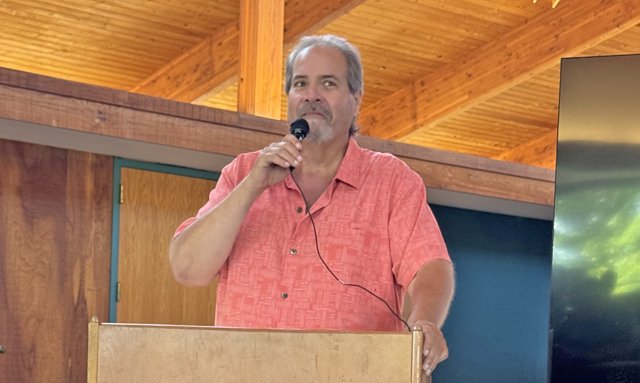
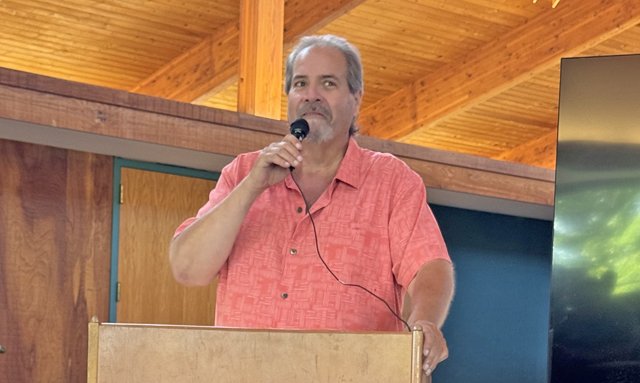
Mark Cupp, Executive Director of the Lower Wisconsin State Riverway Board for the last 37 years, discussed the history of the Riverway, event highlights, partnerships, and plans to celebrate the Riverway’s 40th Anniversary.
“I've got goosebumps up here thinking about how this property and this building are now Driftless Area Land Conservancy owned. It's certainly been a visionary dream of mine for a long time, and here comes DALC, a knight in shining armor on a white horse, to save the day. It is an amazing property with so many different types of habitat and a mile of shoreline, and now it will be protected. I’m looking forward to a bright future for this property,” Cupp observed. “The Riverway is approaching its 40th Anniversary in just a couple of years, and we have a lot of things planned for that 40th. With Dave Gjestson here today, I think we’d both say that back when this started, no one knew if it would last four decades, or even two score, and we’re on the cusp of that.”
Cupp said that the 13 voyageur canoe trips with 140 people had once again been a great success and a popular program. He highlighted the Solstice and Equinox observances at Frank’s Hill, and the growing cultural presence of the Crosscurrents Heritage Center in Richland County.
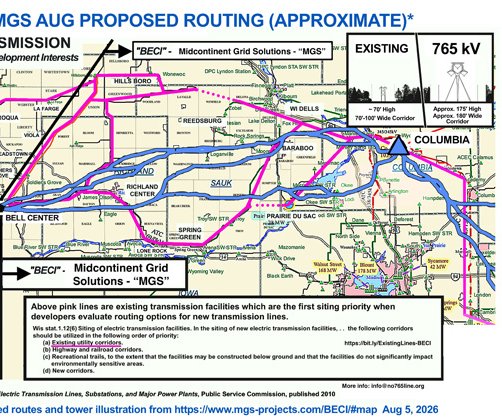
“The last thing I really want to focus you on is this 765 kV transmission line that would go through the heart of the Driftless region. Some people call it the ‘Becky’ line (BECI),” Cupp said. “If built, it would really devastate the heart of the Driftless Area in Vernon, Crawford, Richland, and Sauk counties. So, please self-educate yourself on that. There'll be a variety of open houses coming up, and it's something that is going to have a dramatic impact on our landscape.”
Science team
Jean Unmuth represented the FLOW Science Team at the event, and made a report to the members. She said the team had recently concluded their eight-year fisheries project stocking Lake Chub Suckers and Starhead Top Minnows into various areas above the dam at Prairie du Sac, and in other areas in the Riverway. The fish were raised in a pond on FLOW vice president Dave Marshall’s property.
“This past June, we completed a conservation aquaculture project designed to establish state special concern fish above the Prairie du Sac Dam. The project allowed us to establish these species at four different locations around Lake Wisconsin and as far north as Duck Creek in Columbia County,” Unmuth detailed. “We did document overwinter survival, but we don't know if it is sustainable at this point. And this year, we stocked 289 Starhead Top Minnows and 344 Lake Chub Suckers in Dallas Slough, and in Lodi Marsh. We stocked the remaining fish we had below the dam in a pond close to Blackhawk Ridge that we call Singing Bird Pond.”
Unmuth thanked DNR’s Tim Cougar and Brad Sims for assisting in removal of the fish from the rearing pond, and all the other volunteers that have helped over the years. She remarked that now the Science Team will have to find a new project to work on – perhaps the 765 kV transmission line.
Transmission line
Sauk County board supervisor Gaile Burchill from District 24, representing the Village of Spring Green and Ward Three of the Town of Spring Green, spoke about the proposed 765 kV transmission line.
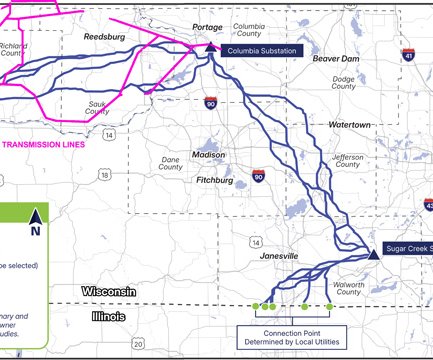
“I'm not an expert by any means, but I've been following it for a couple of months, and it's now reached Sauk County,” Burchill said. “I went to the meeting Wednesday night at the Baraboo Library, which was primarily for landowners. The No 765 Line opposition group, which has been very active since it got started down in Vernon and Crawford counties, put the meeting on to prepare landowners for the open house that's going to be in Baraboo on Tuesday. So, if anyone has any questions, I want to let you know that you can be in touch with me. My contact information is on the Sauk County website. There are five open houses this coming week in Sauk, Columbia, Jefferson, Dane, and Walworth counties.”
Burchill recommended that interested citizens and potentially impacted landowners go to the https://no765line.org/take-action/ website, and consider signing up for the No 765 Line groups e-newsletters.
“They have a lot of information. Start communicating with the community that's already in place - they have a lot of information that people could use,” Burchill said. “There's no guarantee we can defeat this, but if we don't all get involved and participate on a regular basis, we have no chance. So, it's going to take all of us, and it's going to take some time and patience and participation. So, I'm just here to let people know that now is the time to get involved and educate yourself and participate.”
Knowles-Nelson
Seth Taft, Executive Firector of Friends of Wisconsin State Parks, attended the meeting, and advocated for people to let their legislators know that renewing funding for the Knowles-Nelson Stewardship Fund matters to them.
“You know about FLOW, but there's over 65 other friends groups sprawled across the state, associated with state parks, state trails, forests, and recreation areas,” Taft emphasized. “All of them, just like FLOW, are dedicated volunteers, stewards, champions that advocate and do a lot of preservation work, advocate for the habitats, and get people to come out and explore and be curious, from the young to the young-at-heart, and inspire the next generation. Knowles Nelson Stewardship Program is now gone dark at the beginning of July with a new biennial budget. It's not dead. It's just got no money behind it. So, this election year is really critical to advocate for a beloved conservation program that is supported in different ways, from land acquisition to land management, especially the state park system, the river shed, everything.”
Taft said his group has a conservation action policy summit taking place, and it's a coalition from state park reps, our state park system affiliates like Friends of Wisconsin State Parks, conservation, wildlife, hunting and fishing. He pointed out that in conservation funding for Wisconsin, the state now ranks 49th out of 50th, yet ranks eighth in terms of overall economics.
“We know that these spaces, those wonderful locations, they bring so many people together. They inspire us to do more and do good. They bolster our local economies through tourism, and they motivate people to learn and want to go out and be the next generation to take care of these habitats. So, we're working together cohesively to really educate and advocate to our legislators. Get behind us. Get behind conservation. Get behind these spaces that do so much for you,” Taft urged.
Crosscurrents
Ben Moffat, fifth generation descendant of Richland County’s first European settler John Coumbe, was at the meeting to talk about the Crosscurrents Heritage Center Initiative. Located at the Coumbe farm near Blue River, the property has been converted to a cultural and heritage center, offering regular cultural and educational events.
“It's a new, three-year-old non-profit, located at Tippesaukee Rural Historic District. It's on the National Register of Historic Places because of Native American village sites, as well as the first Euro-American settler in Richland County,” Moffat explained. “We're putting on events in the spring and fall, and these events tend to be experiential. We try not to have just somebody up there talking. We try to have music, food, hands-on things. This autumn, we’re offering Fall Foraging with Abby Layman, the kitchen gardener at Taliesin and a foraging expert. And, we’re going to have down home storytelling with music this year and tours of the old house. This next weekend we have Mark Cupp and me giving talks at Blue River Autumn Fest, as well as Casey Brown having a panel with Ho-Chunk artists. The other thing we do now is school field trips, working with fourth graders and high school students.”
To learn more, and sign up for events, go to: https://crosscurrentsheritage.org/
Mussel rescue
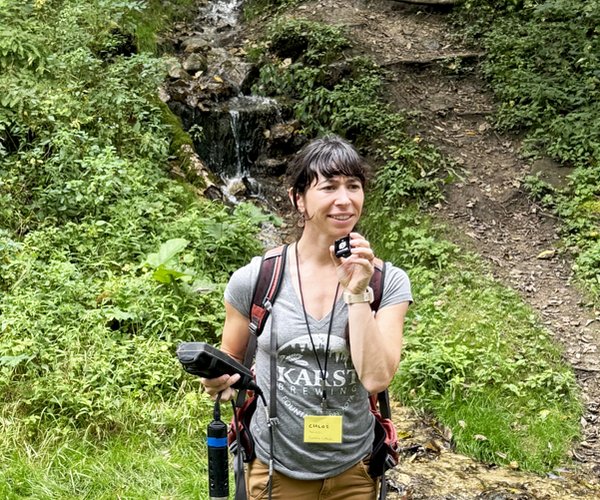
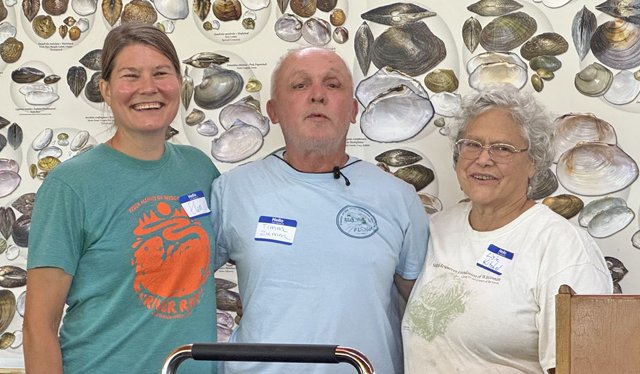
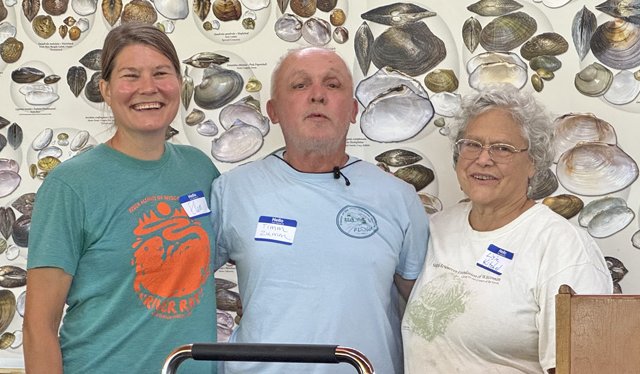
Lisie Kitchel with DNR Natural Heritage, a renowned mussel expert, and Ellen Voss, Climate Resilience Director with River Alliance of Wisconsin, addressed the group about low-water conditions on rivers around the state, and the plight of mussels.
“There are 50 species in Wisconsin, and 40 of them occur in the Lower Wisconsin Riverway, which is pretty amazing,” Kitchel told the group. “They're very important ecologically, and each mussel can filter 10s of gallons of water per day. That means that if you have a mussel bed with 10s, hundreds, 1,000s of mussels, which in the lower Wisconsin River we do find, then they are filtering that water and turning that water over.”
Voss emphasized that across the state, reports are coming in of low-water conditions in the drought-stricken parts of the state, where mussels are in danger the way they were in the Lower Wisconsin in 2023.
“Talks are happening in the Department of Natural Resources about low water levels, not just here but all over the state. We've been a little bit insulated in the southwest part of the state, but in the northern parts of the state, they're experiencing some extreme drought situations and having really hard conversations about what happens to the water,” Voss explained. “Friends of the Lower Wisconsin Riverway created the Mussel Rescue Network for the Lower Wisconsin River, and the model that you created here is something that we're hoping to mimic statewide. So we're getting calls from groups, volunteers, individuals all over the state - the Chippewa, the Black River, Flambeau, and the Saint Croix have all let us know that they're experiencing mussels getting stranded along the banks of their rivers. And hey, do you have any tools and resources? And how do we do this? And what do we do? Everybody's panicking, and so at least we have this great model that you guys came up with that we can share with people.”
Blackhawk War
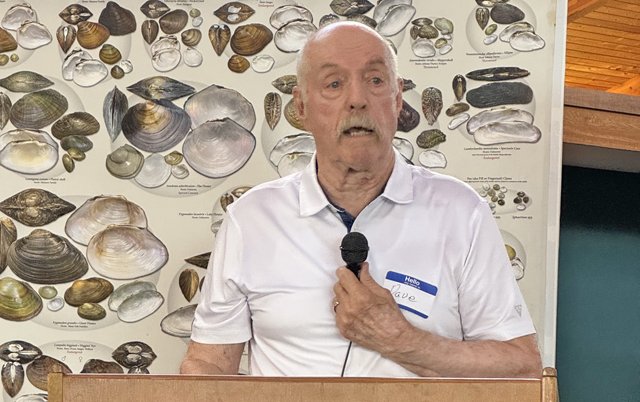
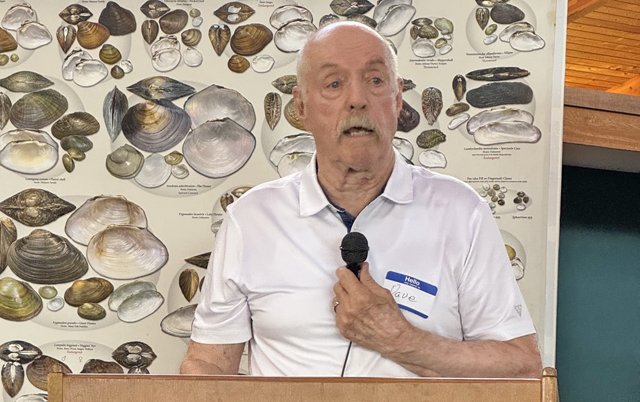
Dave Gjestson, first (and only) Riverway Coordinator with Wisconsin DNR, and Dr. Patrick Jung, discussed their plans to stimulate interest in a 200th Anniversary of the Blackhawk War, coming up in August of 2032. Gjestson, in his role with DNR. was responsible for the acquisition of the Wisconsin Heights battle site in the Riverway.
“Thirty-three years ago, my team drafted a property management plan for the Wisconsin Heights battle site. There were three simple objectives. One is to restore the vegetation to what was there in 1832 when the battle was fought, which is Oak Savanna. Second, we want to develop a trail system to all the significant battle locations. And third, we want to develop a public educational program featuring a self-guided trail,” Gjestson explained. “There was no dedicated Riverway work crew to do the work, so I sweet-talked DNR along with FLOW volunteers to work on-site for a three-year period, and we barely made a dent. I retired in 1999, and I left the area, lost track of what was going on, but I came back in 2022, and I was kind of surprised there hadn't been much done out there. I looked into it, and I’ve got to tell you a few things about this multi-million-dollar agency. DNR has lost 500 positions in the last 20 years, resident hunting and fishing licenses that fund half the agency haven’t been increased since 2005. There's an annual decline in hunter numbers. Why is that important? Because hunters buy licenses, and that license number attracts federal dollars, and as the license sales go down, there’s less federal dollars. So another hit.”
Gjestson pointed out that the boundaries of the Riverway includes 100,000 acres. He said that if this was a park, there'd be 50 full-time workers out there, and a work crew probably in every county along the river, not one dedicated worker.
“They add the work for the Riverway as a collateral duty to all the functions in fish, wildlife, law enforcement, forestry, and the Tower Hill Park Superintendent provides oversight, but there is no work crew,” Gjestson pointed out. “But I also learned that there was a Madison philanthropist that recognized the important historical features of this battle site, and he came up with money that has funded the work that's being done there for the last several years. The State Natural Areas program has such a crew, and while there are plenty of natural areas along the Riverway, and over 100 natural areas in the South Central region, they've agreed to do the work because of the private funding, and we've scheduled work there this fall.”
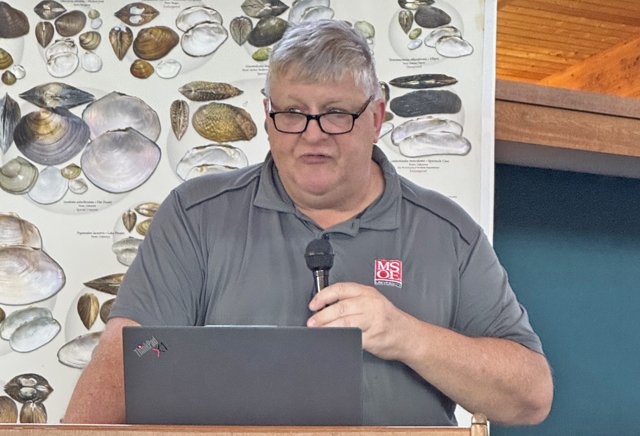
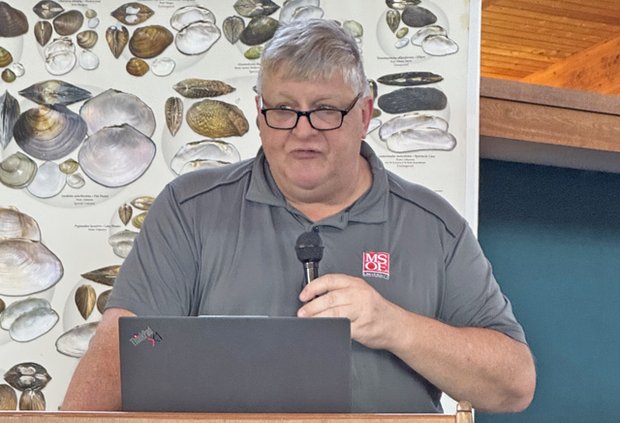
Dr. Patrick Jung is a professor of history and cultural anthropology at the Milwaukee School of Engineering. He's written two books about the Blackhawk War: ‘The Black Hawk War,’ and ‘Battle of Wisconsin Heights: Thunder on the Wisconsin.’ He's has also given several lectures on this topic in recent years, and led tours at the Battle of Wisconsin Heights site.
“The Black Hawk War started in the spring of 1832. It lasted only two-and-a-half months. For the most part, what it consisted of was the U.S. Army chasing Black Hawk and his about 1,100 followers through northern Illinois, southern Wisconsin, and there were lots of little battles,” Jung explained. “There were only three major battles of the Black Hawk War. A battle at Stillman’s Run in Northern Illinois; the Battle of Badaxe, which was fought along the Mississippi River in Vernon County that was the final battle; and in the middle of the war was the Battle of Wisconsin Heights, which was by far the most important battle, the most dramatic battle, and the one that had the most the most significant consequences on the outcomes.”
Jung explained that at Wisconsin Heights, there was a native commander Blackhawk, who commanded the Sauk and Meskwaki warriors, and another commander, commanding the Kickapoo warriors at the site. Blackhawk commanded, including the Kickapoo, only 120 warriors, facing Henry Dodge’s 650 militiamen – no regular U.S. Army troops were present at the battle.
“Black Hawk was trying to get across the Mississippi, and get his people to the safety of the west side of the river. He was being hounded by a militia army for the better part of two months. Dodge's forces actually caught up with him at the Wisconsin River as he was doing a river crossing, trying to get his people across the Wisconsin River to put that between his people and the militia,” Jung explained. “Dodge's scouts made the initial contact probably about 5 p.m. It was a relatively small lead element, and Blackhawk’s warriors pushed them away from the crossing site, and the militia settled on a small ridge called Militia Ridge. For the next hour, other militia units who were close behind begin to show up at the battle site, and as they showed up, they began to fill up the whole ridge.”
Jung said that Blackhawk only intended to fight the militia for as long as it took his band of women, children and the elderly to cross the Wisconsin River.
“For two hours, Blackhawk managed to hold them off, which was an incredible military tactic in itself. Then, he said, "okay, well, that's all I need to do. I just need to keep them in place until all my people cross,” Jung shared. “Probably toward about 7 o'clock, Black Hawk decided that his people were across the river, and he could withdraw his warriors and get them across the river,” Jung narrated. “That's about the same time that Dodge took his 650 militia and ordered them off the ridge into the ravine between Military Ridge and Blackhawk Hill to charge the retreating warriors. That, I believe, was the most lethal part of the battle.”
Jung said that historians have four really good descriptions of the battlefield after it was over. The next morning, Henry Dodge wrote that he said the numbers of killed cannot fall short of 40, and perhaps many more. His direct subordinate, James Henry wrote that the dead are scattered over a large tract of country, covered with thick woods and high grass. He wrote that between 30 and 40 have been found, and others are continually being discovered by scouts.
“We get better accounts from the native people, and there is quite a lot of native testimony. There was one woman, who basically was captured after the end of the war. She was half Sauk, half Menominee. She told the U.S. Army that 68 people had been killed at the Battle of Wisconsin Heights, and from that point on, it basically became the official number that you see repeated in a lot of other sources, Jung said. “The local Indian Agent Joseph Street said 68 had been killed. The theater commander Henry Atkinson said 68 had been killed, and one militiaman James Wakefield said the same.”
Jung said that of the 68 reported killed, 25 were described as wounded and “dying soon after the battle.” He said it’s likely that warriors carried their wounded and dying across the Wisconsin River to be interred north of the river, along their path toward the Mississippi.
“Until we make some real concerted effort to locate all the human remains on both sides of the river, we're never going to know 100% how many died,” Jung observed. “What needs to be done? Well, first of all, I want to raise awareness of battle and the story of what transpired there, we need to work with Native communities, Sauk, Meskwaki, Kickapoo, and Ho-Chunk, to conduct a search for human remains, or at the very least, plan commemoration activities.”
Jung said there should be additional archeology, with an emphasis on finding those human remains. Then there is a need to develop a multi-organization planning commission for the battle's 200th anniversary.
“That's why I'm here today, and I'm going to say it's not a celebration. There was a lot of needless loss of life in this war, but there needs to be a commemoration. There needs to be an understanding that there are human remains that were never properly interred, and a moral imperative that a deceased human needs to be treated with respect. That did not happen for the 68 native people that died in this war.”
For those interested in supporting this effort, Gjestson and Jung can be reached at:
- Dave Gjestson: dgjest-son@gmail.com
- Dr. Patrick Jung: jung@msoe.edu.