DRIFTLESS - Citizens opposing construction of the state’s proposed largest transmission lines through the Driftless Region - MariBell and BECI 765 kV lines – have continued to work with potentially impacted landowners and municipalities.
In the last week, Seneca and Haney townships in Crawford County passed resolutions stating their opposition to the line being built through their towns, as did the Village of Ferryville. In Seneca, 36 citizens attended the town board meeting to express their concerns, and ask the board to pass the resolution.
The Town of Clayton adopted an information request resolution, asking the developers for maps and other information to better understand how town citizens would be impacted by the line.
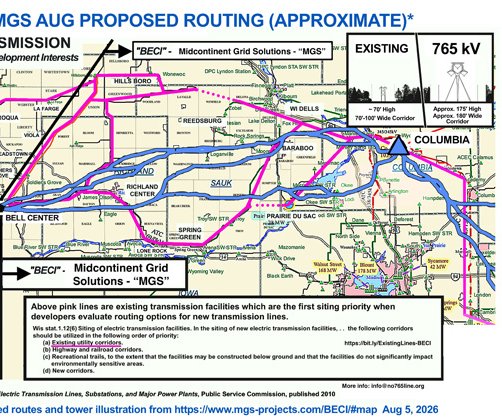
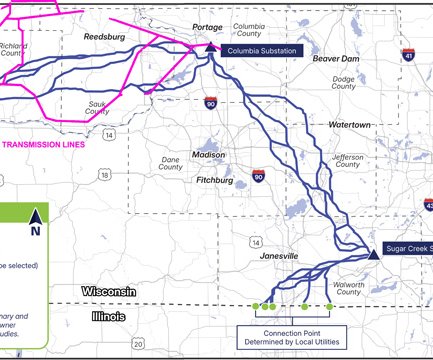
Perhaps most significantly, the activity has shifted to the east into Richland County with last week’s announcement by BECI developers of their intent to submit an application for the 190-mile line, to run on an unspecified route through eastern Crawford, Richland, Sauk, Columbia, Dodge, Jefferson and Walworth counties.
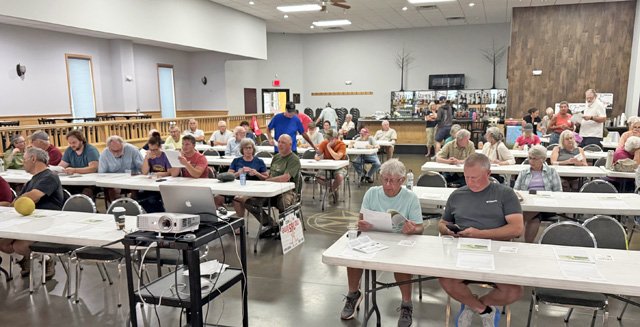
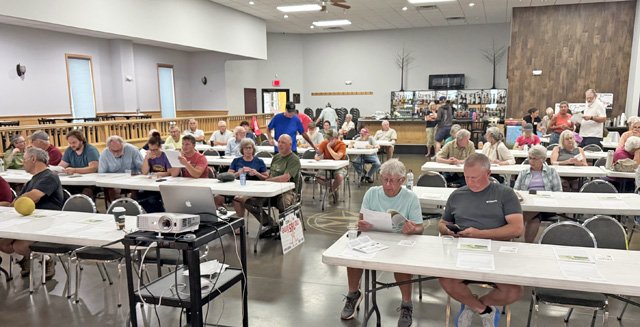
On Thursday, July 16, 120 Richland County residents gathered at the Phoenix Center in Richland Center to learn more about how their land and communities could be impacted by the proposed line. No 765 Line educators Rob Danielson and Tennille Osthoff addressed the participants.
Danielson explained the history of energy market deregulation in Wisconsin, that energy companies make money by putting steel in the ground, that energy demand has been flat in Wisconsin between 2004 and 2024, but that has not stopped construction of new transmission lines. Energy profits have outpaced inflation by 300% in the same timeframe, and that the cost of these transmission lines is borne by ratepayers, whose costs have gone up 30% faster than inflation.
He explained that the Midcontinent Independent System Operator, which runs the energy market that includes Wisconsin employs Dr. David Patton as an independent analyst.
Patton has condemned the current plan put forward by MISO as unrealistic, because it calls for construction of $234 billion worth of new power plants, including large-scale wind and solar. Patton said the plan is unfair to the ratepayers, and that the money would be better spent helping homeowners and businesses become more energy efficient.
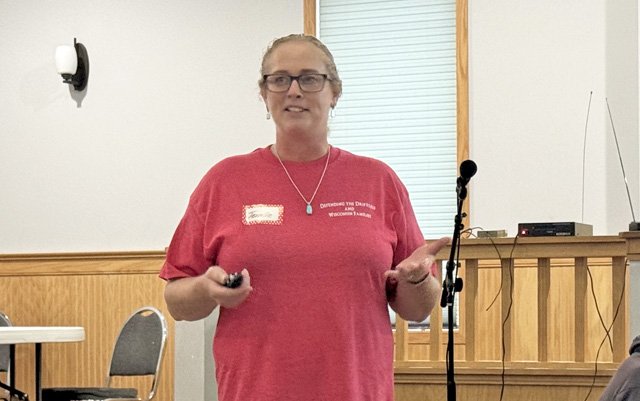
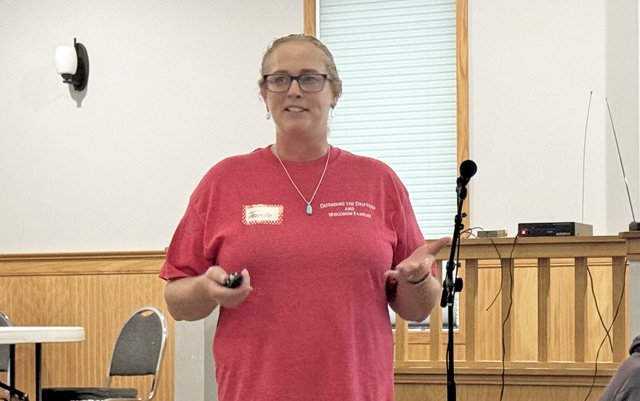
Osthoff explained that other lines had been stopped in other parts of the country, especially by “intense landowner opposition.” She encouraged citizens to speak up, attend town and county board meetings, call their legislators, and write letters to the editor for their local newspapers.
“When your parents or grandparents signed giving the utility company a transmission line easement on their property, they didn't know that this was what was going to happen,” Osthoff observed. “They will run over us if we don't speak up.”
Process matters
Danielson contrasted the approach the MariBell and BECI developers are taking compared to that employed by developers of the Badger-Coulee or Cardinal Hickory Creek 345 kV lines. He particularly emphasized that with BECI, developer Midcontinent Grid Solutions (composed of American Electric Power, Transource and Berkshire-Hathaway Energy) is only allowing seven months for the ‘public information phase’ prior to filing their application with the Wisconsin Public Service Commission.
“I'm going to talk about the problems that are created by the developer in proposing a seven-month public information phase. The public information phase for Badger-Coulee and for Cardinal Hickory Creek were in excess of three years long, and I'm going to talk about why it is necessary to have a long public information phase,” Danielson told the group.
Danielson told the group about his experience with American Transmission Company in the three-year public information phase for the Badger-Coulee line. He said that in that process, along with the initial announcement of the project, they mailed to 120,000 potentially impacted landowners, with personal invitations to eight planned open house events. On the back of the invitation was a map showing all of the existing transmission line easements in the municipality where the landowner’s property is located.
Then, they followed up with another mailing to 147,000 potentially impacted landowners, with a more close up map of existing transmission lines. Then, they did a third mailing after they began to narrow down their preferred and alternate routes, and started meeting with landowners one-on-one. Then, 20 months after their initial announcement, they did a fourth mailing to a narrowed down group of potentially impacted landowners, with parcel specific maps.
“For the third year of the public information phase, they went out and met with landowners and transmission siting engineers who know how to site transmission lines, to have conversations with landowners about adjustments that would reduce impacts for them,” Danielson explained. “So, they went out for one year after they had the preferred and alternate routes, they met with landowners and they resolved lots of things. Can you imagine how much time it took for all those siting engineers to meet with a 200-mile transmission line to work out all of those things one by one by one? A lot.”
Danielson pointed out that in order for BECI developer Midcontinent Grid Solutions to provide the same number of open houses that ATC did for Badger-Coulee, they would have to have an open house every three weeks in seven counties, and that would not even include the opportunity to meet with the siting engineers.
“Their website says they're going to have next steps, but they don't say for what. There are no meetings with transmission siting engineers or anything remotely like that mentioned,” Danielson pointed out. “We're in the early stages, and I say we're not providing nearly enough time to even get part of the job done that the Public Service Commission requires of developers.”
Richland County
In April of 2026, as recommended by the Natural Resources Committee, the Richland County Board of Supervisors passed an information request resolution. That resolution was then mailed to the developers.
Then, out of the blue, a communication addressed to the County Highway Commissioner and County Conservation Director from a representative of HDR, Inc. arrived on June 17. The communication explained that HDR, Inc. is employed as a subcontractor/consultant for the BECI developer. An introductory meeting was requested to initiate communication with county staff.
On July 9, county board members attended the requested meeting, where two Midcontinent Grid Solutions (MGS) employees, a communications specialist, and a technical consultant showed up.
According Supervisor to Steve Carrow, chair of the Natural Resources Committee, the MGS employees were unaware of the information request that had been sent to them from the county, and were provided with a copy of it.
The matter was then taken up at the meeting of the Richland County Executive and Finance Committee meeting, where Carrow was assigned to be the point of contact for MGS with the county. As a result, the transmission line topic was added to the agenda for the July 21 meeting of the Richland County Board of Supervisors.
Citizens attending the July 16 landowner education event in Richland Center had heard that the meeting between some county board members and MGS had taken place, and expressed concerns about the public transparency of that meeting. They encouraged citizens to attend the July 21 Richland County Board of Supervisors meeting to let the board know about their concerns with the proposed line.