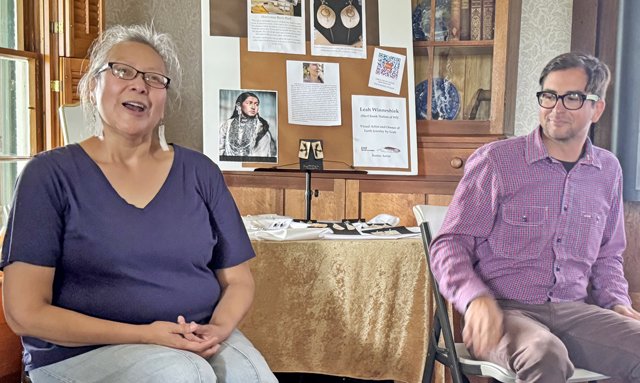
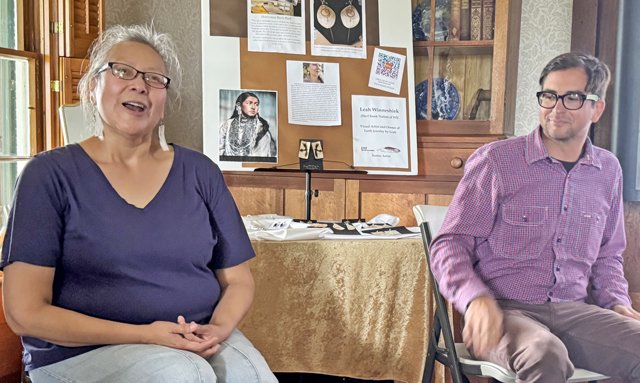
PORT ANDREW - On August 29, the Crosscurrents Heritage Center in rural Port Andrew offered an ‘Artists in the Farmhouse’ event. Featured were two artists who are Ho-Chunk, both from the Thunder Clan. Those artists were Leah Winneshiek and Chloris Lowe.
The discussion was moderated by Casey Brown, an award-winning Ho-Chunk filmmaker. Casey Brown earned an Emmy Award for a short film he produced, ‘Exploring the Artistic Process of Truman Lowe: A Journey Through Native American Art & Education.’
Truman Lowe was a sculptor, woodworker and member of the Ho-Chunk Nation. His artistic works were rooted in Native culture, and showcased the natural world by combining traditional woodworking with more modern techniques, pushing the boundaries of modern art.
“In case you don't know who I am, my name is Casey Brown. I've come here a couple times to talk about Indian Mounds and the ‘Indian Mounds in a Year’ film that I'm making with Julia Pello. We've been filming up and down the Wisconsin River a lot at Muscoda and Frank's Hill,” Brown told the group. “I was asked to be here today to moderate the ‘Artists at the Farmhouse’ discussion. We have two artists here today - Leah Winneshiek and Chloris Lowe.”
Brown provided what he called ‘Ho-Chunk Art Cliff Notes,’ about the different eras of the nation’s art.
The first era is the ‘Mound Building Era,’ which Brown explained began as conical and linear mounds, and evolved into animal mounds, which he described as looking like they’re moving on the land.
The second era, which he called the ‘Before the reservation Era,’ spans a time from 1280 to 1865. He described the art in this period as a lot of our older art, such as bandolier bags, older regalia and older baskets.
The third era was ‘Reservation Area Art Economy Era.’ He said that the art in this period was similar to the before-the-reservation-art, but was made for economic exchange and not for personal use. Brown describes this period as lasting from 1865 to 1987, or ‘before casinos.’
“I chose 1987, because that is when the Supreme Court decision came out that Indian gaming was finally fully legalized, and we started creating the framework for it,” Brown explained. “That really changed Indian Country overall.”
Casey Brown asked each of the artists to introduce themselves.
Leah Winneshiek
Leah told the group she graduated from Wisconsin Dells High School. She said her parents are both Ho-Chunk – her father from the Thunder Clan and her mother from the Bear Clan, which makes her Thunder Clan.
Winneshiek recognized Ritchie Brown (Casey’s father), who was in attendance.
“It’s nice to meet you, and I am very honored to talk in front of one of our esteemed, elite elders,” she said. “So, I’m not nervous about you in the audience – I’m nervous about talking in front of my elder.”
Winneshiek said that she had always liked art, even when she was little. She said it was her best subject in school, and when there were contests, she always won them, which made her feel good. She said it got a little bit more competitive in high school, and then she didn’t feel as good about it.
“I discovered more about myself and felt more confident,” Winneshiek shared. “What I'm bringing here today is birch bark, and I've been doing this now for four years. Cultures from all around the world work with birch, and it's a very useful material that is naturally grown all over the world. It is used to make canoes, baskets, and more. It’s beautiful to look at, and eventually I discovered people making jewelry with it, making medallions, putting porcupine quills on it, putting beadwork on it, and painting.”
Winneshiek says that she didn’t really understand that her mother’s beadwork was art.
“I would watch her – the beads were so tiny, and she would take her time,” Winneshiek remembered. “She was super focused and very peaceful doing that. And I think that was one of the rare moments when I would be at peace watching her.”
She said the birch bark used in the earrings she’d brought to the event came from a birch tree that had to come down on her property. When the tree was felled, she asked the cutters to just let it dry where it was. She said that if you see curves in her earrings, those came about just through the natural process of drying.
“I wanted to put crows on birch bark earrings, and I figured out how to do it. I made a stencil, placed it on the birch, and using gold paint, painted gold rays off the stencil, and that’s what gave me the line for the crow,” she said. “On the earring, everything is glossed over except for the crow, which is matt because I love that crows are very dark. You see them flying by, and all you see is blackness on them. Except, did you know that they have blue in their feathers? So if you ever really notice them, if you happen to find a feather on the ground and you look at it, it has a very beautiful blue shimmer within it.”
Winneshiek said she’d started making jewelry in 1999 with polished gemstones. She said the first ones she discovered were at Paul Bunyan’s Gift Shop in Wisconsin Dells.
“I don't know how young I was, but I was fascinated by all the colorful polished stones. And, the first one that I really gravitated to was the moonstone, because it had a nice rainbow within it,” Winneshiek said. “I started seeing people working with wire and putting that together with gemstones, and I thought that's so pretty, I could do that. So the first thing I did was get some sterling silver wire. I wanted my art to have value and honor the material itself, pairing it with something else that the earth also gives us, which is these precious metals.”
Winneshiek said another early influence was her mother who did elaborate beadwork. She said her mother did peyote stitch and made little Indian maiden dolls, “with a bonnet and everything.”
Chloris Lowe
Lowe shared both his Indian name and his English name with the group, and said that like Winneshiek, he is from the Thunder Clan.
“I do sculptural work, though I was really trained in fine woodworking. I still gravitate toward wood, but I don't hesitate to go towards other materials,” Lowe shared. “For me, it is just really looking at and thinking about shape and form and how that how that interacts with your eye and within space. The other part about it is thinking about how objects can transform space.”
Lowe listed a few of his works of art that are displayed in public places such as the Yellow Thunder memorial site, a piece at the UW Health Systems building near Sun Prairie, and a piece at UW-Madison near the biochemistry building.
“Sauk County Historical Society approached me about the Yellow Thunder Memorial. My focus with the piece wasn’t for it to be overtly Ho-Chunk or overtly Native American – I knew aspects were there, but it wasn’t necessary for the viewers to understand that,” Lowe explained. “Nevertheless, Yellow Thunder is a very important person in our tribe. He was one of the first to acquire land, and be considered a citizen of Wisconsin. He then allowed a space for other Ho-Chunk to be there legally. So, that’s what the piece was about.”
Lowe told the group that a traditional Ho-Chunk dwelling is called a ciiporoke (pronounced chee-poe-doe-kay). He said the Yellow Thunder sculpture represents one with a doorway into it, a steel plate with imagery that represents blooming, some sky plain imagery because Yellow Thunder is from the sky plain, and some imagery from his wife’s moccasin on the medallion.
“This piece is very much supposed to be representative of something Native, but it's not always the case in all my work. I feel like this is one of those pieces where there are things within it that very much are of a Native mindset or a Native worldview,” Lowe observed. “There's this idea of energy transfer between the ground and the earth, and sort of spreading out.”
Lowe said the stump used in the sculpture isn’t just any old stump, but rather from a tree that got blown down in a very powerful storm near the Wisconsin River. He said that the amount of energy that it took for that storm to blow that tree down was something he wanted to incorporate into the sculpture. He said he was trying to activate the space.
Lowe said the piece at the UW Health Building was oriented east, and its name can mean east, sunrise, or a morning prayer.
“The intent of this piece is not necessarily place making, but sort of a way to find your spot, or a reference point for you to kind of think about things that are further out from you,” Lowe explained. And the way this is oriented is in the eastward position, so the sun does come up through it, but also with that idea of a ciiporoke, but extended upwards rather than rather than outwards.”
The last piece Lowe explains sits near the bioChemistry Building at UW-Madison. He said there is nothing overtly Native American about the piece. It is about the idea of people crossing paths, people intersecting, energy intersecting.
“There are rivers that are basically the highways, but then there are also land pathways throughout Madison on the Isthmus,” Lowe said. “Much of it is in a grid, but there are other streets that don’t follow the grid. They might follow a river or cut through at strange angles. If you look back at the earliest maps, you can see those streets there, and you can overlay them with Indian trails. So, thinking about that overlay in both time and space.”
Brown asked Lowe to explain how other people had been a part of making the piece.
Lowe said there had been an old elm tree in the courtyard area that the Biochemistry Building had basically been designed around. It was eventually cut down because it had Dutch Elm Disease. He said he wanted to find a way to use its wood.
“And so, thinking about that idea of this tree as meeting place, where it is just off University Avenue, and understanding that, I can make this piece, but it isn't it isn't about me. But okay, how do I bring other people into it?” Lowe reported. “And so the marks you can see on it, I set up for a day and just invited passersby to put their fingerprints onto the piece. So all of those marks are from people within the biochemical sciences that came by, and we posted it.”
Inspiration
Casey Brown asked the two artists to talk about what inspired them to become artists.
Winneshiek said that it was mostly watching her mother do beadwork, which Brown characterized as “art by osmosis – just taking it in.”
“Then, I started to do art in school, and I liked it. I guess I was on the hyperactive side, and they couldn't sit me down, and I was not going to be attentive, let's say, to start a project and continue on with it - my attention span was a challenge,” Winneshiek explained. “When my mom passed in 2012, it was an honor to get her beads because I was the only one in the family seen as someone that could use those materials. I wanted to do something with them as well, and I will continue on with that because I started to do teaching. I'm more self-taught, but by watching her, and knowing how she worked her process helps.”
Lowe said he was inspired by his grandfather, who he described as a two-dimensional artist.
“He did a lot of paintings and drawings. He was a truck driver, but while he was a truck driver, he was he was also a sign painter,” Lowe remembered. “When he retired from truck driving, he went to work for the Ho-Chunk Nation in the language division. He did illustrations for the children’s Ho-Chunk language books being developed.”
Chloris said that people might think his relative Truman Lowe was his inspiration, but he said that actually Truman had kept his distance and let him explore his own style.
Upcoming events
Crosscurrents Heritage Center at Tippesaukee Farm announces a line-up of fall events that are not just lectures, but sensual experiences, exploring the natural and human history of Southwest Wisconsin.
Places are limited, so people are encouraged to register early at crosscurrentheritage.org and click on the Fall 2026 Events post.
To register, go to: https://crosscurrentsheritage.org/
- Saturday September 26 at 3 p.m. - Fall Fundraiser for Crosscurrents Heritage Center. A casual and festive gathering with a short program at 4 p.m. in the restored parlor in the Old Coumbe House, featuring music by Don Greenwood. Appetizers, beer, wine, and soft drinks will be served. (Registration required. Admission is $75 with $50 as a tax deductible donation.)
- Sunday October 4 at 10 am. - tour of the Old Coumbe House and Grounds. See, hear, touch, feel, smell, and even taste history on this 90 minute tour led by Coumbe descendant Ben Moffat. (Registration required; $5 Admission. Additional donations encouraged.)
- October 17 at 2 p.m.– ‘Stories Farms Can Tell’ with Jim May & and Cecilia Farran.” Emmy Award winning storyteller and author, Jim May, and local teller Cecilia Farran will share stories reflecting on farm life going back to the 1940s and 50s. Jim is a professional teller who was raised on a farm in Northern Illinois. He still lives in that area and he has often been a featured storyteller at the National Storytelling Festival in Jonesborough, Tennessee. Cecilia grew up on a Centennial farm in Wisconsin and now lives in Lone Rock. (Registration required; $5 Admission. Additional donations encouraged.)