As the calendar has turned over to August, back to school season has begun, and students are preparing to start school, or return to school, at either the elementary school or the middle/high school.
But years ago, that wasn’t always the case, as many of the outlying areas surrounding Fennimore had one room school houses for students from rural areas to attend.
That was the case until 1957, when electors voted to integrate as one school district, and many of the surrounding rural districts such as Castle Rock, Stitzer, etc., were dissolved and incorporated into Fennimore Community Schools.
In 1965, a referendum was approved to construct a new elementary school. The old high school was torn down and a new building was built around the previous addition. The new elementary school opened in 1967, which brought many of the rural students into town to attend classes.
The last remaining rural school in Stitzer closed in 1986, giving way to the two-building school set up Fennimore Schools has now.
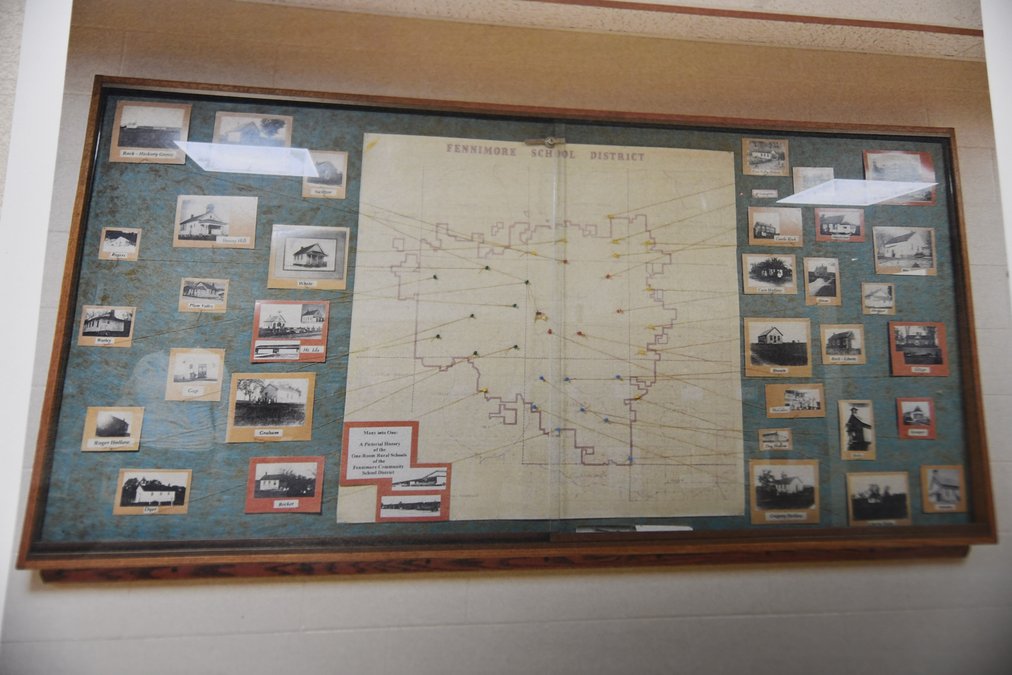
At one time, a map was up in the elementary school that showed where the 32 one-room school house rural districts were all located.
The map sparked an almost four-year mission for Sue Olson of Fennimore and three of her grandchildren, Daniel, Derek, and Bianca.
While picking the three up from the elementary school six years ago, Sue asked the three what they all wanted to do that upcoming summer. Daniel pointed to the map of the rural schools and asked, “Can we find all these?” Sue agreed.
“They read the names of the schools and I wrote them down,” Sue explained. “I took a picture of the map to set a direction.”
Sue and her grandkids went alphabetically and didn’t move on the next one until the one before had been found.
Some of the old schools were easier to find than others. Sue estimated that at least half of the buildings were at the time still standing. She did state since their search ended, two or three are no longer standing.
The ones that were no longer there, at times still had a remnant or two such as a water pump, the most popular one, poles, or the occasional outhouse, which Sue had to explain to Bianca why many times there was “beautiful flowers” near the still standing outhouses, the answering being to “hide the smell.”
And when those weren’t available, they knocked on doors of people living in the area. “The kids said, ‘Grandma you just can’t go up and knock on people’s doors.’ And I said ‘Oh yes I can and we’re going to.’”
In fact, much of the information about the schools came from talking to people living near the schools’ locations.
“We never had a bad experience talking to anyone. Most of them wanted to tell us all about the school.”
Sue and the kids learned information such as at Mt. Ida the second and third schools were at the same location, the third being built after the second had a fire.
Or when knocking on a door asking where the Castle Rock school was, the person at the door responded, “I live in it.”
“Out at Stitzer I had a friend who lived in a school that I had visited there many times and didn’t know it was the school.”
“A couple of times someone would holler, ‘What are you doing on my property’ and once I told them they would get friendly and tell me about it,” Sue went to explain.
Even if nothing was left standing, Sue and the kids would at least try to find the buildings’ foundation. “We had to get on our hands and knees a few times,” Sue explained.
Sue also explained that when word got out about her and the kids’ project she started getting phone calls and letters and old photos sent to her. “That was just so awesome,” Sue stated.
In fact, when talking with someone, they both realized that they were old schoolmates and hadn’t spoken in years. “We ended up talking for a few hours once we figured out who we were,” Sue joked.
And as each school was found, Sue wrote down the directions for each of the 32 sites in a notebook.
Sue stated that her “white whale” of the rural schools was the last one they looked for, the Gates School. “I asked the land owner if the school was there, and she said yes, and I told her I didn’t want to go dig to find the foundation on her property, but she said ‘Well, I can,’ so we went out and found it.”
Daniel was with her then and since the school search was his idea, it was fitting he was along when the last one was finally located.
Most if not all the schools are named either after a family who lived near it or where it was located. “They all had a church and cemetery within one mile of it. I learned many of the schools started in a church while the school was being built,” Sue noted.
If anyone is interested in attempting a school search of their own, Sue suggests starting at the library which has information on all the schools, something she discovered after she had found them all, she said jokingly.
“I would like to add the directions into the information the library has someday,” Sue explained. “If I had the money, I would also love to put signs (historical markers) on all the locations.”
Sue went on say, “My only worry was that the kids would lose interest, but they never did. In fact, they’d call me asking if we go out and look that day.”