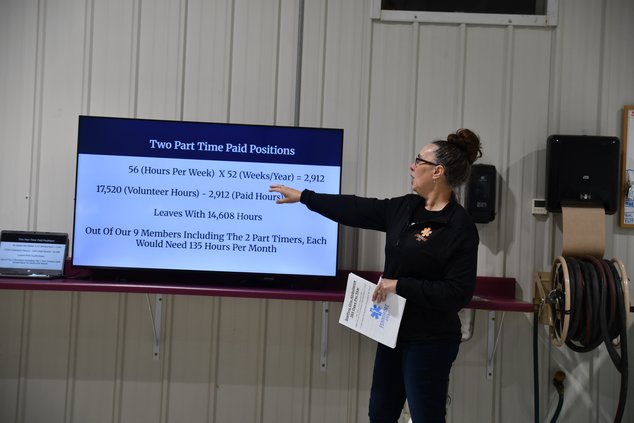
“It’s been a major struggle for long time. There’s very few of us, and it has been a heavy burden,” Jenifer Heisz, current Fennimore EMS secretary/treasurer, emotionally stated to open up Fennimore Area EMS’ community information meeting held at the EMS station on Sunday, Sept. 20.
About 30 people attended last Sunday afternoon’s meeting, mostly made up of current EMS members, surrounding area EMS crews, Fennimore Fire Department members, city and township representatives, and a few citizens.
Heisz along with her husband and Fennimore Area EMS Chief Brian Heisz were hoping for a full house for their informative meeting, but pressed on with those who attended.
The Heiszes gave a brief background on their involvement with the EMS, which started with Brian joining in 2013 when the Fennimore EMS was in need of members. Jenifer joined him in 2018 and their son Nick joined in 2021.
When COVID-19 hit, many EMS members stepped away. Some came back, but some never did. Fast forward to September 2026, the Fennimore EMS is down to nine members and have gone from 209 calls in 2017 to 291 as of Sunday’s meeting with nearly three and a half months to ago in the year.
That averages out to four calls a day, with little or sometimes no crew available. “It’s a lot to ask of nine people to be available 24/7 365 days a year,” Brian explained. “It takes a village to take care of a village,” Jenifer added.
Jenifer stated that she has received many inquiries about why the EMS’ new ambulance is blue and white and not “Fennimore maroon and gold,” and basically it came down to “in case we would have to shut down, it would be easier to sell should we have to liquidate.”
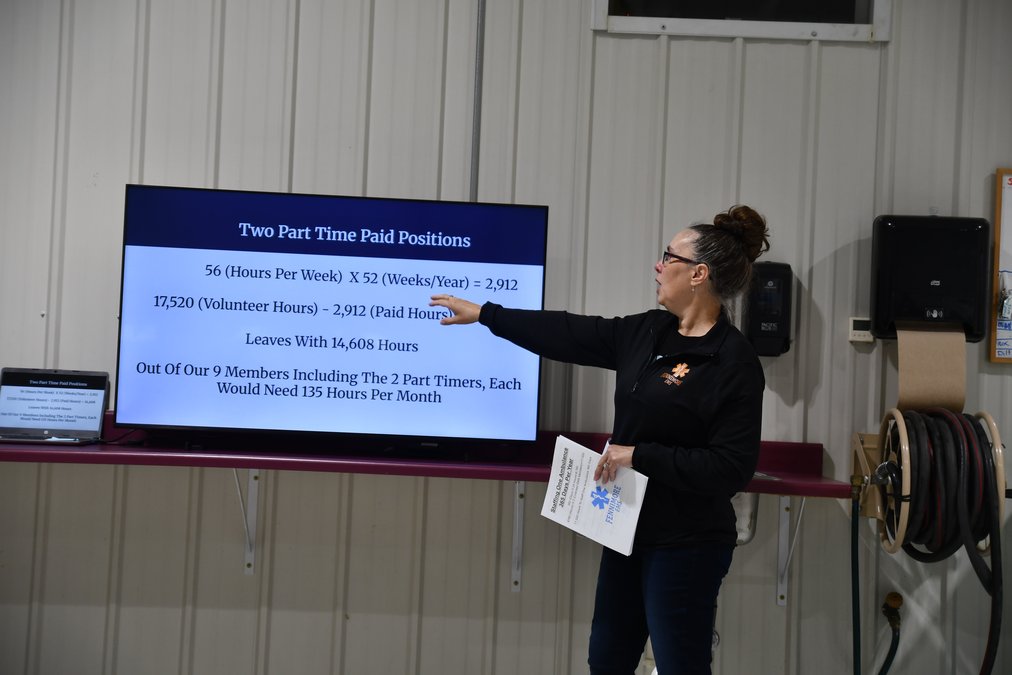
Another recent decision the EMS has made was to hire two current volunteers as part time paid positions, which account for 224 hours of the 1,344 monthly hours needed to have a 24/7 crew, that leaves 1,120 hours needed from the nine current volunteers the squad currently has on its roster, or 35 hours a week.
But even with the struggles Brian stated, “We don’t give up without a fight, we’ll continue on until we can’t. But a decision may have to be made in the future of us possibly not being here.”
Fennimore isn’t the only EMS squad struggling. A Lancaster EMS representative stated they currently have 45 members, which is still a small number for the area they cover, and a Boscobel rep stated they only have 15 current members.
The Heiszes thanked both squads for attending and also for being available when Fennimore is unable to have a crew.
On that topic, Heisz stated that if squads from Boscobel, Lancaster, as well as Montfort and West Grant, provide aid should Fennimore not have crew, it could add an average 45 minutes from arrival to transport to the hospital, where as if Fennimore responds, total time can be five to ten minutes.
“A local crew is closer, knows the area/roads,” Jenifer stated, with Brian adding, “People like to see a familiar face when walking in their house.”
The Heiszes then went through training involved for anyone wanting to be an EMS volunteer. At Southwest Tech, training cost is provided by the Fennimore EMS, as well as three year “refresher courses,” and every two year CPR training. The Fennimore EMS also holds monthly training and works with the Fennimore Fire Department on vehicle extraction training, all costs covered by Fennimore EMS.
Those costs don’t include equipment purchase/maintenance, ambulance maintenance, etc.
A common misconception is that EMS/rescue squads are tax funded. That is not the case as ambulance services are self funding/private business, rasing funds through grants, donations, fund raisers, insurance, or out of pocket.
The Fennimore squad was started in 1951, because as Brian put it, “some good people saw a need,” and has continued ever since being a volunteer/self funded emergency service.
Municipalities are required to provide some type of emergency service. Should a local volunteer service not be available, municipalities would have to contract out to provide emergency services.
Brian gave an example of should Fennimore be forced to close, a paid service would have six full time employees averaging $100,000 a year each with wages and total benefits. In addition to the added costs, the Heiszes stated that small, rural towns such as Fennimore and surrounding areas such as Mt. Ida, Liberty, Hickory Grove, Town of Mt. Hope, North Lancaster, Castle Rock, Little Grant, and Marion, may have problems even contracting a crew due to their lower call volumes.
The Heiszes stated that talks between the City of Fennimore and Fennimore EMS have been quiet as of late. Two ad/hoc committee meetings were held, but not recently.
City of Fennimore Clerk Ashley Edge, who was in attendance, stated that the city council has had internal discussions and that the EMS and their future is on the agenda for the council’s next meeting.
But it all comes back to people and volunteers, which in this day in age, is a struggle for many organizations including locally the Doll and Toy and Railroad Museums, Lions Club, etc. The concession stand at football games has troubles finding volunteers for a two hour shift, as someone in attendance stated.
Brian stated that to offset neighboring squad costs when having to respond when Fennimore can’t get a required two person crew available, municipalities may pay $750 to responding neighboring squads.
One neighboring squad member, Steve Braun, Lancaster EMS Vice-President, as well as Lancaster Fire Chief and Grant County Emergency Manager, called the Fennimore squad a “unicorn.”
“Nothing has changed for you (Fennimore EMS) since 1951, except you do more,” Braun stated to the Heiszes. “It’s not a realistic model.” Speaking to the city and municipality’s representatives in attendance, Braun stated, “It’s your game. It won’t just magically succeed. Communities need to pay at least something, so what are you willing to give to help them succeed.”
Braun explained that the Lancaster EMS gave a proposal to Lancaster and their surrounding municipalities to contribute financially in the way of levy dollars.
“Every community is different, so find a fit for Fennimore,” Braun went on to say, while suggesting that local businesses allow employees to go on calls during work hours should they be needed.
When asked to clarify how the fire department receives funding, the difference with them and the EMS, Todd Bresee, Fennimore Fire Chief, stated that the fire department receives tax levy funds, while the EMS “finds their own funding.”
But Bresee stated that the fire department still has to do fund raising to bridge the gap to cover costs such as equipment, maintenance, and training.
Edge asked should the city, as Braun suggested, enter a contractual relationship with the EMS, how would that be overseen, which Jenifer replied the EMS would have a board like the fire department currently does.
All is not doom and gloom as the EMS has two EMTs in classes now and hopefully will be ready at the beginning of the new year, and also have an EMT ready soon.
In summary, the Heiszes stated Sunday’s meeting was meant to raise awareness and spark conversation. “We’re always recruiting for new members,” the Heiszes said many times during the meeting.
“We’ll continue on until we can’t,” Brian stated with Jenifer adding “hopefully it won’t ever happen.”
When asked how long they can sustain a crew and still provide service, Brian joked, “Some are surprised we’re still going. We’re not shutting down tomorrow, we’re just going a year at a time.”
Anyone interested in beginning EMS training may e-mail Brian at chief@fennimoreems.org.