DRIFTLESS - On Monday, November 9, the U.S. Senate voted 73-25 to invoke cloture (the formal legislative procedure used to end a debate and force a vote on a pending matter) regarding the bill S.5363, named the ‘Bipartisan Affordability and Jobs Act’ of 2026.’
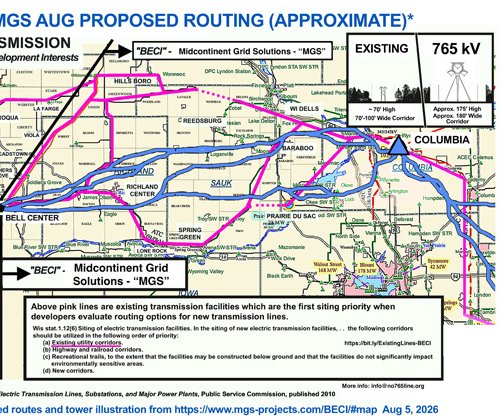
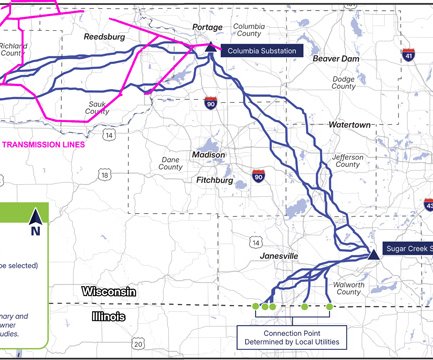
No 765 Line volunteer Tennille Osthoff, rural Genoa, had alerted citizens to the threat this bill posed to citizens opposed to construction of the MariBell and BECI 765 kV transmission lines in the Driftless at the ‘Nature on the Line’ event held October 25.
“Now you wouldn't think that has to do with energy, but it does,” Osthoff explained at the presentation in Gays Mills last month. “What it would do if it was law right now, the transmission line developer wouldn't even file with the Wisconsin PSC - the developer would just file with the Federal Energy Regulatory Commission (FERC), and then there would be a 30-day input period, and you would have to travel. That would not only take it completely out of the landowner’s hands, but also out of the state’s hands.”
Wisconsin U.S. Senator Tammy Baldwin voted ‘no’ to invoke cloture, and end debate. Wisconsin U.S. Senator Ron Johnson voted ‘yes.’ These two Senators can be reached as follows:
- Senator Ron Johnson, D.C. office 202-224-5323, and WI office 608-240-9629
- Senator Tammy Baldwin, D.C. office 202-224-5653, and WI office 608-264-5338.
Official summary
The official summary of the bill reads as follows:
“This bill modifies federal permitting processes, including environmental review, to expedite a wide range of projects.
“The bill limits the scope of the National Environmental Policy Act (NEPA) and expedites environmental reviews, including by:
- further limiting the types of federal actions that trigger environmental review
- narrowing the range of alternatives that must be considered in environmental reviews, and
- exempting additional types of projects from environmental review
“It also establishes deadlines for issuing permits once an environmental review is complete.
“The bill also limits permit obligations under the Clean Water Act, including by:
- narrowing the scope of review for water quality certifications;
- extending the term for permits issued under the National Pollution Discharge Elimination System (NPDES, in Wisconsin, WPDES);
- limiting the time period for review of permits for discharges of dredged or fill materials.
“It also modified requirements concerning threatened or endangered species to expedite the review of federal permits, including by shortening the timeline for certain consultations.
“Additionally, the bill addresses numerous aspects of energy infrastructure permitting, including by:
- expanding the authority of the Federal Energy Regulatory Commission (FERC, a non-governmental entity) to issue construction permits for certain interstate electricity transmission projects;
- directing FERC to establish ratepayer projections related to certain large computational loads (e.g. data centers);
- removing permit requirements for onshore oil and gas drilling on nonfederal land; and
- accelerating renewable energy, geothermal, hydropower, or offshore energy projects.
“It also limits the scope of the National Historic Preservation Act, including by limiting which types of projects trigger review.”
Support/opposition
According to Congressional records, supporters of the bill, like Club for Growth, presented reasons urging Senators to support passage. Those opposed, such as No 765 Line, National Congress of American Indians, Wisconsin Farm Bureau, Waterkeeper Alliance, the Center for Biological Diversity, and the National Association of Tribal Historic Preservation Officers, urged Senators to vote no.
Senators supporting the bill include Shelly Moore Capito (R-West Virginia), Mike Lee (R-Utah), and Martin Heinrich (D-New Mexico) alongside groups like Club for Growth. They argue the package cuts federal red tape, accelerates energy infrastructure, and lowers costs.
The National Association of Tribal Historic Preservation Officers held a rally in front of Congress before the vote on cloture. They wrote:
“Chairman Leonard Forsman of the Suquamish Tribe was exactly right when he said federal agencies need to ‘work with Tribal Nations, not around us and certainly not against us.’ And Pueblo of Laguna Governor Harry Antonio, Jr. provided us with a powerful reminder that ‘Our sacred places are living places of prayer’ and that ‘A court ruling cannot restore a sacred place after it has been bulldozed’.”
Wisconsin Farm Bureau Federation weighed in on the issue, urging members to contact their senators.
“Later today, the U.S. Senate is considering S. 5363, the Bipartisan American Affordability and Jobs Act, which would expand federal authority to approve major interstate transmission projects even when state regulators reject them. Under this legislation, even if the Wisconsin Public Service Commission (PSC) determines that a project like MariBell or BECI is not in Wisconsin’s best interest, federal regulators could potentially override that decision and allow the project to move forward. Wisconsin should have the right to say NO to transmission projects that aren’t in our state’s best interest. Washington shouldn’t have the power to undermine those decisions.”
Waterkeeper Alliance’s Advocacy Director Jacquelne Esposito had the following to say:
“This [Bipartisan American Affordability and Jobs Act] isn’t progress. Our environmental laws are intended to protect human health and our natural resources. Weakening these bedrock laws in the name of ‘clean energy’ is a significant step backward. Real progress means protecting our health, our communities, and our environment, not making it easier for corporations to fast-track projects at the public’s expense.”
The Center for Biological Diversity works through science, law and creative media to secure a future for threatened or endangered species, great or small, hovering on the brink of extinction, and had the following to say:
“If this bill isn't stopped, it could hinder future administrations from restoring protections for and undoing the damage. The consequences could last for decades. Keep calling your senators and urge them to vote NO on S.5653, the Bipartisan American Affordability and Jobs Act.”
The National Congress of American Indians opposes the bill, and wrote the following:
“Tribal nations are standing together to oppose S. 5363 BAAJA, which threatens Tribal Sovereignty and puts our sacred sites at risk. BAAJA was written without tribal consultation, leaves federal agencies alone to decide what’s sacred, penalizes and bypasses Tribal Historic Preservation Officers, and leaves no real remedy in court.”