The Crawford County Land Conservation Committee (LCC) took up a broad-ranging variety of matters at their Tuesday, April 14 meeting. Those included a proposed subdivision ordinance update, data centers and transmission lines, well water testing, NR 151 runoff enforcement, county deer herd recommendations, and large livestock operation issues.
In the Land Use portion of their agenda, the LCC heard that county corporate counsel Mark Peterson had signed off on the final draft of the proposed subdivision ordinance. The committee agreed that a public hearing on the proposed ordinance would be held in advance of the LCC’s meeting on Tuesday, May 12, beginning at 8:45 a.m.
“Dave Troester attended the recent Towns Association meeting in the county, and handed out a sheet describing the provisions in the proposed ordinance,” Crawford County Real Property Lister Gionne Collins told the committee. “Mark Peterson has approved everything, so the next steps are to publicize the public hearing, hold the hearing, bring it back to this committee to make any needed revisions based on public input, and then take it to the county board.”
Collins explained that the ordinance would basically tell landowners what they need to do if they want to subdivide their land.
Supervisor Mary Kuhn asked if the county’s ordinance is dependent on whether any given township is zoned.
“A lot of townships are zoned, or they have comprehensive plans,” Collins responded. “Our subdivision ordinance doesn't say anything about anybody being able to follow that, because it was done before all the comprehensive planning and the zoning was done. If your township has a subdivision ordinance, then you have more authority than you do with your comprehensive plan and zoning, because it's a land division, your zoning is just saying what you can do with the land.”
“Landowners used to be able to create a lot without doing a certified survey map. But now we're making it so if you convey anything 15 acres or less, you have to do a certified survey map,” Collins clarified.
County surveying consultant Richard Marks commented that he understands that some towns are considering adopting zoning ordinances, and encouraged them to talk with Collins or himself about the implications of the proposed county subdivision ordinance.
Data centers, lines
The committee has a standing agenda item, ‘utility scale wind and solar projects,’ on their agenda. Given the proposed data center in Cassville, this discussion also ranged into how the county could be proactive in fielding these kind of development proposals.
“Solar and wind, and data centers, have been on the front page of every newspaper, and I think we need to continue to keep our eyes on that,” committee chair Supervisor Gary Koch observed. “I believe Clayton County, Iowa, has passed, or is considering passing a moratorium on data center development.”
Koch said that he encouraged Troester to engage in conversations with neighboring counties about how they propose to navigate the situation, and suggested that a regional response might be the way to go.
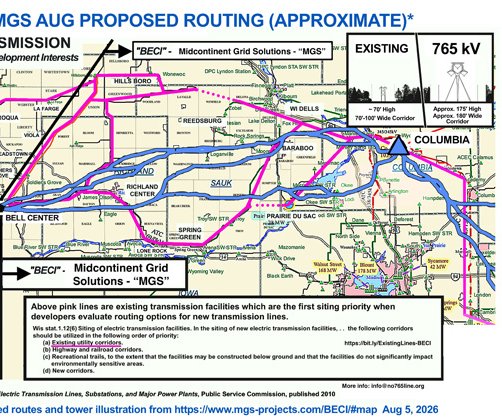
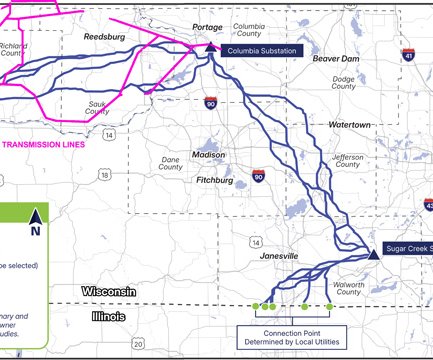
“The data center thing is it's connected to the high voltage lines, and we’re going to hear from Dairyland Power Cooperative next week about the proposed 765kV MariBell transmission line – it will be interesting to hear what they have to say. There’s been a lot of pressure on them to offer landowners and municipalities more information, but it seems to come out in dribs and drabs.”
“Personally, especially with the data centers, I'd like to get ahead of that, instead of being reactive,” Supervisor Mary Kuhn said. “We don't want to get stuck in a position like Cassville, where there it is, and whoever approved the data center signed a non-disclosure-agreement (NDA), so they can't even talk about it. They come in, they propose all these things, and you sign an NDA, so you can't talk about anything that goes on, and that's not very transparent. We could just do a moratorium for a certain period of time, until the legislature has a chance to give us direction on what we should be doing or shouldn't be doing.”
Committee member Russ Wison asked, if a data center wanted to locate in Crawford County, who would give them the okay?
“I would think that it would be the town, or if it's a city,” Koch responded. “These things take up hundreds of acres, so in our county, it’s more likely to be located in a town.”
“And as long as the county has nothing that supersedes what the town has, then we have to go with whatever the town said,” Kuhn observed. “You can’t grandfather any ordinances in – it’s whatever exists the day the agreement is made.”
Troester agreed to reach out to neighboring counties, and talk with corporate counsel about what kind of authority the county could have were such a development proposal to be presented.
Water testing
Troester told the committee that the recent round of well water testing conducted in April, part of the Driftless Area Water Study (DAWS) yielded 100 samples from Crawford County, and a total of 351 samples combined from the counties participating in DAWS – Crawford, Richland and Vernon counties.
“There will be an in-person public outreach event about high level results of the most recent round of testing on Saturday, June 27, in Gays Mills,” Troester told the committee. “In addition, there will also be a shorter presentation to the county board.”
Troester said he’d encountered Representative Travis Tranel at the recent Towns Association meeting. He said Tranel asked if the three counties were starting to see trends emerging from the multiple rounds of DAWS well water testing?
“Of course, I told him I don't know, because we don't get individual results,” Troester said. “It's kind of tough to look for trends, but we're getting to the point that each year we build that data, it will help us out down the road.”
Runoff monitoring
Troester also said his department is responding to a statewide DNR initiative to monitor runoff rule compliance on farms. He said that each county was given a list of farms they need to visit to monitor compliance.
“NR 151 contains the DNR’s runoff standards, and obviously every farm is supposed to meet all of those conservation standards,” Troester explained. “This project is an undertaking of DNR and UW-Extension together. A couple of months ago, they came up with 800 sites across the state, selected randomly, a combination of livestock sites and cropland sites. And basically, they're saying it's the county's job to go do compliance checks to determine what percent of farms are actually in compliance. So we have 12 sites in the county - eight, livestock, four, cropland.”
Troester said that DNR’s ag runoff staff out of La Crosse has offered to spend some time in the county, going out to a couple of the sites, to make sure that county staff know about everything they are supposed to be looking for.
“I think a big question is, so what if one of these farms is out of compliance?” Troester told the committee. “Are they going to be expected to get into compliance? And of course, if I randomly show up at any farm, and I tell them they’re out of compliance and they need a nutrient management plan, then I have to have funding to offer to get that done. So, it remains to be seen.”
Deer herd
Troester told the committee that the County Deer Advisory Committee meeting is coming up, where the county will make recommendations to the state about 2026 deer seasons. He said that he is the representative of agriculture on that committee, and asked committee members if they had any input they would like him to share.
‘When we first moved here, when they went hunting, if you got a deer, you were really lucky,” Kuhn commented. “Now, they see so many, they can pick and choose, which makes me mad. Herd management skills in our county are very lacking, and we have groups of 15-20 deer in separate areas, and they know where our grain bins are, and walk up after we make feed, and clean up the corn.”
“Since I've been on this committee, we've always just voted to maintain our current herd level,” Troester observed. “The DNR keeps saying the numbers are actually going up, and then, of course, 80 out of the 100 public comments that we get are that there's no deer.”
“The reason they don’t see any is because they’re looking for horns,” Kuhn asserted.
“Part of the problem now is you got more and more landowners that do not allow hunting on their land - they just want to shoot the big buck. And, we’re not allowed to bait deer, but anybody can plant a food plot, which is basically baiting deer.”
Kuhn said that it would help if there were more meat processors locally that would take deer as part of the deer donation program.
“If there's no place to donate them, then there's no incentive to kill any more than what you have to take,” Kuhn said. “Realistically, we haven't had a harsh winter in quite a long time. So we've got does that are having twins. Some are even having triplets. And so you go from one to two, to five, and without harsh winters, you just have an astronomical explosion of babies, and there's nothing that that can be done.”
Livestock operations
Now that permits for Gruber Livestock North and South have been approved, county staff are engaged in fulfilling their role as the entity charged with overseeing compliance with the rules for those two operations. Because each facility is expected to house one animal unit short of hog numbers that would have required a water quality permit from the DNR, county staff are shouldering that workload.
“I was online this morning with the Grubers on a kind of pre-construction meeting today,” county conservation technician Travis Bunting told the committee. “So, kind of getting planned to go ahead with that, and got to meet the earthwork contractors and then the guys behind the concrete in the building. It sounds like the earth moving equipment is starting to get hauled in.”
The LCC meeting was followed immediately by the first meeting of the Large Livestock Committee, agreed upon at the last LCC meeting. That group is charged with revisiting the CAFO Study Group Report, generated in 2020. The report was essentially dropped and never taken back up due to the COVID-19 pandemic.
Members of the ad hoc committee include Supervisors Gary Koch and Mary Kuhn, Land Conservation Department employees Dave Troester and Travis Bunting, Public Health employee Dawn Adams, UW-Extension employees Adam Hady and Sara Tedeschi, CCA representative Ed Ruff, farmers Bart Mitchell and Chad Sime, and Forest Jahnke from Crawford Stewardship Project.
The committee held their first meeting, introduced themselves, and did a simple round robin about what they saw as the purpose of the committee and the possible outcomes of their work. The committee will meet next on Tuesday, May 12, immediately following the conclusion of the LCC Soil and Water meeting.