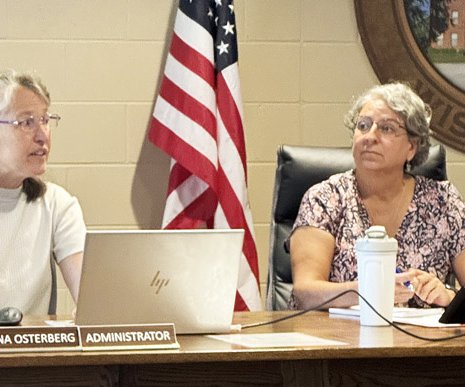
A packed house of nearly 300 Driftless Region citizens attended an ‘On the line. On the record. 765 kV Town Hall,’ held at the Retreat Sportsman’s Club on Monday, August 17. Five elected leaders and one gubernatorial candidate took the stage to answer questions about Wisconsin’s energy policy.
Musician Larry Long opened the event with the ‘world premiere’ of his new song, ‘Want Nothing to do with Line 765.’ Long says he plans to use the music, along with video from potentially impacted landowners, to create a video opposing the line.
Those elected leaders were State Representative Tara Johnson, State Representative Travis Tranel, State Senator Brad Pfaff, Viroqua Mayor Krista Browne, and U.S. Congressman Derrick Van Orden. Gubernatorial candidate from the Independent Party David King also took the stage.
The discussion was moderated by Coalition Against Maribel 765 (CAM765) attorney Erik Olsen of Eminent Domain Services, LLC.
At issue was the politicians’ stance on the proposed MariBell 765 kV transmission line, proposed to run from Marion, Minn. to the Bell Center Substation in Crawford County. The questions asked were posed by CAM 765 members, a group of potentially impacted landowners along the ‘preferred route’ for MariBell in Vernon and Crawford counties.
Ever since the disastrous ‘Citizens United’ U.S. Supreme Court decision, freeing corporations, such as energy industry and big tech corporations, from making virtually unlimited financial contributions to political campaigns. These campaigns have become increasingly indebted to these kinds of large donors – all campaigns.
The subtextual question in front of those seeking office, as it pertains to proposed transmission lines, data centers, and utility-scale solar and wind on Wisconsin farmland, is whether candidates will prioritize the needs and wishes of the voters, who put them in office, over the donors who fund their campaigns.
As the astonishing candidacy of Wisconsin State Representative Francesca Hong in the Wisconsin Governor’s race demonstrated, voters of all political stripes have a strong appetite for change in Wisconsin energy policy and data center development policy. Hong lost her race to Democratic gubernatorial candidate David Crowley by just 3,200 votes.
Hong, a Democratic Socialist, had pledged to enact a data center moratorium if elected. At a campaign stop in Viroqua the week before the election, she also said she would consider a moratorium on new transmission line projects to allow the State of Wisconsin to reverse decades of reliance on energy industry domination of planning and demand forecasting.
Bear in mind, a moratorium is simply hitting the pause button to give the state time to determine where its citizens’ best interests lie, and to put in place protections for citizens. It would not mean that the state opposes data centers or new transmission lines.
Energy discussion
Moderator Attorney Erik Olsen opened the discussion, and went on to ask the assembled politicians six questions.
“I'm really, really happy that everybody's here, and I'm really appreciative of all our (elected officials) who have taken out of their busy schedules to be here tonight. They came here to answer these questions. I know everybody will show them the greatest respect for speaking on this issue, which for many of us is an extremely important issue,” Olsen told the crowd.
Question One: take just a short minute or two to introduce yourselves, and then tell the audience what activities you have done to date, either to support or (oppose) the Maribel transmission project.
Krista Browne is the newly elected mayor of Viroqua. She grew up in De Forest, and her dad lives in Hillpoint ,where he received a letter from BECI developers last week, as did her aunt who lives in Poynette.
“My husband made the website that you've all seen. I've been showing up against this with the people who got those letters from Genoa all the way down,” Browne shared. “This project is not necessary. And it doesn't feel good, and it's not coming through my yard. But I know how it feels to have something like this in your yard, next to your yard, and it's a gutting feeling that kind of makes it hard to do your day. And, I disagree with ever doing that to people. So I'm here because I believe that the power of people is greater than the power of money, and I want to answer your question, and I want to work with you to stop the line and get better design and better solutions.”
Dr. David King is a gubernatorial candidate with the Independent Party, who lives in Milwaukee.
“I came all the way from Milwaukee because my slogan is not just a slogan; it's a reality of my life. I believe in people over parties. I believe in that people should go first and come first in everything,” King explained. “When I was up here in Coon Valley, I found out what you guys were fighting, and I started researching it, and I know there are some things that can happen if you had a governor that was for the people. We have two PSC positions that the governor can appoint with somebody that's there for the people and not their pockets. So I came up to listen to you, so I can learn how to serve you better, because I will be the next governor of the state of Wisconsin.”
Wisconsin State Senator Brad Pfaff represents the 32nd District in Vernon, La Crosse and portions of Trempealeau counties. People of Crawford County are quite familiar with him since the 32nd included the county until recently.
“I've introduced legislation to hold utility companies accountable. The legislation that I've introduced, co-sponsored by State Representative Tara Johnson, does the following: It tells the utilities you're not going to go across farmland and forests that you do not really have a right of way. Follow existing utility infrastructure right away. That's number one,” Pfaff said. “The second thing it does is that when it comes to fragile and unique landscapes like we have, bury the wire. They're going to tell you they can't afford it, but make them tell you that because I'll tell you, when it comes to broadband, we're burying the fiber, and we should bury the wire.”
Wisconsin State Representative Travis Tranel represents a little bit of Vernon County, but all of Crawford, and a large portion of Grant County. He is a dairy farmer, who milks outside of Cuba City.
“I came here because this is an important issue for me. I have been on the Energies and Utilities Committee in the State Assembly now for eight sessions,” Tranel told the crowd. “Anybody ever heard of Cassville? I was in Cassville when Alliant Energy wanted to spend a billion dollars upgrading that plant to a clean coal power plant. The proposal was rejected by Jim Doyle's PSC. I have been a staunch advocate of comprehensive energy reform in this state for a long time, and I tell people it's about time the general public has gotten to where I'm at. Does anybody know the difference between base load and intermittent power? Base load power is power that you need all of the time. How many of you like your lights to turn on sometimes? No. Most people, what they know about power, they flip the light on. There better be power. We have made a policy decision in the state and in this country to switch to more intermittent sources of power: wind and solar.
“When you switch to wind and solar, you generate it further away from where it's needed. When you do that, what happens? You have to move the power, and that's why we have proposals like the 765 line. The further you move power, the more power you lose. If any of us are serious about stopping this line, if any of us are serious about stopping the destruction of rural Wisconsin, you better be for comprehensive energy reform.”
Wisconsin State Representative Tara Johnson represents the 96th Assembly District, which is 850-square-miles from the shores of the Mississippi all the way to the banks of the Kickapoo in the Driftless Region.
“You heard from Senator Pfaff on the legislation that we authored. Unfortunately, it went nowhere, but we're working on that, and would encourage you to think about who you are voting for this November, and who is supportive of that legislation, and what governor is going to sign that legislation,” Johnson stated. “This is probably the number one issue that I hear from constituents about. So every day in our office, phone calls, e-mails. I know Tenille and I know Tim Woodhouse probably better than they want to know me because when I do district office hours every month, this is the topic that fills the calendar for those appointments.”
U.S. Congressman Derrick Van Orden represents the 3rd Congressional District in Western Wisconsin. He and his wife Sarah Jane live in the Driftless Region.
“I don't want to tell you what to do as a member of the federal government. My base of government philosophy is not that,” Van Orden stated. “At the federal level, what we're trying to do is increase the base load across the entire United States of America, so we don't have to have things like this. Because what Travis said is absolutely accurate. The longer you have to move power from one place to another, the more power you lose. That's why you have to have these 250-foot tall monstrosities running through farmland. That means we're trying to increase nuclear energy, clean burning coal energy, and clean burning natural gas.”
Question Two: how many would be in favor of passing enhanced legislation that would protect people from use of eminent domain that was for the purpose of private profit?
“It's private property. I've introduced legislation, and I'll repeat it: follow the existing infrastructure,” Brad Pfaff emphasized. “We have public infrastructure throughout this state, state highways, interstate highways. I know they may curve and wind and bend, but the thing is this: we do not have to take away private property.”
“The utilities in Wisconsin are very powerful. It doesn't matter if you're a Republican or a Democrat,” Travis Tranel said. “Does anybody know what a guaranteed rate of return is? How many of you have a 401(k) or some type of investment account or retirement account? If any of you have a 10% guaranteed rate of return, let me know because I sure as hell would love to sign up for that. Well, in Wisconsin, our utilities have a 10% guaranteed rate of return, which is why if you owned a power plant yourself and you didn't have it paid for yet, would you be upset if you shut it down to build a different generating source? Do you think the utilities care? Nope, because they have their guaranteed rate of return, right? So do you realize, as a ratepayer, you are still paying for legacy power plants, which is a fancy way of saying they shut down power plants that aren't paid for yet, so we could switch how we generate power.”
“I didn't come up here to play games. I came to you guys as the governor. If it comes to my desk, you guys are protected. And if there's a loophole in there, we're gonna get rid of the loophole. But I also want you to understand, just like the song said, the power is in your hands,” David King stated. “Travis mentioned Tom Tiffany – where is he? This is what we as the people have to understand. If you really want to protect your land, if you really want to be able to pass your farm down to the next generation to the next one, then we gotta have people that's for real. We gotta have people that's really gonna back you. I do want you to know you have a fighter with me.”
“The answer is yes, I would support legislation reining in use of eminent domain,” Tara Johnson stated. “At the risk of extending the answer, I would agree with my colleague, Representative Tranel that that a 10% guaranteed rate of return for utilities is demotivating for making good decisions. I think on the part of utilities, and perhaps Representative Tranel and others on this stage today, would join me in saying, maybe this is a point at which we return to state-run utilities.”
“I want better law and better policy that we negotiate at a table transparently after listening to what people want, that then on a local level we help implement with proper funding,” Krista Browne shared. “There’s too much consolidation, too much privatization, too much capitalizing on people. When things get over privatized, and it's all about bottom-line dollars, they get consolidated, and then that bottom line becomes the thing that drives it, not the people. We need to be reminding leaders, and we need to demand they listen about what we want and how we want to be neighbors with each other. So, no, we should not be using eminent domain for private good. We need to reinvest in public good.”
“I'm crystal clear in my position on eminent domain – I am not a fan of it at all,” Derrick Van Orden said. “There are times when you are doing things that that affect everyone at a very large level, where you need to exercise it. Like the railroad, for instance, that is part of the intermodal goods and service transportation in the country. Everything that goes on that railroad, we wind up using for the entire nation. We have a responsibility amongst ourselves to try and take care of each other. But no way in hell should we be using this eminent domain to take people's private property so a single company can profit. That's just not okay with me. It's never okay.”
Question Three: on a personal level, how do you how do you balance or how do you evaluate the costs to society, such as ecological balance, public health and welfare, our great historical sites and geological formations like the Driftless. When we have to build it against an enormous project like this, that would actually be the largest transmission line ever built in the history of the State of Wisconsin. On your own personal level, because that obviously reflects on how you might vote. How do you balance these competing interests?
“I am an all boats rise kind of person. That's who I am in my core, and I also come from county government, local government, where elected officials are closest to the people and make decisions much like the mayor has talked about from listening and conversations with folks in the community,” Tara Johnson responded. “I think the balance for me is always going to be the common good above the individual profit-making good. I would just cite one quick example on the La Crosse County Board during my time as chair, we faced an issue with cell tower siting, and the state legislature had changed laws that took away local control. La Crosse County is also very fragile in terms of the topography. The law changed and said you really don't have local control over where cell towers are sited. We had a tower that was hoping to be built up in the Town of Holland on very fragile land. We said no. We were told by the state ‘you can't say no. You don't have a choice in this.’ They said it's an automatic approve unless like 85 horrible things happen, which they did. Right. We were threatened with lawsuits. And we continued to say no. And the company Bug Tussel found another location for that cell tower. And that is something I am really, really proud of.”
“You always have to have a balance. My approach to legislating is the same approach that I take in my private sector job of farming. I am honest. I'm direct. I'm a realist, and I tell people the truth,” Travis Tranel stated. “I am the only Republican member in the legislature in Wisconsin that is on this stage. My colleagues, neither one of them, I believe, were in the legislature in 2009. But it was when Jim Doyle, a Democrat governor, and we had an entire Democrat legislature in the Assembly and in the Senate when 2009 Act 40, took away local control. And we took away local control for siting large industrial wind and solar projects because we wanted to make a decision to go towards more green energy. At the time, a lot of people bought into it. I believe they thought that it was a cute idea that would not turn into these industrial projects like we've now seen. I always tease people. I say when I go to Madison, or the three of us go to Madison, and the lakes are covered with solar, that's when we can talk about putting solar in Vernon or Crawford or Grant counties, because everybody wants to say not in my backyard, but they still want the supposed benefits of green energy. In my opinion, we are permanently altering the landscape of rural Wisconsin, and we are not getting anything for it. And utilities aren't like monopolies - they literally are monopolies. We grant them the monopolistic privilege of generating power in return for what the legislature is supposed to regulate them. And in my opinion, the legislature has been failing, and it has been difficult to get Republicans or Democrats on board to have this conversation because the utilities are so powerful - they have both parties in their pocket. I am starting to make some inroads on our side of the aisle, and I am thrilled to hear that I'm starting to make some inroads on the other side of the aisle. Because ultimately, it takes bipartisan support to do something.”
“I listen to my neighbors. The Driftless Region came forward 20 years ago with an idea called distributed generation. Rather than having the idea of large-scale solar farms, let's talk about having distributed generation. Utilities say absolutely not. Can't do it. There has been legislation introduced, but the thing is, it never goes anywhere. We need to talk about distributed generation. That is something that is a serious concept, and is something that can work,” Brad Pfaff stated. “We all then would quote have ‘skin in the game.’ I also believe in energy efficiency models. There is something called a Focus on Energy. If you go into the grocery, you go into the hardware store, or if you go up and purchase a new washer and dryer, you will see a sticker on there. It's energy efficiency. More can be done. Energy efficiency models can be done at an affordable rate. We have to push our Public Service Commission to be more aggressive and to stand up to these utilities, but we also need to make sure that we hold all of us as legislators accountable. Because the thing is this: we all want to make sure that we have viable, dependable energy that we can turn on the light switch, the lights come on, we go to the barn, and the vacuum pump turns on. That is very important, but at the same time, we can do this in a way that is conservation-minded, that is energy efficient, and is also affordable.”
“Anytime anybody mess with your constitutional rights, I have a problem. One of the things that, being American, we have is the right to life, liberty and the pursuit of happiness. And I will always stand with people who owns their own property,” David King said. “No money can make me sway left or right. I am so sick and tired of us having taxation without representation. We are not being represented right. They're not fighting for us. So personally, I jumped in this fight to run for governor to make sure the people of Wisconsin are really taken care of. We don't need no project that's going to take away from us. We need something that's going to benefit us. And the thing about it is this: they're not even looking at the health part of it. They're not looking at the cancer it might cause. They're not looking at the land that it might destroy, they're just looking at the dollar, and they talk about billions of dollars. Billions of dollars is not worth your health or your children's health.”
“When I think about most things, I think about: what are the true costs? What are the externalities of the decision? You have to take into consideration all the costs, not just the dollar value, not just the dollar value that day based on the market. You have to think about sense of worth. You have to think about your identity. You have to think about what it's doing to connectedness and community,” Krista Browne said. “Projects like this one are too large of a scale. People are very frustrated about data centers because they can see them. If they could see the scale of this and the impacts of this, they would be outraged, and the data centers wouldn't much matter. But because we're human size, we can see a data center and feel really outraged about its. This is going to have greater ramifications on water because we're talking about karst geology. When that pylon hits a cave what happens to our aquifers? We're standing on four aquifers right here. We also need to get very communal in how we compromise together. How many things can you unplug? How many things are you not using right now? Have we talked about conservation in a while? What are we doing to compromise so that all of us are compromising and no one is getting good or bad? We're all making a compromise, which actually makes us all more the same, and leadership needs to be showing that and doing that.”
“My basic governing philosophy is I want local control. So when we're talking about data centers and transmission lines, I do not want anyone sitting in one of those marble buildings that I work in Washington D.C. telling you what's going to go in your yard. It's your yard,” Derrick Van Orden said. “The federal government has gotten so huge and so out of control, and it's doing so many things it has no business doing. So big defense - we got to look at that. We're going to have to have military bases. We're going to have to have plants. We're going to have to protect ourselves. These are very basic things. We have an agreement on infrastructure. DeSoto can't build a new bridge by itself – it needs help from the federal government. We just got a fire truck right down the road in Genoa. You know why? Because Genoa couldn't afford a fire truck by themselves. So they got ahold of my office, and we got them several $100,000 for a new fire truck. Those are the things the federal government should be doing. And so when I look at things, I look at them holistically. First and foremost, can these people take care of the problem? If the answer is yes, there is no question for me. I'm not going to stick my fingers in their business. I think that that's fundamentally wrong. Our entire system needs to change to focus on our local government much more.”
Question Four: many of our members feel distraught over the loss that they will feel to their livelihoods, possibly health, homes, hunting, and recreational activities if this line is built. They're all here because they're concerned. So, for those of you who are on the stage, how close would you feel was okay for you and your family or a family of your loved ones to live to one of these high voltage transmission lines with 765,000 volts?
“My family moved back to Wisconsin and chose to move rural from downtown Minneapolis and downtown St. Paul. We bought 43 acres in the town of Wyoming in Iowa County, and the week that we closed on our house, the neighbor put up a cell tower, and I called my husband to tell him, and he called me to say I think I'm getting laid off. So that really sucked, but it made no sense because the cell tower didn't have a permit, and we tried to get an injunction with the 37 some people in the township, and they put it up over Memorial Day Weekend,” Viroqua Mayor Krista Browne said. “We don't live there anymore. I couldn't even make breakfast because I was like, "What's the point? We just lost all the equity we built. I don't want to look at it. I don't understand why they would do this to their neighbors. I just became so disoriented to my daily life that we moved. We sold our land and we moved to Viroqua. And this line is too close for my comfort, and that's in the city. This isn't what we do to neighbors. There is no far enough away when it's this much power.”
“I wouldn't want my enemy living that close. When I walked through the door, I met a farmer, and I met his uncles and his cousin. Five generations. I don't want to see anybody die off. I want to protect you,” Independent Party gubernatorial candidate Dr. David King responded. “I am fighting because I care, and I travel this state because I care. And it's about you right now. It's not about me. It's about you. If you don't own it, you should not have to have it. Point blank and simple.”
“The piece of legislation that I've introduced that is currently in the state legislature creates what's called infrastructure corridors for utility energy to move through so we do not have willy-nilly cutting across people's farmland, cutting across private property. We have to have a conversation in this state,” State Senator Brad Pfaff asserted. “We cannot just allow the siting of transmission lines to go across people's property. As far as the health and welfare, that must be part of this conversation as well. I will be absolutely upfront to you. I represent La Crosse and north of La Crosse, I've got CapEx 2020 that's coming across the river in Alma. It's coming down Highway 35, multiple towers coming into Holmen, where 11,000 people live. I want to make sure they stay safe as well. I just want you to know I don't think any of us should take anybody's health lightly. We want to make sure that this area stays a good, healthy place to live. And as was brought up by Representative Tranel in his earlier comments, if we are going to be using power produced hundreds of miles away in the west, and moving it to the east, this has to be part of the conversation as well. How do we make sure that we ensure and protect public health?”
“I'm very passionate about this issue because I understand it pretty well. Does anybody know what MISO is? Yeah. Okay. So everybody understands that our grid is completely connected. We're connected in the Midwest. We're connected to Iowa. We're connected all the way to Canada. We're connected into Illinois. You don't have to take our word for it. MISO has a report out. They cite that their reason for this line is because we're going to need roughly 40 percent more energy in the coming decades,” State Representative Travis Tranel stated. “The reason I'm telling you this is I hope that you can grasp that I am sincere. I'm a farmer. I like to solve problems. We can talk about energy efficiency. We can talk about we don't want it in our backyard. We can talk about all of that. But at the end of the day, we're going to need more power. If we don't want transmission lines running through rural Wisconsin, if we don't want industrial solar, we have got to figure out how we are going to generate baseload power closer to where it is being used. Because we can talk about people's feelings and listen to people all day long. We get the phone calls when people are driving through rural Wisconsin and their cell phones drop. They call us and complain, which is a good example of why we have to have infrastructure somewhere. We need people who are serious about full, comprehensive energy reform. I've heard Tom Tiffany say that in front of an audience equally as large as this in Mineral Point. We need David Crowley to say the same thing. We need Republicans and Democrats to put pressure on both parties to openly admit that they are willing to do full, comprehensive energy reform in the state of Wisconsin.”
“My wife Sarah Jane and I live in the Driftless on purpose, and I don't want to see these things. So the health hazards and all that stuff - that's a debate for doctors,” Congressman Derrick Van Orden said. “I don't want to see them at all because they are a blight, and they put up a 4,300-acre solar field in Grant County, and that dirt is as black as that chair. So guess what? I have very serious conditions. First and foremost, there must be local buy-in. Two, you cannot cover up our black dirt. If the people in the community don't want it, it doesn't go.”
Question Five: if we need these really big lines at all, should they be buried in the interstate right of way given that it's going to be more expensive ultimately out of your and my pocketbook? Do we spend more and bury it in the highway right of way, or do we go cheap and put it through people's homes?
“I introduced legislation that said, number one, let's bury this where we can, especially in fragile landscapes like we have here. Number two, let's create the infrastructure corridor that follows existing right of ways. If we're going to move this power, let's do it that way,” Brad Pfaff stated. “My preference would be to figure out how we can create some local energy, and number two, more energy efficiency models. I'm getting much criticism on this bill, that it's too parochial and that it's going to be too expensive. It does cost more to get a backhoe and dig a trench than it does to put up a steel telephone pole and hang the wire. But I believe that in the long run it would be overall better for us because we would not have such an eyesore out our backyard, and number two, when it comes to the utilities, they do have a guaranteed rate of return. There is some hard conversations that need to take place with these investment-owned utilities and even with cooperative utilities. Of the three members of the Public Service Commission, only one of them has been confirmed – the other two were never confirmed by the Senate. We never had the opportunity to ask them a bunch of questions on where they would stand on these issues. The next governor will appoint the next two public service commissioners. I guarantee you, I will be having conversations with those appointees in regard to how we move forward on projects like this and future projects.”
“This session, we moved a bill out of Energies and Utilities, a committee I've served on for eight sessions now, and they actually moved it to the Assembly Committee on Agriculture because it wasn't going to get a hearing, and they sure as hell knew it wasn't going to get a vote in Energies and Utilities,” Travis Tranel shared. “We took the bill. It's a community solar bill, and we marked it up to protect farmland in Wisconsin. We said if your NCCPI rating [a number from 0 to 100 that estimates how well a specific type of soil can grow non-irrigated commodity crops] is above a certain threshold, you can't put wind or solar on it. I couldn't get a single Democrat to vote for it. I couldn't even get all of the Republicans to vote for it. That's probably the biggest step we've taken in 20 years as a state towards comprehensive energy reform. I like that Senator Pfaff is talking about moving towards reform, but here is my concern with burying the lines. First off, I'm pretty sure the bill says you'll bury them to the extent feasible. So that's pretty open-ended. But also, as a farmer, I have a whole bunch of concerns with stray voltage issues. Ultimately, if we're going to need 40% more power as we move forward, why would we bury all of this infrastructure in Wisconsin to move power around? We need to get at the heart of the issue, which is we need to generate power closer to where it's being consumed.”
“I won't disagree with that, but you do ground electricity,” Brad Pfaff responded. “You do not want it to come straight over your house or barn. That is why we have copper rods next to our house. We want to make sure that lightning doesn't strike the house and start it on fire. Make sure that that stuff is not causing any damage to homes or cattle. We need to have a conversation on what our energy policy is in the state and what it's going to look like. There is no doubt about that.”
“I don't think that it's actually costing us more to bury it. I think if we talk about true cost, it's costing us more in ways wider than money to do the primary route or the secondary route or any of the routes that are proposed across Wisconsin,” Krista Browne stated. “There’s the costs of loss of land and the flooding that will happen. There's a lot of negative externalities to these decisions, whereas burying it might cost more money up front. Brad and Tara put that bill forward four or five months ago, and they responded quickly and succinctly with a plan, and I think that's a great way to make policies to work like that and be transparent. Generating power at a smaller scale, closer to the point of service sounds like a better solution. However, we have to be conscious that we are thinking about who's making the money on that too, right? So we can't just say great, coal plants. We need to be at the table, every single one of us, from the top down to the local leaders. We need to hear that it's going to take more time. We have to temper our expectations over having immediate results to your problems. We have to decide how urgent is this problem. I want to know how urgent it is, because it seems urgent to MISO, but is it? Based on what data? Who's saying? Does anybody know? I don't know. We have to ask those questions and demand correct answers so we can make choices together on what we're going to compromise on to get the best solution with the lowest cost.”
“How many teams are on the football field on Sunday? Two? Are y'all sure? There's three. There's the home team, the visiting team, and the referee team. The referee job is to govern the game according to the rules that come down from the NFL in New York,” Dr. David King said. “As an independent candidate for governor, what happens is it makes both sides play fair, and it makes both sides present their argument to we the people, so we can make the decision-not them. If it's safer, put it under the ground. It might cost a little more, but if it's safer, does our health has a price on it? We have to have both sides bring experts that have nothing in in the game to tell us the pros and cons in order for us to make a conscious decision. One thing I found out since I've been dealing with politics for a long time is they never bring both sides to the table. They only push one side of the issue. But we, the people, we have to take our power back, and demand it.”
“The interstate right of way is the Mississippi River, and I don't want these in the Mississippi River. So this is a rather more complicated issue, not a simple black and white question,” Derrick Van Orden stated. “We live in the Coulee Region, right? In order to put that stuff underground, you have to get those boring machines that they dig subways with. That's why they want to put these things over the hills. I hope I've been crystal clear with everybody here, I do not want to see these things around. The questions need to be answered. What is the real technical need for this? Is this needed now? Is it needed within the next generation? Then, we need to look at this data and say, what the hell are we doing? From the federal government side, I believe in the 10th Amendment. I believe in states' rights. I believe in local control over government. So when I go back to the DC, the big thing that we're doing is, I think I found a couple billion dollars between the Department of Energy and the Department of Agriculture to put small modular reactors back in Genoa, where they worked before, which will cut a huge amount of this problem. We've been working on that now for about nine months to find that money. There's already storage there, and there's already transmission lines there. Everything's already there. So if we can get that that project going, then a lot of these things are going to be denied.”
Question Six: many of our members believe that this project would essentially turn the Driftless Region into what some have called a sacrifice zone - an area of the country that is being sacrificed in the name of progress. Here, it’s the line, but what's behind the line is the data centers. Do we need the data centers? Why or why not?
“As a designer, I never start by telling you what I'm going to do. First, I listen. Then we discover. And then we design. And as a leader, I listen. We discover. We deliberate, and we decide,” Krista Browne said. “That should be what we're doing here. If we, in fact, want to have tools such as AI, first, what does it mean, and what are the rules of the road? We wouldn't all just drive cars without rules. Where do we feel comfortable processing data? Again, too much consolidation is not appropriate. It's not good for people. It's not good for water. It's good for pockets for a few, but not everyone. I don't think that this is the first time this place has become sacrificed. This is just another sacrifice, and I think that's why we're living in the time we're living in. Because does anybody still live on small family farms the way that we grew up? No, we sacrificed those for consolidation. Now we're sacrificing again for consolidation. Are y'all making a bunch of money? Because I'm not. This is not good design for power transmission or for power generation. This is not good design for data. It's not humane. It's not neighborly.”
“One thing we didn't even talk about as an agricultural audience, a lot of you guys are probably familiar with the concept of a right of first refusal. So if you have the right of first refusal on your neighbor's farm, if he gets offered 10,000 bucks an acre, then you have the right of first refusal. You can buy that farm for 10,000 bucks an acre,” Travis Tranel stated. “The utilities are so arrogant in the state of Wisconsin that they wanted to pass a piece of legislation that said if you're an incumbent utility in this state and somebody like MISO orders a transmission line, you get a right of first refusal on it. Now you might think that means that they get to match whatever the most competitive bid is. No, it meant that they get to build the line with no bid. I fought like hell to kill that for two or three sessions in a row, but that's just another example of how and why we need complete energy reform in Wisconsin. Otherwise, to the heart of your question, we absolutely are becoming the stomping ground because the people that are primarily voting for this were short-sighted. They don't have to look at it. Nobody wants to look at 2,000 or 4,000 acre solar farms. Nobody wants to look at turbines that are 400 feet in the air. Nobody wants to look at a 765, transmission line. But we all want the power to work, myself included. We all want our phones to work when we pick them up, myself included. I said earlier we need to be realists. So if we're going to have the amenities that we all demand in a 21st century economy, we need to produce our power closer to where we are using it.”
“We're having a conversation about data centers because of the issue of artificial intelligence, and I think there's a hell of a lot of questions that need to be answered about what is artificial intelligence and what is the future of artificial intelligence,” Brad Pfaff stated. “I want the USA to be the best there is. I don't want to concede any of this to China. But having said that, I want these big tech CEO execs, Mark Zuckerberg, Elon Musk, Jeff Bezos, and Oracle, to start answering our questions. What is the future of AI? What is it going to do? Because if we're going to be talking about building massive data centers on farmland, using fresh water, and moving electricity hundreds or 1,000s of miles, we need to hear from them about what this is all about. I do not believe that we should have a handful of big tech, billionaires or even trillionaires, driving policy. But I'll leave it at that. The thing is this: we are having a conversation in the state regarding data centers, about zoning, local control on zoning, water use, power use. Making sure that we have domestic American labor building them. All that's important, but what's it being used for? Yes, I want to be able to protect the pictures in the family album that I've got on my iPhone. All of that is part of what you know. It's the cloud. We've all heard the concept of cloud for a lot of years, but now the cloud is becoming massive, and the reason why it's becoming massive, and the reason why Wall Street is going up and down when it comes to stocks, is because they're excited about the future of AI. What is that future? Share a little bit with us. Tell us what it is. We want America to succeed. It's important, but we can't have 5 billionaire’s hands driving this policy. This needs to be all of us-local, state, and national governments working together, asking questions. We do not want to see a foreign nation or a foreign enemy capture this ahead of us, but having said that, include us in this conversation.”
“I do believe in progress, but not at the sacrifice of the people. We need to know everything about data centers before they even go up,” Dr. David King said. “I'm sick and tired of them doing things, and then we find out later, because now we've been affected. I think we should be at the table understanding what's going up and how it's going to affect us. If it's going to affect our water, they know you're going to say no. If it's going to mess up your land, they know you're going to say no. So why are we giving our power to elected officials to allow them to allow these companies to set up anything without your okay. The power is in the hand of we the people, not the elected officials. You're their boss. We gotta start acting like a boss. James Madison said it this way. He said, "Knowledge will always govern ignorance.” So if they keep the information from us, we're ignorant, and they get to govern us and tell us anything. And we have to make sure we get everything. We need to know it all. How many y'all have ever used the phrase "I gotta dot every i and cross every t?" That should be how it is with data centers. That should be about everything that is going on, and they won't do it until you stand up, Wisconsin. This is a critical time. We can rise up, and we can take our powder back.”
“On a teleconference three weeks ago, I asked the Department of War to develop a slide brief about data centers, their actual power usage, water usage, sound, land, all this stuff. And then I asked the House Permanent Select Committee on Intelligence to declassify some documents to explain that the Chinese Communist Party is putting out a lot of this information about data centers. That comes directly from the Permanent House Select Committee on Intelligence,” Derrick Van Orden said. “So here's what I hear from people. Number one, you have to have local buy-in. Number two, you cannot cover up our farmland. Number three, we don't want to hear them. Number four, we do not want to have any increase in our rates at all. And number five, you can't use up a ton of water. Does everybody agree on that? So, working with the Department of War, they put out a request for proposals to do a public-private partnership and put these things on federal military reservations. Never out on a farm. It can't cover black dirt. The ratepayer protection is written into that. They have to use closed-loop cooling systems. You get the benefit of a public-private partnership, and we don't have to look at or hear these things because they're on a federal base behind large fences. Because I'm telling you right now, who looked at pictures of their kids on Facebook today? Who uses precision agriculture? Go in a combine now, and it looks like you're sitting in a spaceship. That combine is connected to a chopper. It's connected to a tractor. It's connected to a prime mover. It's connected to UAVs flying. All of that is predicated on these technologies. The Chinese Communist Party understands that whoever wins the AI war either wins the next war, or we prevent the next war from happening. And I spent my whole adult life at war, training other people for war or training for war myself. And the last thing that I want is that. So we have to stay ahead of these things. Fort McCoy's one of the largest military reservations in the entire nation, and there's two different 500-acre plots. If you put one of these on, you'd never know it's there. And I think that that is a very equitable solution to make sure that everybody's needs are met. That's what I work on in D.C.”

Counties to east
Since almost 300 citizens gathered at the Retreat Sportsman’s Club on Monday, August 17, to hear politicans answer questions about the proposed MariBell 765 kV transmission line, lots of things have transpired. Things are really heating up in counties to the east, with large gatherings of concerned citizens in Richland and Sauk counties, and beyond.
On Tuesday, August 18, a Richland County Board of Supervisors meeting was held at the Phoenix Center in Richland Center with a capacity crowd. Despite calls for the board to pass an opposition resolution, the board voted to send a refined information request to Midcontinent Grid Solutions. On Monday, August 24, the first of the BECI open house events was held in Richland Center, and drew a large crowd.
Meanwhile, in Sauk County, No 765 Line held a Landowner Information Meeting at the Library in Baraboo on Thursday, August 20. The event drew 300 citizens, with the venue only accommodating 150. Potentially impacted landowners were admitted, and No 765 Line educators talked with other attendees outside the venue. According to Sauk County Supervisor Gaile Burchill, the attending landowners are committed to becoming intervenors in the permit approval process with the Public Service Commission.
On August 24, the Sauk Prairie School Board passed a resolution opposing the proposed 765 kV BECI transmission line project. The resolution ended with the following text:
“BE IT FURTHER RESOLVED that the Board condemns any transmission line routing proposal that places 765 kV infrastructure or associated high-voltage corridors in close proximity to school campuses or directly over outdoor learning spaces regularly utilized by students; and
“BE IT FURTHER RESOLVED that the Board urges the Public Service Commission to mandate comprehensive, site-specific environmental, visual, acoustic, and health impact studies that account for the integrity of public educational facilities in low-noise rural soundscapes; and
“BE IT FURTHER RESOLVED that the Board strongly urges that any necessary grid expansion prioritize the utilization of existing established utility corridors rather than creating new infrastructure corridors through rural communities and educational assets, and demands maximum protective buffer zones from public educational facilities and associated outdoor learning spaces.”
Sauk County is also engaged in discussion of a data center moratorium. On September 10, the county’s Land Resources and Extension Committee will consider whether to recommend passage of a moratorium to the Board of Supervisors, who are expected to take the issue up at their Tuesday, Sept. 15 meeting.
Last week, four Wisconsin counties passed data center moratoriums: Winnebago, Polk, Oneida and Dodge. This is in addition to township and municipal moratoria that have been enacted. Dodge County includes Beaver Dam, where a 500-acre Meta data center is already being built, which the moratorium won’t affect.
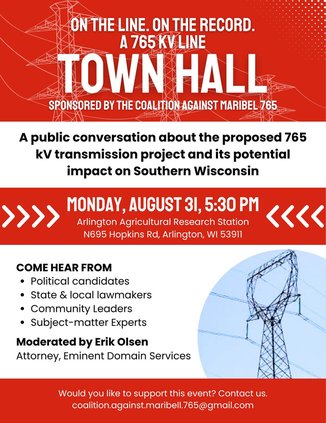
Finally, as a follow-up to the Town Hall in Retreat, an ‘On the Record. On the Line. 765 kV Town Hall’ is planned at the Arlington Agricultural Research Station on Monday, August 31, at 5:30 p.m. At the event, citizens will be able to hear politician’s responses to questions about the proposed line, as they did recently in Retreat.