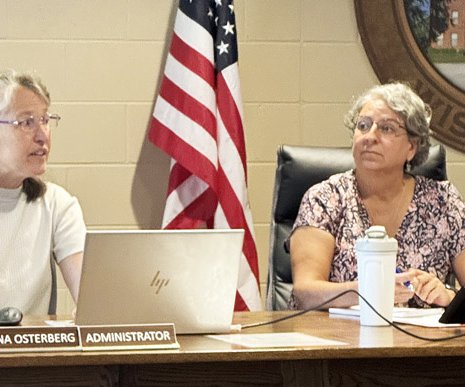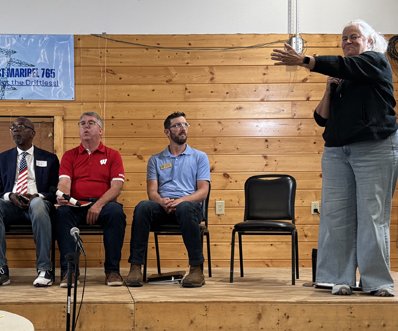
At their August 11 meeting, the Crawford County Land Conservation Committee (LCC) took up the topics of data centers, MariBell and BECI 765 kV transmission lines, and their animal waste and septic system ordinances.
The question facing the committee is what authority they have to enact a data center moratorium or an operational ordinance in the absence of countywide zoning. County Conservation Director Dave Troester reported he’d reached out to County Corporate Counsel Mark Peterson about what the county’s options might be.
So my question was, what are counties without zoning doing? And what if we were in the middle of our comprehensive plan? And if even, potentially, we should have countywide zoning,” Troester said. “The consensus was we should just be working with the townships with zoning to help them.”
Supervisor Mary Kuhn pressed Troester on what other options the county might have.
“Is there no way that we could have a moratorium across the county while we're in the process of developing an operational ordinance, because you don't have to have county zoning to do an operational ordinance, do you?” Kuhn asked. “We could say things like you can have all the permits you want, but you have to do a full environmental impact study. You have to provide all the infrastructure that you're going to use. You have to be at least a mile away from all residences, schools, and businesses, and you have to have some contingency plan so that when it's no longer operational, that you have money set aside to take care of that building, so that the county or the township isn't responsible for whatever they have to do with them.”
“While other counties that have passed moratoiums have had zoning, I don't see any reason that we would have to have that,” Crawford Stewardship Project’s Forest Jahnke said. “Crawford County has passed moratoriums on fracsand mines and CAFOs and other industries before to take the time to do exactly what you're saying. Decide what, if anything, the county wants to do to regulate them. I don't see why there'd be a specific restriction on data centers.”
Troester said that the county does regulate non-metallic mines and livestock facilities, but pointed out that nobody has to seek any sort of permit from the county to build a data center at this time.
Mississippi River Regional Planning Commission’s John Bingol told the committee that he had learned that Carl Green from UW-Extension is offering informational sessions about data centers for counties. He offered to share his contact information with the committee.
“It just seems to me that if you put up enough roadblocks in an operational ordinance, that they maybe would think twice about siting it here, even though we don't have county zoning,” Kuhn pursued. “I know in one instance, a data center was required to do a full environmental impact study, and then DNR came back and said, "No, you can do a smaller one.” So, if we make enough obstacles for them, maybe it'll work. Maybe it won't. But I think it's worth looking into.”
“It’s pretty hard for townships to stand up to something like that because they get railroaded and steamrolled pretty easy,” Kuhn said and Supervisor Al Thompson agreed. “I think if the county at least is saying we're going try and help them and give them some direction, that would be helpful.”
Transmission line
Supervisor Al Thompson reported that representatives from Dairyland Power Cooperative are approaching county board supervisors. He said they are trying to understand what the basis for widespread public opposition to the project is.
“All I told them was that they just aren’t selling a good product,” Thompson told the committee.
Troester reported to the committee that he and Highway Commissioner Kyle Kozelka had met with representatives of the developers of the BECI line, proposed to run between Bell Center to the Columbia Substation near Portage, and from there south to the Illinois state line.
“They just kind of wanted to touch base, let us know that it was coming. I don’t know why they thought we were important enough to meet with…” Troester said. “Nothing groundbreaking came out of it, other than they shared a really good website that they have up. It sounds like the project will be very similar to MariBell.”
One thing I learned from talking with the developers that I think it would be really good to get out to all the townships is that they need a lot of documentation on the roads that they'll be using to put these lines in,” Thompson told the committee. “If you don't have the documentation of what shape they were in before they started, then none of the roads will be repaired. From the homework I've done, the Town of Freeman is lucky because we've had so many disasters that I've got 1,000s of pictures of almost every road. But if you can't prove that that was an actual seal coat road, or it was a gravel road that was well maintained, or the culverts were round instead of crushed flat, then you probably won't get any money out of it. They promise that they're going to fix everything though – they painted a really rosy picture.”
Thompson said the developers told him that some of the cranes they’ll be bringing in would be over 100,000 pounds.
“I think people lose sight of the fact that if we can't stop it, we better at least minimize the damage, and at least make it so they have to at least put it back, because that that would make it even worse,” Thompson said.
Troester told the committee he’d been contacted by the Town of Scott, asking if the county was going to pass a BECI opposition resolution, like the one passed regarding the MariBell project. The committee directed Troester to get a proposed resolution ready for the committee’s next regular meeting.
Ordinances
Both the county’s Animal Waste Storage and Septic System ordinances came up in discussion at the meeting. The Animal Waste discussion had spilled over from the last meeting where the committee asked Troester to pursue a revision with corporate counsel. That revision would have removed the language requiring farmers to provide a witness for land spreading agreements submitted to the county.
“I did talk with Mark Peterson since our last meeting about some of the concerns expressed with the ordinance language, and things that have been suggested,” Troester reported. “His recommendation is, since the ordinance was just passed, that we need to sit tight a little bit longer and find out where the hiccups are. He doesn't think we need to amend anything now in case then in a few months we want to do something. He wants to see how it plays out.”
Committee chair Supervisor Gary Koch reported he’d also had a discussion with Peterson, and had been told the same thing as Troester. He reported that Peterson said that concerned individuals are welcome to call him to talk about it.
“That doesn't make me happy, especially the form that they have to fill out that requires a witness,” Kuhn said. “Once again, you are assuming that farmers are going to be dishonest and they're not going to do what they are supposed to do, and I find that very insulting.”
Committee member Russ Gillitzer observed that if all the committee members call him, he won’t be talking to them for free. Koch suggested the committee invite Peterson to the next meeting, and Thompson agreed that would be the cheapest way to do it, and could have a list of things the committee wants him to know.
Septic ordinance
Discussion of the county’s Septic System ordinance came up in the context of a discussion about the ‘Field of Dreams’ subdivision being developed in the Town of Prairie du Chien by Guy and Tamara Nelson.
“According to Rich and according to me, it's good to go according to our ordinance,” County Real Property Lister Gionne Collins told the committee. “Field of Dreams is going to be a subdivision flat in the town of Prairie du Chien, and everybody has signed it except for me and the county treasurer. The only issue is Becky with the POWTS, and the township has told me they don't want this filed until he's got the wastewater figured out. They said it's contingent upon him hooking up to their sewer line.”
County Zoning Technician Becky Nagel told the committee that when the project first began, she’d had a conversation with Guy Nelson. She said she’d told him that if he was going to do it, he needed to get soil tests to know where septic systems would go to make sure that his lot sizes were appropriate. She said at that time, Nelson told her he was planning to hook up to City of Prairie du Chien sewer because there is a lateral nearby.
“The town’s sewer would require him to go under the railroad tracks. Otherwise, he can’t get to it because he’s landlocked because a neighbor refuses to let him go through his land,” Nagel told the committee. “He's working with the railroad to try to get under the railroad tracks, and I don't know if the railroad's going to let him do that, or what's going on there. But he's adamant that he's going to do that.”
Nagel said she wasn’t sure if the town’s ordinance required that he hook up to their sewer. She said that Tom Cornford told her, “if it doesn’t hook up, we’re not approving it.”
“The problem with all of this is that the town already signed off on this proposal that’s before us,” Collins observed.
Nagel also reported that Nelson had told her that he already has sewer laterals running through the lots.
“He’s done a lot of dirt work, so I don’t know if at this point, lot buyers could even put in a private septic system,” Nagel said.
“He’s doing what Guy does, and that’s whatever he pleases,” Kuhn observed. “This is true Guy Nelson.”
Nagel said her only suggestion is that the committee approve the proposal contingent upon the town providing written confirmation saying that they approve the plat the way it is.
“I know it's crystal ball, but I know the salesman,” Thompson stated. “People end up selling every one of these lots, and it'll be buyer who has to figure it out. He did exactly the same thing in our township.”
“Is there a way that if he doesn't put his own system in, that we could put a deed restriction on each one of those lots that they would have to do all the testing, prove that they could put a septic system in there, and put a restriction on those lots until each one of those lots comes in with the soil test and all that stuff?” Kuhn asked.
“I think it has to be in our ordinance,” Nagel responded. “When we redid our ordinance, we didn't require that like other counties, for instance, Iowa and Grant counties.”
“What do these people do if they buy the lot, and it turns out that it doesn't perk, and so it's a non-buildable lot?” Kuhn asked.
“I think a lot of this sits with the Town of Prairie du Chien. I mean, it's in their jurisdiction. So, why shouldn't we make a motion to refer it back to the town board, explain that the problem we have is the sewer,” Koch proposed. “Until we know what the sewer situation is going to be, we're not going to approve it ourselves. So refer it back and just say we need clarification on the sewer issue. And then, they have to come back to us in writing.”
Koch told Collins that he would be willing to talk with the Nelsons about the committee’s decision. He said the town needed to let the county know where they stand on it, because otherwise it could put the county in a bind, and also put Becky Nagel in a bind.
“The big solution here is for him to get hooked up to municipal sewer,” Koch said.
“The town should never have signed this until they had an agreement,” Collins concluded.
“The thing is, if we approve this one, without any of the POWTS stuff resolved, then how do we not approve somebody else who does the same thing?” Kuhn observed. “If we approve this, we would be setting a precedent by allowing this to go through without the proper septic system arrangements in place, because then we can't deny anybody if we let this go through.”
Collins observed that for many of the CSMs approved by the committee, there is no septic system plan in place. Koch pointed out that for rural properties, there wouldn’t be a municipal sewer hook up option.
“If you want to start requiring an approved septic system plan, then we will need to put it in our ordinance,” Collins told the committee.