
DRIFTLESS - Counties in the Driftless Region of Southwest Wisconsin continue to unite in opposition to the proposed 765 kV transmission lines – MariBell and BECI.
Vernon, Crawford and Richland county boards have all progressed beyond asking for information or communicating formal opposition. Those three counties have now called for the Wisconsin Legislature to enact a moratorium on the consideration or approval of any 765 kV transmission line(s) in Wisconsin until the Legislature has convened a fairly-constituted Legislative Council Special Committee, acting in an open and democratic process, charged with making recommendations for:
- electricity resource planning for the State of Wisconsin
- Public Service Commission (PSC) reform
- a future transmission line policy that includes local stakeholders.
The Vernon County Board acted to pass a ‘Moratorium Resolution’ first at their October 22 meeting. The Richland County Board passed the identical resolution at their October 28 meeting, and the Crawford County Board followed suit at their meeting on November 10.
County objections
The three counties that have passed these ‘moratorium resolutions’ cite facts that call into question Midcontinent Independent System Operator’s (MISO) planning process established need for the line and Public Service Commission impartiality.
The counties allege the following about the MISO planning process:
- MISO does not include landowners and local communities to be impacted in their planning process
- In July of 2025, five states within MISO’s territory filed a complaint with the Federal Energy Regulatory Commission (FERC) stating that MISO’s approval of the ‘tranche’ of transmission lines that include MariBell and BECI violates MISO’s tariff (establishes legally binding rates, terms, conditions, and operating rules under which MISO must operate)
- FERC has still not acted on this complaint 16 months later
- MISO’s own Independent Market Monitor (IMM) reviewed their selected set of transmission projects that include MariBell and BECI, and concluded it to be based on “extremely unrealistic” assumptions, and that MISO’s “methodologies are likely to lead to substantially over-estimated benefits”
- An expert for the five states that filed the complaint with FERC, William Hogan, formerly the Research Director of the Harvard Electricity Policy Group, concluded, like the IMM, that MISO had not fairly compared building the ‘tranche’ of transmission lines that include the MariBell and BECI lines with the alternatives likely to come into existence if they are not built.
The counties allege the following about the PSC permitting process:
- PSC co-sponsored a September 9, 2025, filing with MISO calling for FERC to dismiss the five-state complaint, and describing the PSC’s anticipated consideration of MariBell and BECI as simply an issue of “further approval,” indicating pre-judgment of the projects
- In the filing to FERC the PSC also stated that “[t]he Tranche 2.1 portfolio reflects states’ resource plans,” yet the PSC filing did not identify any Wisconsin ‘resource plan’ reflected in MISO’s approval
- The ‘Advance Plan’ process, Wisconsin’s former method for ‘Integrated Resource Planning’ through which electrical infrastructure and improved efficiency were considered and planned together, was terminated almost three decades ago through 1997 Wisconsin Act 204.
Vernon and Crawford counties have entered into an agreement to retain Progressive Law Group attorney Frank Jablonski. The agreement is based on the assumption that the two counties share the same concerns and goals with regard to the MariBell line.
Crawford County Supervisor Gary Koch explained the nature and structure of the agreement at the October 13 meeting of the Land Conservation Committee.
“Frank Jablonski has done this kind of work and seems to be a pretty impressive guy,” Koch said. “As long as Vernon and Crawford counties have the same goal to stop the line, he thinks we should have a shared agreement, and share the cost. So, his initial agreement is just for those advisory services. It's up to $10,000, of which Vernon and Crawford can share. So $5,000 apiece.”
CAM 765 lawsuit
Citizens Against MariBell 765 filed a lawsuit in Vernon County Circuit Court on June 30, 2026. The lawsuit, if successful, would establish that the MariBell 765 kV transmission line would constitute a public nuisance. CAM 765 is the group of potentially impacted landowners along the proposed preferred route for MariBell in Vernon and Crawford counties.
Since then, lawyers for MariBell developers Dairyland Power Cooperative and GridLiance filed a motion to have the case dismissed. CAM 765’s attorney Erik Olsen responded with a filing establishing a large amount of detail about how landowners in Vernon and Crawford counties would be harmed by the line. This filing was intended to establish CAM 765’s standing to bring the lawsuit.
As a result, the MariBell developer’s motion to dismiss the case was dropped, and the planned motion hearing was cancelled. Now, the developers have once again filed a second motion to dismiss the case.
A motion hearing has been scheduled by Timothy Gaskell, Vernon County Circuit Court Judge, for Monday, Jan. 4, 2027, in the Vernon County Courthouse – Upper Courtroom, at 9 a.m.
Dairyland Power
Crawford County’s Jay McCloskey and Vernon County’s Travis Klinkner received an ‘Invitation to Attend & Provide Comment at October 2026 Dairyland Power Board Meeting.’
McCloskey is a member of Scenic Rivers Energy Co-op (SREC), and Klinkner is a member of Vernon Electric Co-op (VEC). Both SREC and VEC are distribution co-ops that deliver power to homes and businesses in their service areas. Both purchase power from Dairyland, a generation and transmission company.
In Spring of 2026, both SREC and VEC passed ‘information request’ resolutions at their Annual Meetings. In these resolutions, a request was made to address the Dairyland Board regarding the MariBell project.
The invitation from Dairyland to their October 2026 board meeting stated that each designated representative of SREC and VEC could bring up to two additional members, and the group would collectively have 30 minutes to submit comments and information orally and in writing to the board. McCloskey, along with Emile Smith (rural Seneca) and Pete Moris (Mt. Hope) represented SREC members at the meeting. Klinkner, along with Rob Danielson (rural La Farge) and Dan Arnold (rural Viroqua).
The invitation read, “Please note that this agenda item is not a discussion topic for the Dairyland Board; rather, the attendees are invited to offer comment and information for the Dairyland Board to consider in future Dairyland Board decision-making for the Project. If the Dairyland Board determines a response to submitted comment or information is necessary, the Dairyland Board will direct Project and Dairyland personnel to develop a response as a follow-up to the October Board meeting.”
It came out that Dairyland had published a response to the information requests from SREC and VEC on their project website, but members of the distribution co-ops were never notified of that by SREC or VEC.
Incomplete answers
In their remarks to the Dairyland board, the SREC and VEC members said that of the 13 requests for information, one was answered, four had incomplete answers, and 8 were unanswered in the response on Dairyland’s website. This includes:
- A. High-resolution, to-scale map in digital format. Not answered: only a non-high-resolution map was provided
- B. Elevation rendering maps of existing infrastructure. Not answered: the map ‘Total Length and Location’ does not meet the engineering, architectural or regulatory definition of an ‘elevation rendering’
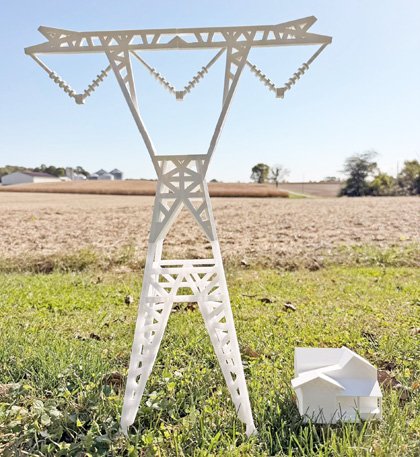
- C. Images of all possible tower designs, sited alone or in combination with another transmission line. Incomplete answer: only one tower type image was provided
- D. For each tower type, per (C) above, provide minimum and maximum heights. Incomplete answer: minimum and maximum heights were provided for only one tower type
- E. For each tower type, per (C) above, provide minimum and maximum widths. Incomplete answer: minimum and maximum widths were provided for only one tower type
F. Documentation of MISO’s consideration of using buried, high-voltage direct current for the project. Incomplete answer: response shares MISO’s considerations and decision-making, it does not address the ‘SOO Green’ buried line in Iowa or include routes considered
G. Vegetation management documentation and sample contracts. Not answered: no requested information provided
H. Documentation of GridLiance’s parent company, NextEra Transmission, accommodations made to mitigate noise and light concerns with previous transmission projects. Not answered: just vague information about noise and light
I. Documentation of GridLiance’s parent company, NextEra Transmission, accommodations made to mitigate electromagnetic frequency (EMF) concerns with previous transmission projects. Not answered: no requested specifications provided
J. Documentation of the ages of the existing 161 kV line segments between Genoa to Seneca, Seneca to Bell Center, and Bell Center to Hillsboro. Answered.
K. Documentation of cost to rebuild the existing 161 kV lines along the route using wooden poles and upgraded conductors. Not answered: cost in 2026 dollars was not provided, nor does the link to ‘publicly available’ analysis work
L. Documentation of total, estimated cost for MariBell that ratepayers would assume over the next 20 years using the preferred route. Not answered: website said this would be provided in the developer’s application to PSC
M. Documentation of total, estimated cost for MariBell that ratepayers would assume over the next 20 years using the alternative route. Not answered: website said this would be pro-vided in the developer’s application to PSC.
After the meeting
Following the meeting, SREC member Jay McCloskey of rural Seneca made the point that the resolutions passed by SREC and VEC asked for ‘transparent communication and open dialogue.’ They stated that neither the response on Dairyland’s website nor the format for the audience with Dairyland’s board had provided either.
“It is apparent that the specifications in the invitation extended contradict the ‘transparent communication’ and ‘ongoing open dialogue’ statements in the response published on Dairyland’s website, as well as the cooperative principles they say they operate by,” McCloskey said. “This is both incongruous and very disconcerting. I am certain the SREC members would share our concerns about this, and also about the answers provided to questions and requests for information that members unanimously passed at SREC’s Annual Meeting.”
VEC member of rural Genoa Travis Klinkner had this to say following the meeting with the Dairyland board:
“There was no discussion - only our ability to voice our frustration and concerns towards the line, and how poorly Dairyland has been at informing the public and members, about decisions that affect members without seeking their input first,” Klinkner said following the meeting. “VEC members are worried about energy bill increases, lack of information about costs and benefits for this line, and how poorly the informational meetings have been set up.”
Klinkner said that as VEC members, they would like to have more transparency, better dialogue, more discussion on generating power where it's needed, alternatives to high power transmission lines, how communities can create more energy independence amongst the cooperative, and encourage more energy conservation efforts, instead of spending billions on transmission.
“During the meeting, the board was silent but appeared to have individuals taking in the information with faces of concern,” Klinkner observed. “I thought it went well. I saw some board members nodding in agreement to some of the things said. Some took notes. It was a good opportunity to point out how they have failed member owners - I think that stung them, because we all said it, and said it clearly.”