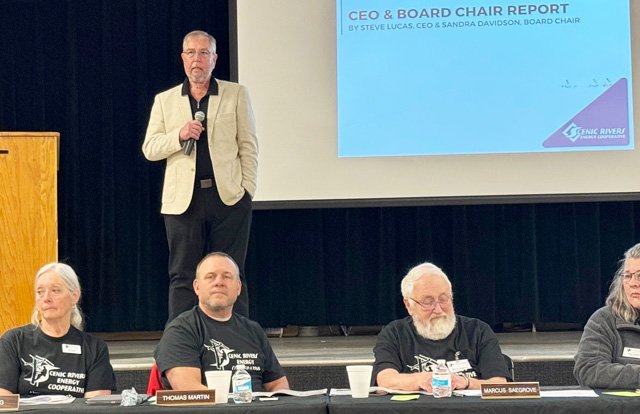
DRIFTLESS - Scenic Rivers Energy Cooperative members voted unanimously for a resolution requesting more information about the proposed 765 killivolt (kV) MariBell transmission line from developers Dairyland Power Cooperative and GridLiance. The decision came at the electric cooperative’s annual meeting, held Saturday, April 11 in Lancaster.
The result of the vote mirrored a similar decision by the members of the Vernon Electric Cooperative at their annual meeting in Westby in late February. A similar resolution is expected to be in front of Richland Electric Cooperative members at their annual meeting, coming up on Saturday, April 18, in Richland Center.
While there was some confusion on the part of those attending the meeting about the ins-and-outs of Roberts Rules of Order, and a motion made to ‘call the question.’ Local Town of Franklin resident Chuck Bolstad cleared things up. Some members felt the motion was an attempt to shut down member input.
“I am speaking to the secondary motion to bring closure to this matter,” Bolstad stated. “Just a reminder, if we vote to turn down the secondary motion [to call the question], then the debate can still continue on the primary motion [to approve the resolution].”
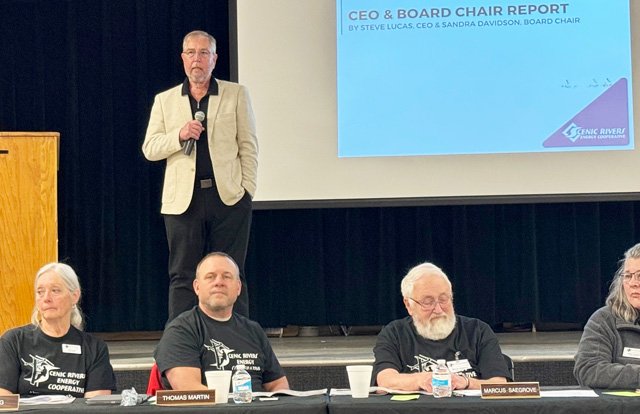
After the secondary motion failed by a vote of the membership, retiring Scenic Rivers CEO Steve Lucas gave the members some savvy advice.
“I've talked to some privately, and I've heard everything you said,” Lucas told the members. “There was just a motion to end debate and call the question, and it got voted down. What I'm seeing from up here is, if the motion to end debate failed, that means that you probably got enough votes to pass this thing. My advice is, take yes for an answer. As soon as you vote, I know what I'm going to do, and you all can watch me do it, but you got to vote first. I guarantee you, I'm going to do what you've asked me to do.”
Once the members voted unanimously to approve the resolution, Lucas walked a paper copy of the resolution over to the Dairyland Power Cooperative representative in attendance, and handed it to them.
Prior to the vote, board member Steve Carpenter had extolled Lucas’ leadership of the cooperative over the last 15 years.
“There are employees who work 24/7 - farmers, doctors, EMTs - this guy works 25/8,” Carpenter said. “I've never seen anybody so committed to his job, to his co-op, to his members, and to his employees. He refers to them as his ‘other family’.”
Massive line
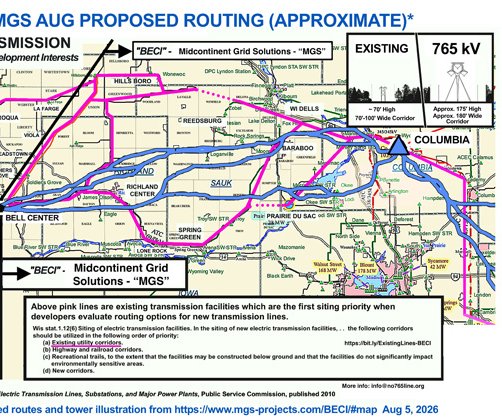
If built, the massive 765 kV bulk transmission line will run in two segments, with two different developers across Southeast Minnesota, Southwest and South Central Wisconsin, to the Illinois state line near Sugar Creek, Wisconsin in Walworth County.
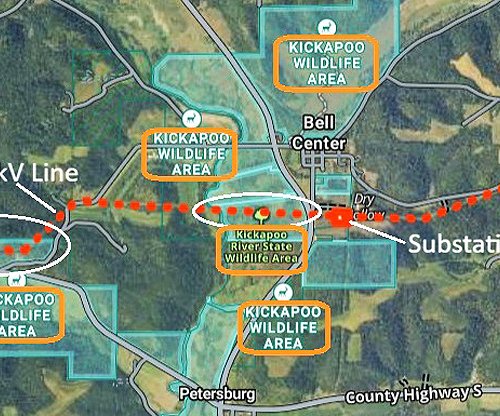
The MariBell segment will run across Southeast Minnesota, starting in Marion, Minn. (the Gopher-to-Badger Link). The line would cross the Upper Mississippi River Fish & Wildlife Refuge into Wisconsin at Genoa. From there, the line is expected to run along existing 161 kV transmission line easements, already owned by Dairyland Power Cooperative, through western Vernon and Crawford counties, to the substation in Bell Center.
From there, a different developer, Transource, will run the line east through an as yet undetermined route, that could cut through Crawford, Richland, Vernon, Sauk, and Columbia counties to the Columbia substation near Portage, Wisconsin. From there, the line would continue to the Illinois state line near Sugar Creek in Walworth County.
Unlike the current 70-foot wood poles, and 100-foot wide easement for the 161 kV line, the MariBell line would install 150-200-foot steel towers and require an easement expansion to 250-feet.
The resolution
The resolution voted on by SREC members reads as follows:
Whereas, member-owners of Scenic Rivers Electric Cooperative own property that stands to be impacted by Dairyland Power Cooperative's & GridLiance-Heartland's proposed 765 kV line;
Whereas, a transmission line of this size has never previously been proposed or built in Wisconsin;
Whereas, all Scenic Rivers Electric Cooperative members would bear the cost of this proposed line;
Whereas, 765 kV transmission facilities are known to create audible noise and visible corona discharge effects, especially under high humidity or damp conditions.
Now, Therefore, be it Resolved, that Scenic Rivers Electric Cooperative members request that Dairyland Power Cooperative and GridLiance-Heartland provide the following information by April 28, 2026:
Be it Further Resolved, that Scenic Rivers Cooperative members request that Dairyland Power Cooperative and GridLiance-Heartland make a presentation concerning the proposed 765 kV transmission line allowing time for group questioning and answering with Scenic Rivers Electric Cooperative members.
Be it Further Resolved, that Scenic Rivers Cooperative members support gaining the opportunity to provide in-person input to the Board of Dairyland Power Cooperative before the MariBell application is submitted to the Wisconsin Public Service Commission.
Be it Further Resolved, that Scenic Rivers Cooperative members support the study, and greater implementation of member-owned and sited power generation, load management and efficiency improvements to increase member self-sufficiencies, lower electricity service costs over time and to promote local job creation and resiliency.
Introduction
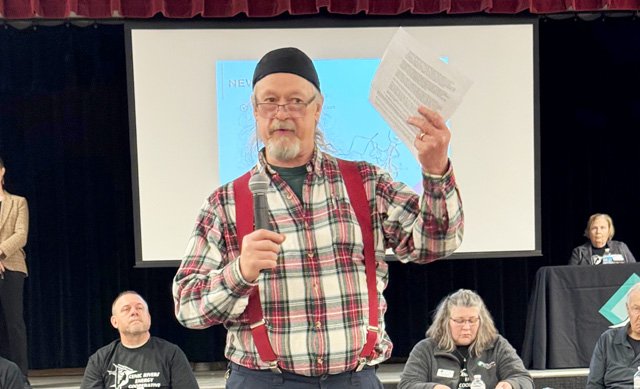
Jay McCloskey of rural Seneca was the author of the resolution approved, and introduced it to the membership. The resolution was moved by McCloskey, and seconded by Emile Smith of rural Seneca.
“I would like to take the opportunity to thank the Board of Scenic Rivers, CEO Steve Lucas, who I've had the pleasure of dealing with on several occasions, and all of the employees of Scenic Rivers,” McCloskey offered. “We live in a very rural area, and we've had very few power outages. Mainly, we had one this past winter caused by a downed power line on our property. And I was shocked at how quickly the linemen were out there on our property.”
McCloskey commented that he was “very proud” to be a member of Scenic Rivers Energy Cooperative.
“The purpose of this resolution is to get answers from Dairyland Power Cooperative about their MariBell Transmission Project,” McCloskey explained. “About a dozen Co-op members worked together in writing this advisory resolution. We would appreciate your support, as fellow members, to vote to approve this resolution.”
McCloskey said that the 140-mile MariBell segment of the massive 765 kV line is a portion of a proposed hyper-scale transmission line project, that would result in almost 300 miles of 765 kV transmission lines, and would run through many other communities as well. The current 161 kilovolt lines and 70 foot wooden poles that are in the “backyard” of our farm, would be replaced with 200-foot steel towers that would carry both 161 kV and 765 kV lines.
“Many of us that would be affected by MariBell have tried valiantly for months and months to get more information from Dairyland Power Co-operative,” McCloskey shared. “We’ve written letters, attended meetings, and asked a lot of questions, requesting written answers. To date, our questions have not been answered.”
McCloskey shared that ultra-high Voltage 765 kilovolt lines are very rare in the Midwest. He said the highest capacity transmission lines currently in Wisconsin or Minnesota are 345 kV (Badger Coulee, Cardinal-Hickory). He pointed out that all Scenic Rivers Electric Co-op members would bear the cost of the MariBell line, for the portion of the lines in SREC’s service area.
“We know that there are visual effects, audible effects, property devaluation effects, loss of farmland and woodland, for a major slash through our unique and beautiful part of the world,” McCloskey continued. “We know that 765 kV lines would result in migratory issues for birds, dangers to wildlife, negative impacts on hunting, erosion problems, potential health problems, and people who would be displaced from their homes and farms, among other horrors.”
McCloskey stated that impacted landowners, communities and municipalities deserve to know the answers to the many other questions:
- high-resolution maps and the elevation renderings of existing infrastructure/easements.
- actual tower designs, including minimum and maximum heights and specifying below-ground configurations.
- estimated total weight of each tower and its foundation, so we can consider impacts upon our karst geology and aquifers.
- plans for vegetation management and erosion control, and about fire control if a line goes down in our forests.
- the costs that we ratepayers would have to pay over the next 20 years.
“None of this is an outrageous ask for a project that will change our lives so dramatically. Yet, we still wait, and wait, for the information,” McCloskey shared. “First, Dairyland asked us to write letters with our unanswered questions, telling us ‘we’ll get back to you.’ We did - they didn’t. Many have written follow-up letters, asking again. Still nothing. Now we’re being told we need to make individual appointments with Dairyland to get our answers.”
Lies, lies, lies
McCloskey said that a neighbor made one of those appointments, and it turned out NOT to be with Dairyland, but with Doyle, the developer’s survey subcontractor.
“When the Doyle representative showed up at our doorstep, that individual attempted to coerce me and my wife into signing their ‘Survey Consent Agreement,’ and pay us $500, to provide Dairyland an "Irrevocable License and right of entry,” to survey our property,” McCloskey shared. “As happened for us, and the many Landowners I’ve talked to, refusal to sign their form resulted in the representative threatening eminent domain. My wife and I were told, ‘if you don’t sign, they’ll just do this by eminent domain’.”
McCloskey pointed out that this is a lie—property cannot be ‘condemned’ by eminent domain until after the Public Service Commission has approved the project. He said he and his wife were also told, “most of your neighbors have signed this.” We checked with many neighbors—none had signed - another lie. The third lie McCloskey said the Doyle representative told them was, “this is going to happen anyway.”
McCloskey emphatically told the group, “this is not inevitable,” and so, that was another lie. McCloskey shared that another neighbor had a meeting two days ago, in which the Doyle rep told them that there is no property devaluation at all with these lines going across the land.
“We know this is false,” McCloskey said. “So yet, another outright lie.”
Dairyland is running cutesy ads, with adorable children, where they link the new transmission line with “protecting our land, our soil, our way of life and livelihood for the next generation”. If this is such a great idea, then why won’t they share the details and answer our questions?
McCloskey pointed out that the reality is that the electricity transmitted in the 400 miles of the 765 kV lines, that would run all the way from the Mississippi River to the Illinois border, is not needed in rural Wisconsin, but would be needed for the AI data centers in eastern Wisconsin.
“Wisconsin’s electric needs have actually decreased over the past 20 years. So, it’s not for us, but it hurts us. We are right to question this,” McCloskey asserted. “The reason we are asking Scenic Rivers for their help is because they are one of the 24 electric co-ops that are members of Dairyland Power Cooperative. We know our Scenic Rivers Co-op will have our backs, through their dedicated district supervisors, staff, and management.”
Discussion
Several Co-op members from rural Seneca joined McCloskey and Emile Smith to discuss the potential impacts of the line for their families, land values and lifestyle.
“I live near Seneca, and these towers would not directly be on my property, but adjacent to my property, on the field. On January 29, I sent two letters to the companies that are in charge of this project. I only got one response back on March 5, and basically they told me it doesn't concern me because it's not on my property,” Silke O’Donnell told the crowd. “These towers will not improve the quality of life for our community. I am really worried about the wildlife in my area. I am really worried about the pesticides. This is not a good project - we lived in the Driftless Area for hundreds and 1,000’s of years, and were spared any changes. This is going to be devastating to our area. Please vote to get some answers - we do not want these towers. We cannot undo these changes.”
Emile Smith of rural Seneca shared his sentiments next, extolling the value of information conveyed to members in Scenic River’s newsletters.
“They're telling us what's coming, they're telling us why it's coming, and they're telling us how it's coming, and they're telling us what kind of challenge it is for the people that sit on the board and represent us. And then represent us at Dairyland Power Cooperative,” Smith said. “Thank you very much. As a consortium of electric co-ops, is it time for us to change direction? Perhaps. How do we change direction? We think of new things - we innovate. We know that there are solutions beyond running a million volts across the countryside where there's hardly any light, and there's hardly any noise. MariBell will be light and noise and power, but for whom?”
Marilyn Sleik from the Town of Seneca also made the journey to Lancaster to speak to the issues.
“I got a good friend. She's 95, and she's had her farm since 1964,” Sleik said. “Her son-in-law retired, and they built a house on the property so he could help with the farming, and now they're going to be putting these things right by the house through their farm. The cattle are going to be underneath the lines. Who knows if you'll even be able to do anything with the cattle after the pollution that they get from the lines, and the lights and everything. I just think it's a bad thing.”