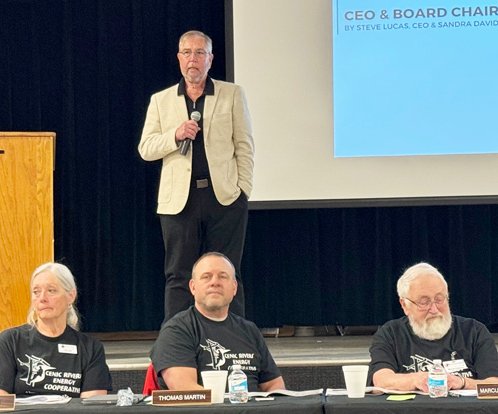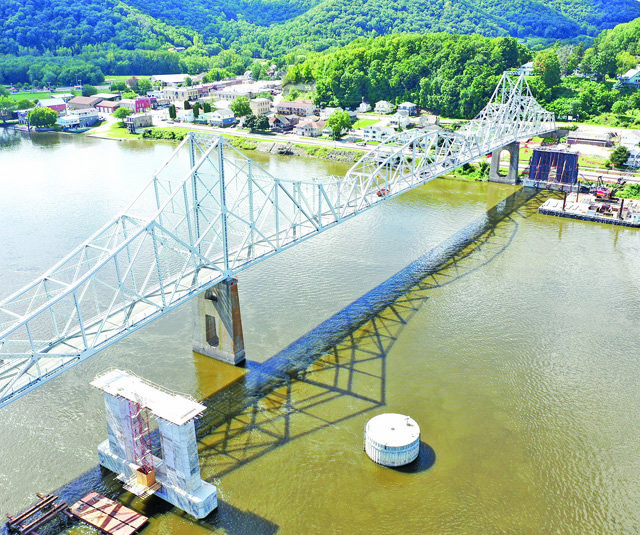
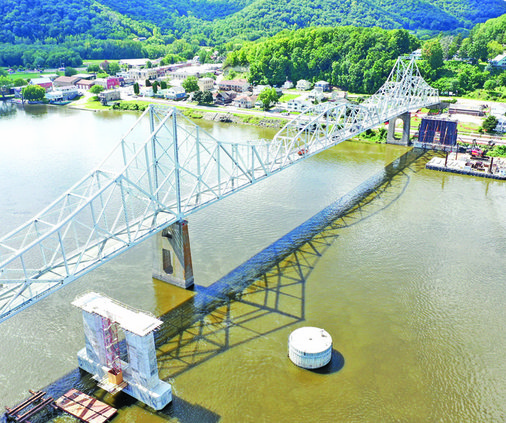
Iowa DOT’s Clayton Burke gave another of his monthly ‘Bridge Talks’ at the Meehan Memorial Library in Lansing last Thursday. In his talk, Burke discussed preparation to launch the car ferry and the demolition plan for the old bridge.
Burke explained that their contractor is busy doing the preparation work to allow for the car ferry operation on both the Lansing and Wisconsin sides of the car ferry route.
“One of the elements that we had to improve before we could start the car ferry is the railroad crossings at the Lansing Marina,” Burke explained. “Before there was a pretty significant bump going over the tracks, and the turning radius was very tight. This made it a challenge to get certain vehicles in and out of that area. So, we took a chunk of Front Street out, and the railroad came in and put nice new concrete crossings in, and then we had an asphalt contractor, repave the roadway. Then they put a new ramp down to the Marina, so the surface is nice and smooth.”
Burke said that in the same area they’d also been working on a ‘dock wall,’ where they put in a bunch of sheet pile and fill it with sand, similar to a coffer dam. Burke said he expected work on the Lansing side to be complete in a week or two.
“That's where the ferry lands and puts its ramp down, and then vehicles can drive up onto it,” Burke said. “We’re also constructing one of these on the Wisconsin side of the car ferry route.”
Burke said that the work on the Wisconsin side, near the construction work area and the Army Corps of Engineers sand pile, is a little more complicated.
“We have to get people through the Army Corps of Engineers’ big sand pit. To do that, we need to construct a new roadway. So, we're building a gravel road that connects Highway 82 at the entrance over to where the boat ramp is by the river,” Burke explained.
Burke said that concrete barriers would be placed along the side of the road to prevent car ferry passengers from getting into the sandy area.
One meeting participant asked if the elevation of the car ferry landings would be impacted by high water on the Mississippi River?
“We're making it the same elevation as the Lansing Marina,” Burke said. “So if the Marina floods, then we're out of luck.”
Burke said that lanes of the gravel road would be wide enough for snow plowing, and that it would be ‘fun this winter.’ He said that the Corps will continue to send trucks into the area to remove sand, but no new sand will be deposited there until construction of the new bridge is completed.
Burke said that the Cassville Car Ferry would be in service throughout the winter, and then the plan is to contract with other vendors who bid on the project.
“The idea is that we contract with Cassville for the winter, and then we're working with two other service providers that that had responded to our request for proposal,” Burke said. “Then we would develop a contract with one of the other two service providers for the rest of the period of the closure.”
Burke said that the car ferry can accommodate 12, two-axle, vehicles at a time, and would run for 16 hours-per-day. He said that means, if the ferry always runs at capacity, that it can carry about 700 vehicles per day.
Demolition plan
Burke said that the initial demolition of the old bridge will involve just removing the steel deck.
“The contractor will just make cuts in the deck and then use a forklift to lift those sections up and take them and some of the steel beams off,” Burke explained. “When we demolish the old bridge, the first thing we're going to do is only take down very center and eastern portion of the bridge. We have to leave the Iowa side in place because that is over the railroad and the roadway next to houses.”
Burke said then, about mid-December, after they have everything prepared for the implosion, that's when a demolition contractor will come out to start pre-cutting some of the members.
“They'll attach what we call shaped charges, which are just explosives in strategic locations, and then they will implode the bridge and drop it into the river,” Burke said.
“There's been some extensive design by a demolition engineering firm that analyzed leaving the Iowa side in place. And they looked at what happens when you separate that center portion from the Iowa side,” Burke said. “It's actually kind of like a giant spring. So when that center portion drops, this side will spring up a little bit and come back down. And there's a lot of analysis to figure out what that does to each of those different steel beams that are that are going to be left in place.”
One meeting participant asked if the Iowa side will hold itself up when the center is removed?
“Yep,” Burke replied. “It never goes out of tension, which is our big concern. So some of these top members are just I-beams, and they don't have the strength to go into compression, they'll just bend like a plate would. So, we wanted to make sure they never went into compression, which is what they found when they released that spring. We've got a plan together to do the demolition and to keep the Iowa side in place. And then the ferry can run underneath the Iowa side, through the demolition of the cantilever. And then after the bridge is dropped in the river, we'll have to stop the ferry for a day or two, while they pick some of the steel beams out of the river and make sure that it's clear and safe for the ferry to continue.”
Burke said that then they'll start working on that section on the Iowa side that was left in place, and will carefully take that apart piece by piece. Then, he said, the contractor will have to watch out for the ferry as it goes underneath, and go take a piece off, then let the ferry go, and then take another piece off and work together that way.
Burke said it would take about two months to get the deck off, and then the implosion is instantaneous. Then, he said, it will take about a month to scoop the debris out of the river, and they can be working on the Iowa side at the same time, but said they'd be done by spring of 2026.
“It does take some time, and especially when you have to be careful and take part of it apart piece by piece,” Burke explained. “Typically, bridges are just completely dropped, and then it's easier to take the pieces off site. They're going to have to put divers in the water to get the steel out, or they're going to attach some floats or something.”
Burke said that the demolition plan is very strategic.
“They're not going to blow it into a million little pieces. They're just going to cut it into some of the biggest pieces that they can handle,” Burke explained. “And so as it drops, it'll stay together in manageable sections, and then they'll use excavators and cranes to grab them, pull them up on the barge, and then take them off site.”