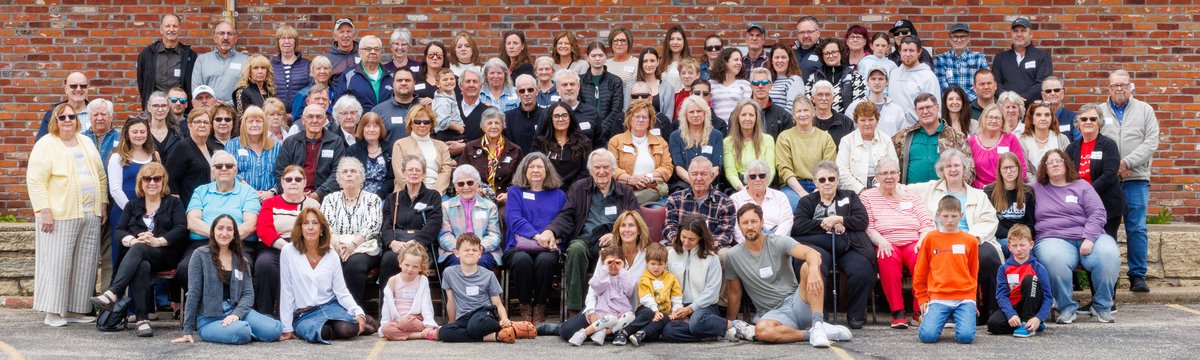
On May 2, more than 100 descendants of Jacob H. and Mary Frances Wagner gathered to celebrate the 100th annual Wagner Family Reunion—a remarkable milestone few American families can claim.
Held at Crossroads Restaurant in Arthur, the reunion honored a century of family traditions with a buffet luncheon, photo displays, and certificates from the Governor’s Office and the Wisconsin State Historical Society to recognize the significance of the occasion.
Deb Kenny Becker and Rita Oleson Riley offered a meal prayer and led the program. Introductions by family were made. Attendee Patrick McKeon introduced his family and reminisced about his mother, the late Ruby Wagner McKeon. “Traveling to the annual reunions from the suburbs of Milwaukee provided her with connection, memories, and a renewed sense of pride in being a Wagner,” said the middle son of the late Harold “Butch” and Ruby McKeon.
The Lloyd Wagner Sr. family was especially well represented, with 35 descendants attending. Among them were the oldest attendee, 94-year-old Carol Bourette Thomas; the travelers who came the greatest distance, Sophia Hernandez and her mother, Dr. Amy Wagner of Santa Clarita, California; the youngest attendee, 3-year-old Luca Kieler; Robert Wagner, the only grandchild of Jacob Wagner present; Michele Ingersoll Peacock, who traveled from Arizona; and 8-year-old Isla Wagner, who claimed the most “greats” as a great-great-great-great-granddaughter of Jacob and Mary.
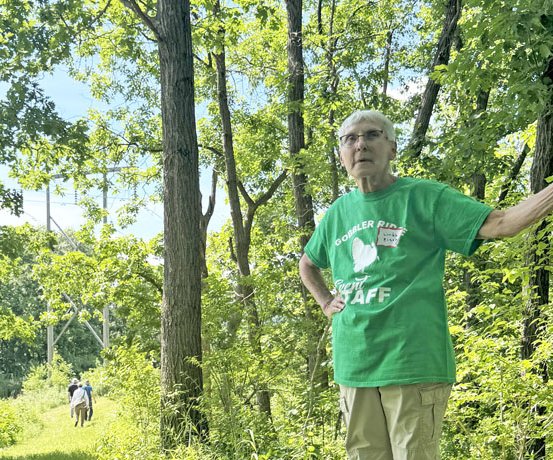
After a group photo, attendees boarded two school buses for a tour of the 13 farms once owned by Jacob Wagner. Some attendees had taken the bus tour that was part of the 2010 reunion. Clyde Wagner and his family researched and created a detailed Farm Tour booklet. For the 100th reunion, their family served as the reunion planning committee, created a 2026 Farm Tour booklet, and narrated the bus tour. The Farm Tour helped descendants understand where earlier generations lived, farmed, worshipped, went to school, and were buried.
The family’s history survives largely because a dedicated descendant took the time to preserve it. Jacob’s great-granddaughter, Cheryl Lyght Lemanski, spent years manually researching and typing the Wagner genealogy. In 1991, she published The Wagner Families of Farview, Grant County, Wisconsin 1828–1991, documenting more than 160 years of family history. Cheryl and two of her daughters attended the 100th reunion.
The bus tour ended at Rock Church Cemetery near Livingston, where Jacob, Mary, and their children are buried. Cheryl Lemanski’s Wagner genealogy and the Clyde Wagner and family Farm Tour booklets transformed family memories into recorded history.
The Wagners’ American story traces back to German emigrant Heinrich “Henry” Wagner, born in Germany in 1820. In 1854, Henry married German-born Ernestina Taenzler in Philadelphia, Pa.
Shortly after their marriage, the young couple journeyed west to Wisconsin with her parents and some of her siblings. Wisconsin had become a state in 1848, and inexpensive farmland offered an opportunity to immigrant families willing to endure hardship and uncertainty. The family settled on Harold Road in the Town of Liberty, Grant County. In 1861, a new German Evangelical church, St. Paul’s Evangelical and Reform Church, was built in Liberty Ridge, and Henry was a charter member.
Henry and Ernestina Wagner had three sons and eight daughters. Four of the daughters did not live to reach 6 years old. Matilda, who attended the Platteville Normal School, became ill and died at age 31.
The Taenzler property was in bad shape, and life on the frontier was anything but easy. The family home burned, forcing the Wagners to move into the barn. Later, the barn roof collapsed in a windstorm. In 1867, Henry bought a farm owned by Jacob Weir in the Town of Clifton, and they moved his family there. It was once part of the Clifton Badger Mining Co. When gold was discovered in Colorado, Henry and a neighbor briefly left Wisconsin to prospect at Pikes Peak. He returned the following year, reporting harsh conditions and little success.
Henry’s oldest child, Louis, was a skilled carpenter. He built a house for his wife, Matilda Latham, on Grant County E west of Livingston. He also built four houses on the Wagner block in Livingston. He and Matilda helped to build the Farview Congregational Church and were active members until their deaths.
Jacob was Henry’s fourth child. He was born in Decemnber 1861, on the farmstead in Liberty. In 1877, Ernestina filed for divorce. The impending divorce and financial hardship began to eat away at Henry.
Later in 1877, the family suffered a far greater hardship when Henry died by his own hand at 56. Jacob was only 15 when he and his older brothers, Louis and William, suddenly became responsible for keeping the farm up and supporting their mother. Ernestina lived on the Wagner farm until she died in 1907 at 73. There is one large headstone for Ernestina Wagner and their five unmarried daughters at the United Church of Christ Cemetery in Lancaster. Henry is buried in the Lima Union Church cemetery.
In 1886, Jacob married Mary Frances Hannan in Ellenboro. They had four sons and seven daughters: Martha Allen, Lloyd; Frances Wisdom, William, Viola Mellor, Cora (drowned at 3); Jesse, Floy Knutson, Alta Lee; Melda Haney, and Charles.
The difficult early years shaped the tireless work ethic and determination that would later define Jacob’s life. Like his older brother Louis, Jacob was a remarkable builder, stone mason, and farmer. He had an instinct for improving both land and buildings.
Jacob and Mary Wagner’s home farm was on Fairview Road in the Town of Ellenboro. Jacob made many improvements, including building a new house and a new barn. The Platteville newspaper reported that “The big barn was 45 x 96 feet and was the largest barn in the county.” Jacob’s children climbed a large hill and cut through Henry Reed’s land to get to the Henry School. In 1992, owners Marvin and Nora Knutson Ellis received a Century Farm Certificate signed by Gov. Tommy Thompson.
Jacob went into debt for the first time in 1892 when he purchased the Kaump farm in Sections 1 and 6 of the Town of Lima. Many of the farms required extensive improvements, and Jacob often built the barns and homes with help from his sons and sons-in-law.
Despite suffering from rheumatism by 43, Jacob rarely slowed down. He had boundless energy and continued to buy farms in Clifton, Lima and Liberty. Jacob would look for farms that had a water source for the cattle and, if possible, a nearby quarry. When he, Mary, and the family moved to a new farm, he would rent the previous farm to a relative. As each of his children married, Jacob helped establish them on a farm he owned, ensuring the next generation remained connected to the land.
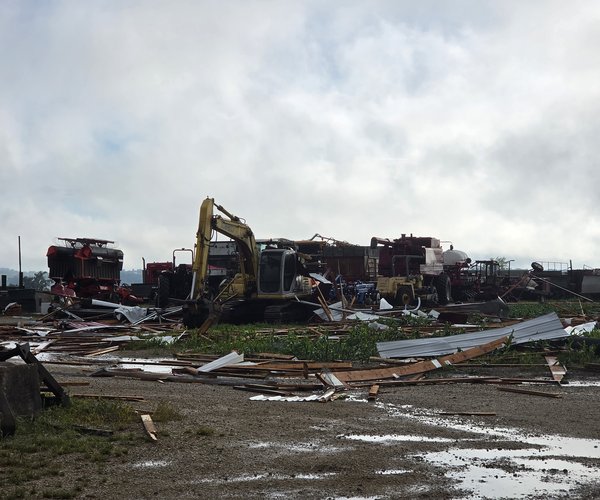
Jacob’s daughter Viola and her husband John Mellor started farming on her grandfather Henry’s farm in Section 5 of Lima. In 1945, my parents, Merlin and Darlene Fillbach Mellor, purchased the farm, and my siblings and I grew up there. Jacob built both the barn and the house. The barn was damaged in a windstorm in May 1950. It was torn down and replaced with a very large structure for its time, 60 feet long and 48 feet wide. Two Century Farm Certificates were awarded. Viola received one in October of 1948, signed by Gov. Oscar Rennebohm, indicating that the farm was acquired in 1835 and had remained in continuous family ownership. Merlin received the award in August of 1986, signed by Gov. Anthony Earl.
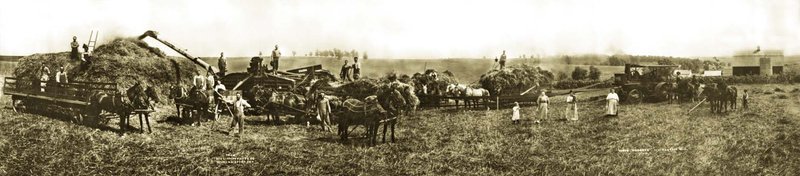
Threshing was a busy time on the farms. Jacob and his son, Lloyd Sr., owned the threshing and silo-filling equipment in the area. In 1917, a panoramic photo of the threshing crew was taken on Lloyd’s farm in Clifton. The steam engine was fired in the morning, and it took nearly all morning to reach full capacity. A water boy added water as needed. Another youngster would watch the horse team. A long, moving belt connected the engine to the threshing machine, creating a constant threat. For safety, the thresher’s owner stayed by the engine to shut it down in case of emergency.
Young children would ride a pony to deliver the call for “dinner time.” The host wife depended on help from the other wives. Several chickens, ducks, or geese were prepared and served with potatoes and vegetables from the garden. Seven or eight berry pies were needed, and the women prepared their best pie. Threshers were not afraid to take seconds, inspiring the saying, “eating like a thresher.”
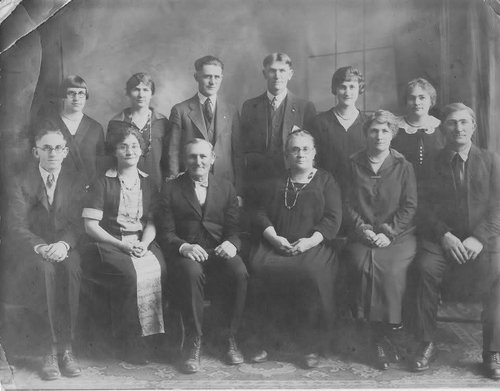
In 1922, Jacob and Mary divorced, after 36 years of marriage. Mary received the 120-acre farm northeast of Hake School, along with part of the home farm. With help from her younger sons, Mary lived on her farm until she moved to the Wagner block in Livingston. Her brother-in-law, Louis Wagner, had built her a new home on County E of Livingston, but she so liked the smaller house across the road from the village park where Louis lived that they swapped houses. Mary lived here until she died in 1948.
Jacob spent his later years rotating among his children’s homes, helping with construction projects and farm improvements. Determined to keep the family united, Jacob began organizing large family gatherings at Christmas, always insisting on providing the meat for the meal.
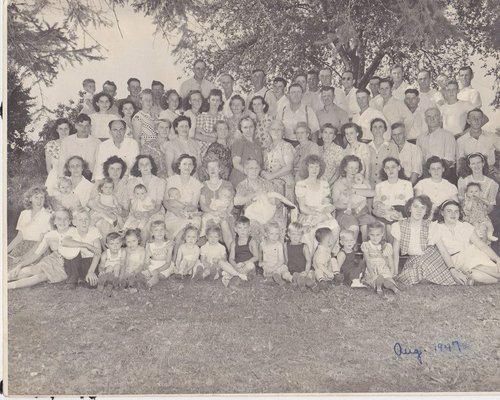
In 1926, the first official Wagner Family Reunion was held at Lloyd Wagner Sr.’s farm. The married children continued the annual reunions by taking turns hosting. In later years, the reunion became a summer event. In August 1947, Edward and Dollie Wisdom Roh hosted the 21st reunion on their farm. A large group gathered, and 82 relatives were photographed. Later, the reunions were held in local parks and restaurants.
The 60th reunion was held in May 1986, at the Livingston Fire Station. The Wisconsin State Genealogical Society issued a Certificate of Commendation. The oldest attendee was Frances Wisdom, Jacob’s oldest living child, just shy of 96. The oldest grandson was Donald Mellor, 73. The oldest granddaughter was Dorothy Wagner Bourette, 75. The youngest member was Bradley Kieler, age 5 months, son of Debra Booth Kieler. Jakie and Phyllis Wagner came the furthest, from Sarasota, Fla. The oldest married couple was Homer and Mary Wagner Yelinek, married 52 years. Jacob and Mary had 53 grandchildren, and 51 were still living.
Jacob had become one of the area’s most successful landowners. Over time, he had acquired thirteen farms totaling nearly 1,500 acres. Jacob died in May 1928 at 66. He was living on the last farm he had purchased, located near Livingston. It was the former Arch Rundell farm in section 23 of Clifton. At the time of his death, Jacob was the second-largest landowner in Wisconsin, behind only Nelson Dewey. Henry’s farms were valued at $123,000 — a tremendous sum for the era.
However, the true legacy of Jacob and Mary Wagner was never measured by acreage or property value. It lives on in the generations that followed — in the farms still worked by descendants, the stories preserved around family tables, and the annual reunions that continue to bring the family together a full century after it began. What started with German emigrants building a life on the Wisconsin frontier became something far greater: a family rooted in resilience, hard work, and enduring connections across generations.
Darla Mellor Banfi is Jacob Wagner's great-granddaughter.