The Crawford County Land Conservation Committee (LCC) continued their ongoing discussion of industrial energy projects. Those include transmission lines, utility-scale wind and solar projects, and data centers.
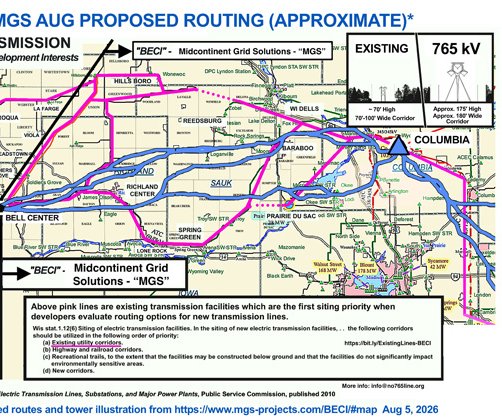
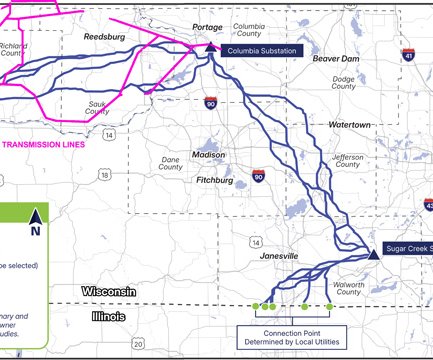
The committee unanimously approved a resolution, modeled on one approved by the Town of Freeman, to state opposition to siting of the 765kV MariBell bulk electrical transmission line through Crawford County. That resolution will go before the Crawford County Board of Supervisors on Tuesday, June 16 with the committee’s recommendation, for approval.
On Tuesday, June 16, the Crawford County Board of Supervisors unanimously approved the resolution. Look for the text of the resolution in this edition.
Data Centers
Committee chair Supervisor Gary Koch asked County Conservation Director Dave Troester to share what he had learned about other counties’ efforts to protect themselves against development of data centers in their municipal boundaries.
Troester said he’d forwarded along a detailed zoning ordinance amendment recently enacted by Allamakee County in northeast Iowa.
“The key thing is, all these counties doing this stuff have county level zoning,” Troester shared. “I don’t know what they’re doing about industrial wind and solar projects. Hoping to speak with Vernon County Zoning Administrator Matt Albright about what they’re doing – they also don’t have county level zoning, but I’ve not heard back from him.”
“A lot of counties in Wisconsin are doing data center moratoriums, but all those counties have countywide zoning, and we don't, so it falls really to towns if they have zoning or villages and cities if they have zoning,” Koch explained. “It's pretty hard for us to implement anything.”
Koch pointed out that the county would be diving into an update to the county’s comprehensive plan later in the summer or in the fall.
“I think data centers are going to be a topic,” Koch said. “There's only three counties in the state of Wisconsin who do not have countywide zoning. When you have issues like we have today, it’s sort of gotten past time, because you can't implement any enforcement.”
Crawford County Supervisor Mary Kuhn from Utica Township was adamant that the county should push forward on the data center issue.
“I know of 68 municipalities across the United States that have issued moratoriums against data centers. California now says that if you get government money, any kind of state money, tax money for your data center, then that has to go to the people to be voted on,” Kuhn observed.
Kuhn shared the story of a data center developed in the Lake Tahoe area of California by Elon Musk.
“Lake Tahoe area residents have been informed that their energy company will no longer provide energy to them, because all their energy now has to go to supply for the data center,” Kuhn shared. “My nephew works in the Port Washington area of Wisconsin, and has seen how angry local residents are about the lack of transparency around data centers there. They were told that construction would only happen five days per week. But then, due to rain, they got behind, so now it’s ongoing 24/7.”
Kuhn shared that the State of Maine had recently enacted a statewide moratorium on data centers.
“I just think that to ignore it and say, well, we can't do anything because we lack some authority, is not acceptable in my opinion,” Kuhn stated.
“How does it help us?” Kuhn asked. “This is why they're working this area. For a small data center, they require 300,000 to 500,000 gallons of water a day. The larger ones take 3-5 billion gallons of water a day - that's a huge amount of water to move to remove, and if it comes out of the aquifer, then what do we do?”
Supervisor Al Thompson from Freeman Township weighed in on the issue.
“The Town of Freeman’s building inspector lives in Mt. Sterling, and travels all over America, inspecting data centers,” Thompson shared. “He said there's not one good thing for the local person at all in data centers. I don't think that towns have really had this on the radar - we need to start doing something at the town level. Our zoning will bring something up in Freeman Township – we need to make it a lot more transparent.”
Troester shared that Dane County had recently passed an 18-month moratorium on hyper-scale data centers (over 5,000 servers or 10,000 square-feet).
“I spoke to a Clayton County (Iowa) Zoning and Environmental Health person, and she sent me their moratorium that they passed the last year,” Troester shared. “They're debating a final banning of them with their zoning ordinance. The thing to do is ask Crawford County Corporate Counsel Mark Peterson what he thinks we could do if we're going to do a moratorium. What is the justification? Are we considering proposing countywide zoning?”
In other business
In other business, the Crawford County Land Conservation Committee:
- voted to forward the final, amended version of the subdivision ordinance to the Crawford County Board of Supervisors, after public notice had been provided in local newspapers
- heard that Sanitation and Zoning Technician Becky Nagel had issued 11 sanitary permits, reviewed 10 soil tests, been on site for 11 septic system installations and 16 soil tests, and learned that the Falling Rock community near Lynxville is now in compliance
- learned that Mississippi Valley Conservancy’s streambank improvement project on their Plum Creek property has been issued a zoning permit, and they are just finishing up the paperwork with Ducks Unlimited, and their hydrology and hydraulics study, with the project is likely to begin in June
- heard in public input from Town of Freeman resident Edie Ehlert, that whether or not the county has countywide zoning, adopting an operations ordinance might be an avenue to prevent the worst impacts from a potential data center development, and that would not require countywide zoning to be in place
- learned that a public education event about the Driftless Area Water Study results in Crawford County, and across Vernon, Crawford and Richland counties, will be held on Saturday, June 27, 4 to 6 p.m., at the Gays Mills Community Commerce Center
- heard a detailed report from Conservation Technician Travis Bunting about his work monitoring construction of the Gruber Livestock North and South facilities
- learned that Crawford County UW-Extension educator Sara Tedeschi has been working hard at plans to encourage agricultural tourism in the county, with 90 farmers in the area interested in investigating ‘agritourism.’
At their meeting on Tuesday, June 16, the Crawford County Board of Supervisors unanimously adopted the following resolution stating the county’s opposition to the siting of the proposed MariBell 765 kV transmission line in Crawford County. That resolution reads as follows:
WHEREAS, Dairyland Power Cooperative, through the Midcontinent Independent System Operator (MISO), is proposing the construction of a 765-kilovolt electric transmission line extending from Marion, Minnesota to Bell Center, Wisconsin, commonly referred to as the MariBell Project, and identified as part of MISO Tranche 2.1; and,
WHEREAS, until September 2024, MISO Tranche2.1 planning maps avoided the Driftless Area option for a more northerly route through the Xcel Energy territory. After years of planning otherwise, in just three months between September and December of 2024, a less direct route through the central Driftless Area was adopted and awarded without competitive bidding to a partnership of GridLiance and Dairyland Power Cooperative; and,
WHEREAS, the proposed MariBell Project route is intended to traverse areas in Crawford County, Wisconsin, including lands within and adjacent to the Townships of Freeman, Haney, and Seneca and the Village of Bell Center; and,
WHEREAS, Crawford County is located within the Driftless Area, a region characterized by steep and fragile topography, karst geology, cold water streams, productive agricultural lands, extensive timber resources, and landscapes that are unusually sensitive to disturbance from large scale linear infrastructure; and,
WHEREAS, the proposed project is in proximity to the Upper Mississippi River National Fish and Wildlife Refuge, including Pool 9 of the Mississippi River, an area of national ecological significance; and,
WHEREAS, Pool 9 and adjoining bluff lands provide critical habitat for nesting bald eagles and lie within a recognized tundra swan migration corridor, both of which are highly sensitive to habitat fragmentation, aerial obstructions, construction disturbance, and long-term landscape alteration; and,
WHEREAS, transmission lines of the 765-kilovolt class require wide permanent easements, tall structures, and ongoing vegetation management that result in substantial ground disturbance and may adversely affect wildlife behavior, nesting success, migratory patterns, and the ecological integrity of protected and sensitive areas; and,
WHEREAS, the construction and permanent presence of a 765-kilovolt transmission line may result in measurable reductions in property values for affected and adjacent landowners due to visual intrusion, limitations on land use within easements, loss of privacy and rural character, and perceived safety risks; and,
WHEREAS, reductions in assessed property values or changes in land classification associated with the proposed transmission corridor may lead to long-term loss of property tax revenue for Crawford County, shifting the tax burden to other residents and constraining the County's ability to fund essential local services and infrastructure; and,
WHEREAS, the proposed MariBell Project would require permanent clearing and perpetual maintenance of a broad transmission right-of-way, resulting in the irreversible loss of productive timberland, forest habitat, and associated ecological, economic, and carbon-sequestration benefits, and,
WHEREAS, the scenic bluff lands, river corridors, forested landscapes, and undeveloped rural character of the Driftless Area are essential to tourism, outdoor recreation, and associated local business activity, and the introduction of large-scale transmission infrastructure may substantially diminish tourism appeal and result in long-term economic losses to the County and surrounding region; and,
WHEREAS, residents, landowners, and the electorate of Crawford County have expressed significant concern regarding the cumulative environmental, agricultural, economic, scenic, and property-related impacts associated with the proposed MariBell Project; and,
WHEREAS, the Crawford County Board of Supervisors has a responsibility to represent the interests, welfare, and expressed concerns of the County electorate and to communicate those concerns to state regulatory authorities;
NOW, THEREFORE, BE IT RESOLVED, that the Crawford County Board of Supervisors, on behalf of the electorate of the county, formally states its opposition to the proposed MariBell 765-kilavolt transmission project as currently proposed, due to the exceptional sensitivity of the Driftless Area and the unacceptable potential impacts on wildlife habitat, natural resources, agricultural, and timber lands, property values, county tax base, tourism revenues, and overall community character;
NOW, THEREFORE, BE IT FURTHER RESOLVED, that the Crawford County Board of Supervisors respectfully requests that the Public Service Commission of Wisconsin give careful and deliberate consideration of the Driftless Area, the presence of the Upper Mississippi River National Fish and Wildlife Refuge, and the formal concerns of affected local governments and residents during its review of the MariBell Project;
NOW, THEREFORE, BE IT FURTHER RESOLVED, that this resolution be entered into the official records of Crawford County and transmitted to:
- The Public Service Commission of Wisconsin
- Dairyland Power Cooperative
- Any other state or regional agencies involved in the review of the MariBell Project