As this reporter drove to Gobbler Ridge Farm in rural Seneca, lovingly stewarded by Tim and Linda Eisele, I was treated to an eye-popping array of large transmission lines grouped around a substation. That substation is located at the intersection of Oak Grove Ridge Road and Kettle Hollow Road.
It was shocking just to see that after driving through an idyllic, summer countryside.
But then, entering the 100-acre Gobbler Ridge property, you drove under the current 161 kV lines at the entrance, and eventually walked back to another 161 kV line easement crossing the property at the far back.
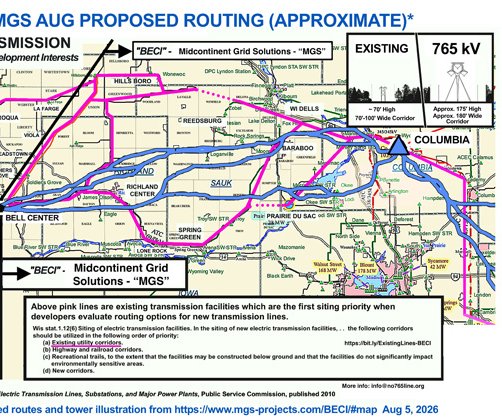
The current towers are 70-feet tall, and the current easement is about 100-feet wide. The towers for the 765 kV MariBell transmission line, as proposed by Dairyland Power Cooperative and GridLiance would be 150-200 feet tall, and the easement would be expanded to 250-feet.
It’s one thing to hear about it, or look at comparisons drawn to scale, and quite another to drive underneath it, and imagine the scale and scope of the changes proposed for the landscape.
Gobbler Ridge
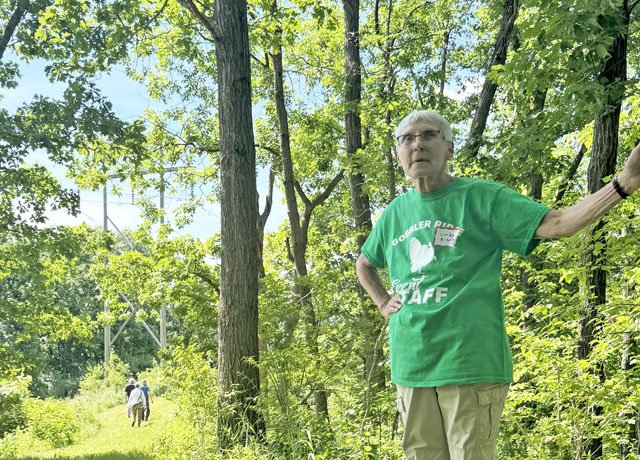
Tim and Linda Eisele live in Madison, and bought their 100-acre property in rural Seneca in 1990. Eisele, who celebrated his 80th birthday last Saturday, worked for many years as a venerable, full-time, freelance outdoor writer and photographer. His love of hunting is what inspired them to purchase the property, but the two have also taken the challenge of stewarding the land for wildlife and diversity deeply to heart.
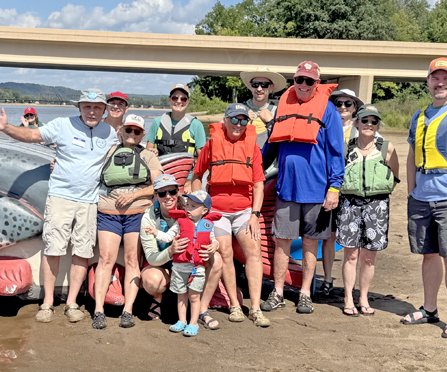
“I'm a hunter, basically I was interested in grouse hunting and turkey hunting, and so we bought the property to have for that, but then also to manage the land to try and leave it better,” Eisele told the almost 40 people assembled in a piney clearing outside their off-the-grid log cabin. “I love the diversity of the property. It starts down in the valley, comes up to this ridge, goes down to the valley over there, and then goes up to the next ridge.”
Eisele said that 80 of their 100 acres is enrolled in the Managed Forest Law program, and they are managing for woodlands. The area where the gathering was held was once cropland, and is currently enrolled in the Conservation Reserve Program (CRP). Through CRP and working with the Natural Resources Conservation Service (NRCS), the Eiseles were given permission to plant two areas into prairie.
“We put in a large prairie, and a small prairie right in front of our log cabin,” Eisele told the group. “Our main goal, is diversity and benefiting wildlife. The trees were planted before we bought it, because it was in CRP, so they had planted the white pine, white spruce, walnuts and oaks. We like to be out here – it’s secluded and it's quiet. We want to have a small footprint on the land.”
Eisele shared that he has the original surveyor’s notes for the property from 1839, and those notes reveal that the property was an open, oak savanna, with widely-spaced oak trees and a prairie understory. That landscape was produced and maintained for thousands of years by Native Americans burning the area, and was a landscape rich in biodiversity.
“What are the assets? We've got bluebirds, we've got scarlet tanagers, we've got redheaded woodpeckers, we've got indigo buntings. These are what we have, and we have deer, and there's been a bear around here too,” he shared. “But also, in addition to that, we've got honeysuckle, we've got box elder, we've got garlic mustard. So, when we come here, what do we do? We're working in the woods and we're trying to improve it.”
The threat
The Eiseles demonstrated to people attending the event what they are working to protect. A series of speakers followed Eisele. They explained the threat that the proposed 765 kV MariBell transmission line would pose to the Driftless Area.
Those speakers were Mark Martin, Forest Jahnke of Crawford Stewardship Project, and Jay McCloskey, President of No 765 Line. All three spoke about the threat the MariBell Line could pose to local residents, wildlife and birds, well water quality, public health and safety, outdoor recreational tourism income; and more.
Mark Martin and his wife Sue are retirees from the DNR State Natural Areas program. In addition, they were co-managers of Goose Pond Sanctuary, a wildlife sanctuary just north of Madison, where they have worked on prairie restoration.
“Mark and Sue received the Great Egret Award from the National Audubon Society, which is the highest award you can get from them,” Eisele said in introducing Martin. “Also, four years ago, they were inducted into the Wisconsin Conservation Hall of Fame - these are really good people.”
Martin explained that he and his wife had known Tim and Linda for a long time, and that his focus in his remarks would be to discuss the threats facing grassland bird species. He pointed out that the area used to be ideal habitat for those species when it was managed by Native Americans as an open oak savanna, using fire on the landscape.
“I worked for the State Natural Areas program for 28 years, and during that time, I helped purchase a lot of land at the Hogback and at Rush Creek State Natural Areas,” Martin told the group. “Sue and I have been the managers at Goose Pond Sanctuary, where we have 730 acres since 1979, and our bird list is really extensive with 270 species.”
He said that through his work with Bird Alliance, they had recently purchased 3,000 acres with a power line running through it.
“It's 90-foot easement, goes through about almost three quarters of a mile of our property, and so we know what the power lines can do,” Martin shared. “The power company said we can plant prairie on their easement. I don't like to see them out there spraying shrubs, they don't know what their shrubs are, they just spray them, but they said we don't have to spray any shrubs on your property, if you plant prairie and you can burn it, so we’ll be doing that.”
Martin pointed out that the area where the MariBell Line is proposed to run is in the Western Coulees and Ridges ecological region. He said that for those interested, you can look that up on line to see what DNR is working to protect in this area, and what their management plans are.
“This was oak savanna, and dominated by oaks as a result of Native Americans for thousands of years burning out here,” Martin pointed out. “That's why it was dominated by oaks and prairies on the east facing slopes. When we're talking about birds, I'm a proponent of oaks. If you want to help the birds, the best trees to plant are oaks. They provide acorns for the deer and turkeys, but most importantly, oaks provide super insects for the migrating warblers and the resident birds.”
Martin pointed out that there's very little oak savanna in Wisconsin today, but that the state had once had millions of acres. Now, he said, most of it's gone to either oak woodland habitat or it's gone to hardwoods or anything else.
One member of the audience asked Martin what the impact on songbirds and migrating waterfowl would be from the proposed transmission line.
“We have a power line near where we live, and on occasion, great blue herons and American white pelicans don't see it. When the power line has got fog in it, and they fly, then they hit that - that's one of the big things,” Martin shared. “Where it's really critical is with flyways in areas with water. The power company can put things up there that the birds can see and avoid, and all power companies aren't as bad as some others.”
Martin told a story about when a transmission line was put in Sauk County, near the Aldo Leopold shack, how that company worked with concerned bird enthusiasts to help protect the extensive populations of Sandhill Cranes in the area.
“They spent like $3 million to refigure the poles, so they didn't have Sandhill Cranes flying into the power lines,” Martin explained. “They did that because when the power company flew it, they had 10,000 cranes feeding from the Wisconsin River out into the cornfields.”
The power company told the Leopold Foundation folks it would cost $3 million more to reconfigure the lines in that area. But, in the end, the power company agreed to it.
“You’re better off with protecting migrating waterfowl with shorter towers – if they’re shorter, it’s better for everything,” Martin said.
Karst geology
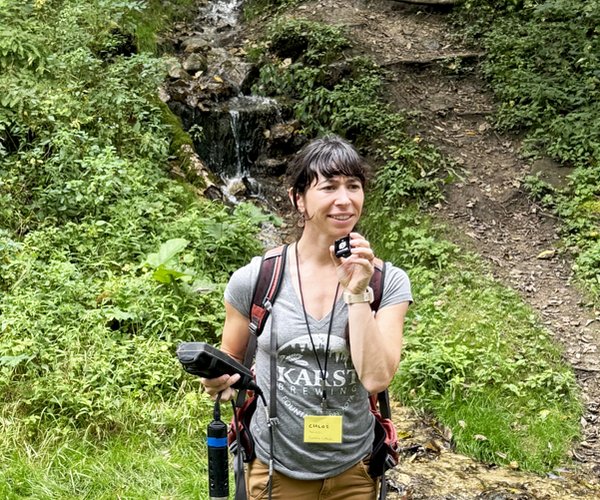
Next up was CSP’s Forest Jahnke to discuss the Driftless Region’s fractured karst geology and its generally excellent water quality. Jahnke emphasized both were vulnerable and worth protecting. He also noted the dangers of siting heavy objects atop a fractured karst landscape that can be prone to collapses.
“One of the key parts about the karst geology is water moves through this land very differently than people might assume,” Jahnke told the group. “This is a half-billion-year-old landscape, or a 500-million-year-old landscape, and essentially that's about how long this area has been above water and developing into what it is today.”
Jahnke explained what he described as the ‘layer cake geology’ of the Driftless Area. He said it is formed primarily from dolomites and limestones laid down when this area was covered by an inland sea, alternating with layers of sandstone when the waters would recede. He explained that the area’s world-class drinking water aquifers are located deep in the bedrock profile, in sandstone.
“The rock in these formations is very soluble with acid which can come from rainwater and decomposing vegetation on the surface,” Jahnke noted. “This results in the dolomites and limestones having an ever-widening system of vertical and horizontal fractures, which can transmit contaminants such as nitrate very rapidly down into the deeper layers where the aquifers are located. Those aquifers are so deep in the system, they are almost impossible to flush out once they become contaminated.”
Jahnke said that every hole that is poked in the surface, for instance private wells, can become like a sinkhole, a ‘direct conduit to groundwater.’ For this reason, the deep borings that will be needed to construct the bases for the massive transmission line towers have great potential to become a conduit of contamination to local wells.
In addition, the lack of knowledge of this fractured system could pose a threat to public safety were the weight of the transmission line towers to cause a collapse in the fragile system, according to Jahnke.
“I couldn't tell you if there's a giant cave underneath right here or not,” Jahnke explained. “No one really knows, and that I think is one of the things that is of concern to people here, especially in this context about the lines that they're going to be digging down real deep, and we don't really know exactly what's down there at any given point.
“When we're talking about this complicated karst geology, and any given major construction infrastructure, industrial, anything, a lot of times it's built to general standards that do not incorporate the local information of the geology,” Jahnke said. “So, what we would like to see in general is just more information, and a thorough geotechnical investigation with bore holes going down far enough to determine whether what is underneath the 40-60-foot footings they will pour is stable enough to support the tower’s weight.
“I favor something like electromagnetic resistivity imaging, that's actually going to give you a map of the underground, as opposed to just boreholes, which might miss the cave by five feet. To be safe, you would need to know what’s going on under the footings for a good 30-50 feet.”
No 765 Line
Last up was a potentially impacted landowner from rural Seneca, Jay McCloskey. He is president of the No 765 Line group, which has recently become a not-for-profit and able to accept tax deductible charitable donations. He pointed to the No 765 Line yard signs, which he explained are both a component of the group’s public awareness campaign, but also a fundraiser for the group’s activities. He said the main thing they are raising funds for is to hire expert witnesses to testify in the Public Service Commission proceedings.
McCloskey explained that as of this week, the group will also have a website where people can go to learn more. That site will also offer an online donation option. That website can be found at: www.no765line.org
“No 765 Line started with a handful of neighbors, and with a woman from Doyle Land Services who came knocking at my doorstep and told my wife and I three lies to attempt to coerce us into signing their authorization to survey our land,” McCloskey shared. “She said to us, well, if you don't sign it, they're just going to do it by eminent domain – the first lie. They said all your neighbors have signed this. We started checking with our neighbors. We didn't find one that signed it – the second lie. Their last lie was, it's going to happen anyway. Well, not on our watch. My personal motto on this is ‘failure is not an option.’ It is our job to make sure that 765 kilovolt lines do not go through anybody's farms, fields, forests, or homes.”
McCloskey pointed out that the Driftless Region was missed by the last three glaciations of the area, and is considered a national treasure. He pointed to multiple threats from the line, including to migrating birds, from the corona effect of the light on human and wildlife health, health impacts from electromagnetic frequencies (EMF), and more.
“Also, we're talking about these towers which will weigh an estimated 500,000 pounds plus the tower of concrete. That concrete is the equivalent of 12-15 fully loaded 36-ton concrete trucks,” McCloskey pointed out. “How are we going to get concrete trucks here? They'll drop it in from Sikorsky helicopters or Chinooks, so we're going to have all these helicopters flying around, scaring and terrifying in many cases, potentially stampeding livestock.
“If we have a tower that requires four million pounds of concrete, that is 90-100 fully loaded concrete trucks full of concrete to be able to pour those footings - a major issue,” McCloskey pointed out. “And, for all four footings we're looking at between 75 to 125 feet of open holes where runoff can go down without being filtered by the soil, and feed directly into the aquifer. It's not just going to affect the aquifer in the immediate area either, it's going to affect people for miles and miles around.”
Lastly, McCloskey explained that of the economic benefits projected to come to the local area from having the transmission line sited here, very little of that would actually benefit the area.
“They say there will be $30 million in tax revenue that they're talking about over the lifetime of the project, and they're talking about $70 million in construction costs that would come into the area,” McCloskey said. “But, only about $10 million at most would actually come into the area, because, as you can imagine, all of these towers and concrete and all of the stuff they're doing, these are not things that local people know how to build – it’s going to require specialized crews, and the $10 million will mostly come from meals and lodging, and stuff like that.”
However, McCloskey pointed out, the project will actually have a net negative impact on the local economy because of its impact on outdoor recreational tourism. McCloskey said that in Vernon and Crawford counties, that tourism is worth $112 million annually.
“We're on the major flyway, and we have so many birds and bird populations here. The economic impact is $112 million currently between Vernon and Crawford counties,” McCloskey explained. “The expectation is that the line will cause a 10-20% negative impact on that tourism, which would mean an annual loss of between $11-12 million per year, canceling out any economic benefits from siting the line here.”