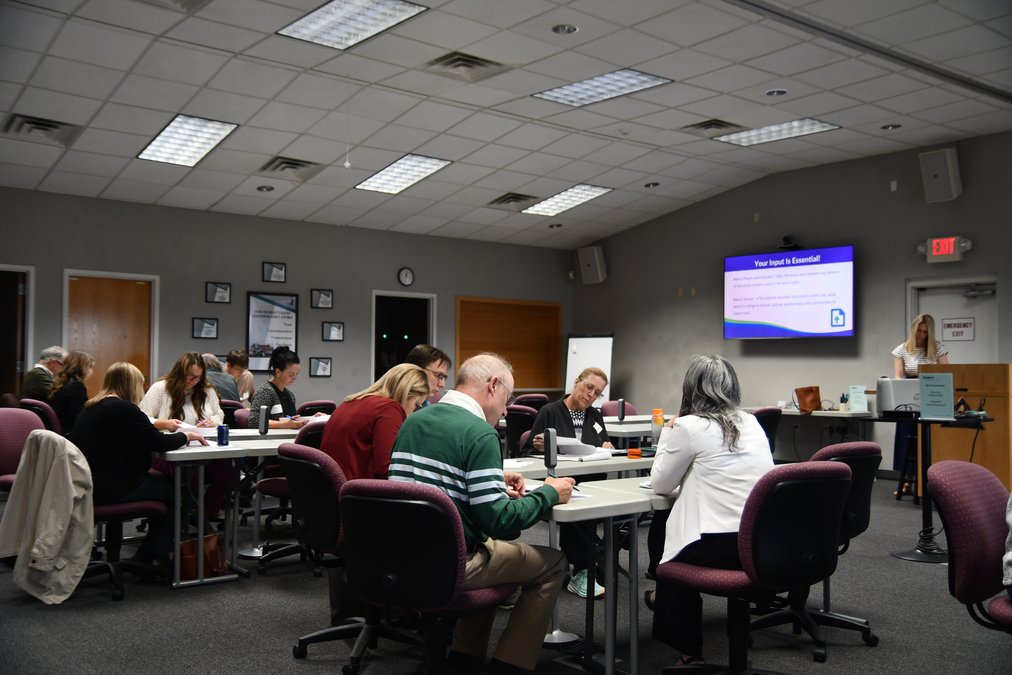
Area high school educators and administrators, along with representatives from Southwest Tech and CESA 3 came together last Wednesday at CESA 3 in Fennimore for a listening session on a statewide definition of a “Portrait of a Graduate.”
The Wisconsin Department of Public Instruction’s (DPI) Portrait of a Graduate is a statewide effort to define the knowledge, skills, and mindsets every Wisconsin student needs to succeed after high school—no matter the path they choose.
The School Superintendents Association (AASA), is partnering with the Wisconsin Department of Public Instruction in the creation of our statewide Portrait of a Graduate.
Many individual schools have their own Portraits, but a statewide one, which has been adapted by over 20 states, would be in addition to the “localized ones,” according to Dr. Laura Roeker, DPI’s Director of the Bureau of Teaching and Learning, who lead the May 6 listening session.
One of the main reasons behind the DPI’s decision to implement a statewide Portrait is no surprise, technology moving ever faster, and with many related jobs and wanted skills becoming more and more in demand.
The statewide Portrait of a Graduate model would focus on preparing students for real life by emphasizing essential skills such as critical thinking, communication, collaboration, and adaptability or as Roeker stated, “Skills that would be durable through life, in addition to just college and career. And skills that are important to Wisconsin.”
Roeker gave a few examples of what a state Portrait of a Graduate would be and what it wouldn’t be. The “would nots” included: a replacement for centric learning, new curriculum, or a quick fix.
Rather, it “would be” a shared “student success plan,” a bridge between value and practice, and forward looking.
Or in other words, the Portrait of a Graduate would serve as a “North Star,” by guiding innovation and decision-making across the state’s education system.
“Wisconsin has made innovation in education a top strategic plan,” Roeker stated to the attendees. “We need to meet the needs of the learners in an uncertain future.”
The area educators and representatives then broke into small groups to discuss current landscape shifts in workforce, pace of change, social intelligence, and learning research.
When “joined together” again in a large group, some of key points of their discussions were:
- Do growing jobs and growing skills match accordingly?
- Focus on career/community ready, rather than “drilling” in college ready.
- Students’ fear of failure and fear of asking for help.
- Balance between working independently and in a group.
- Social media/AI’s influence on personable skills/ engagement.
One overall agreement amongst the group was that whatever shape the state’s Portrait of a Graduate is, it can’t be “just add things/curriculum to the teachers or be just fancy words on a poster on the wall.”
“What needs to change in schools is policies and partnerships with communities. We can’t just keep adding things. We need to change our ways it gets the most impactful results,” Roeker stated.
Fennimore District Administrator Jane Wonderling added, “Politicians drive everything, but they rarely are in schools, especially rural ones. More legislators need to see what happening in rural schools. We’re doing some amazing things.”
Roeker agreed, stating, “Schools are doing many amazing things that don’t show up on a district report card.”
From there, attendees took part in survey on what should be Wisconsin’s Portrait of a Graduate’s six to seven durable skills.
Your opinion matters
The durable skills part of the state’s upcoming Portrait of a Graduate are not meant to be decided only be educators.
Families, community members, and business leaders are all invited to read more on the DPI’s “Portrait of a Graduate” module on their website at: https://dpi.wi.gov/families-students/programs-initiatives/portrait-graduate
The same survey taken at CESA 3 last week on the Portrait’s six to seven durable skills is open to everyone, and can be taken at tejoin.com. Those interested in taking the survey will need to enter the nine digit code 331-353-213.
The year long process to develop Wisconsin’s Portrait is expected to be finalized this October.