In January of 2025, as the efforts of the Department of Government Efficiency (DOGE) cranked up under the newly installed Trump Administration, which led to the firing of a beloved park ranger at Effigy Mounds National Monument, sparked persistent citizen resistance.
Now, 72 weeks later, citizens are still seen in the ‘free speech space’ near the highway, protesting peacefully, with signs conveying the topics that concern them. Motorists driving by either honk, or give a thumbs up or thumbs down.
The group has gathered weekly at the site, on Sundays, beginning at 11 a.m. – rain or shine, heat or sub zero temperatures. Attendance has sometimes swelled as high as 100, and at others pared down to a pithy 5-10 committed individuals.
According to Toby Cain of Civil Service Strong, since January of 2025, 450,000 dedicated, nonpartisan, federal civil service employees have lost their jobs or retired. But, those employees aren’t just sitting around licking their wounds or quietly moving on without looking back. Many have joined forces, looking for ways to care for those still in federal service, and pursuing ways to vision a better model for governing the nation that doesn’t blow with the political winds.
Before the Trump Administration took office, Cain resigned her political appointment as Chief of the Risk Management Agency within the U.S. Department of Agriculture. In her role, she oversaw a helping agricultural producers manage the risk of $207 billion in liability.
According to the organization’s website, ‘Civil Service Strong,’ the organization is dedicated to the following purpose:
“Civil Service Strong, a project of Democracy Forward, is a collaborative effort of people, organizations, and communities across the country who are joining together in support of our civil servants.
“Alongside the 95% of people who believe civil servants should be hired and promoted based on their merit rather than their political beliefs, we are committed to supporting a career, non-partisan civil service and the people who power it.
“Civil Service Strong is leading a comprehensive response to the Trump Administration’s dismantling of the civil service through advocacy, storytelling, organizing, resources, data, and policy.”
“The most beautiful thing that I've seen since last January is that federal workers, even though 450,000 of them have left their jobs, they haven't left their commitment to the Constitution,” Cain said. “They've started nonprofits, they started organizing groups, because they care.”
Cain told the Independent-Scout that last week Democracy Forward filed a lawsuit to combat the dismantling of USDA proposed by Agriculture Secretary Brooke Rollins.
“We've got 20-plus plaintiffs. And then on July 23rd, a lot of local unions from Forest Service and Food Nutrition Service, have created this kind of organizing. And all their local unions are starting to raise awareness,” Cain shared. “On July 23, we're going to have a virtual briefing, saying the destruction of the USDA is going to mean the destruction of public lands, nutrition services, research, food safety, and more.”
Local impact
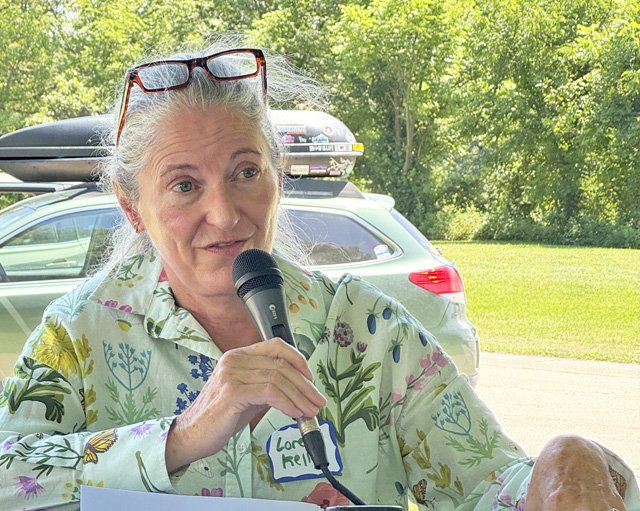
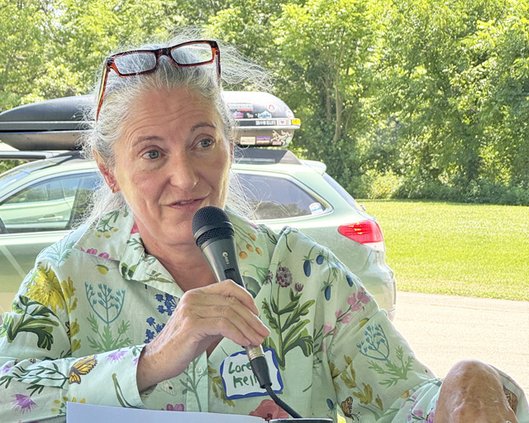
Accompanying Cain to Effigy Mounds National Monument last Sunday was a woman named Lorelai Kelly. She worked in and out of the House of Representatives in Washington for 23 years, with the last 10 years spent dedicated to Congress from Georgetown University to help rebuild the legislative body’s technology and data capacity to meet the modern world.
“Just to give you some context, the U.S. Congress is the most powerful legislature in the world, and it only entirely got off the free version of Zoom last year. That means people working on and advising on nuclear weapons, on wars, on all kinds of global issues and domestic issues having to hang up and call back at 40 minutes,” Kelly explained. “A lot of the public memory that Congress uses for lawmaking is being deleted right now. As a separate branch of government, it can protect itself. It is the data in the federal agencies that Congress uses for evidence-based lawmaking. A lot of it is privatized into lobbying firms. This is an incentive system where people come to work and go straight into the private sector to come back and provide a commercial version of information. Not that it's wrong, but it's very narrow, or the information is in shoeboxes, literally in the basement.”
Kelly said that during the pandemic, Congress was required to change its rules dramatically, for instance converting to Zoom to hold hearings.
“My favorite statistic from those days is that the diversity among the witnesses in front of Congress went up over 200 percent during the pandemic,” Kelly observed. “So that was a tremendous small ‘d’ democratic moment of representative government, and so I was thinking, why can't we just continue to do that and move some of these functions of record and witnessing and information support and sense-making into the districts? Because Washington D.C. is not only backward - it's really captured by a lot of private interests right now.”
For this reason, Kelly has chosen to spearhead resurrecting an old tradition dating back to the Civil War era where members of Congress were required to go out into their districts to obtain feedback on issues from their constituents. She refers to this process as a ‘Local Impact Hearing.’
“The data that we collect today is to hear the community voices about the impacts of recent federal decisions, specifically from this administration, and we're going to collect this information and put it in a structured format, meaning labeled by geography and voice and topic, into what's called a federal depository library that is actually part of the first branch of government, meaning Congress can integrate it seamlessly into the process of lawmaking. These field hearings bolster the first branch of government by gathering this potentially deleted memory in a new format, ” Kelly explained. “And, in this case, we're hoping to be able to sort and filter this information for committees, in the coming years when we're going to have to repair and redesign an entire government.”
Kelly said that she and Cain work with an organization that is really interested in collecting evidence of harm, but also evidence of hope. For this reason, they're collecting ideas from the people with the best administrative knowledge of how these places run, the local impact of what they are emotionally, and what's called lived experience, and turn that into evidence that's appropriate for lawmaking.
Five spoke
At the initial, pilot Local Impact Hearing at Effigy Mounds, five concerned individuals with deep connections to the place, spoke about what it has meant to them in their lives, and what it would mean if it ceased to exist. Note: the comments below are exceprts, and not intended to represent the full scope of the remarks archived into the public record.
Scott Boylen is a sixth-grade science teacher from Decorah, Iowa, who grew up near what is now Effigy Mounds National Monument. He explained that, “this is my home.”
“When I was a new father, my wife and I brought our young kids here to one of their first Hawk Watch programs. Our daughter, who was about two or three years old was in my arms? We were watching John Stravers, as he brought a trapped red-tail hawk that they had measured and tagged up on top of the hill down to the crowd,” Boylen shared. “I've heard John tell this story actually too, that he saw my daughter, and saw her eyeballs, and decided she was the kid that he was going to bring the hawk up to, and let her release it. I'll cry telling the story because it is so impactful to me. This place has offered my children and me, incredible opportunities to learn about the natural world and to connect to it. My daughter, from that moment on, she lit up and has been on a crusade to do good for the world and for the next generations. That's what this place means to me.
“That is what started me on a road toward becoming an outdoor educator, an environmental educator, and then eventually an actual public school teacher. I've continued to work with young people and adults to learn more about better ways to appreciate the complexity that is our natural environment, and all the relationships and interconnectivity that exists within that that greater umbrella that we call the environment,” Boylen explained. “We are connected, all of us. What is done to one is done to all. Some of these words will sound very familiar. These ideas are not new. They are part of indigenous teachings and living. That is also something I learned from Effigy Mounds National Monument and other places like it. I have now come to the last third of my life. I know that we need to pass certain things and ways of thinking on to future generations. Some of those things come from Western science, and some come from older ways of knowing, based on more close relationships with the land and the other life forms that occupy our spaces with us.
“Working at Effigy Mounds in the Ranger Teacher Program, offered me a closer look at how the areas of interpretation of history and the natural world are very carefully thought out and purposeful activities. At the time that I was working here, they were working through difficulties and hugely important issues, including the past superintendent had built a deck on top of mounds right across the highway. They had to work through that. They had to remove the decking. They had to remove the footings. They had to talk to and deal with native tribes as you know they rightly needed to do,” Boylen said. “So that was good to see to see that our government was able to admit to making mistakes, and to try to make them right and be sensitive about those things. A lot of this came also from the 1990 Native American Graves Protection and Repatriation Act. I happened to be here at the time, and a previous superintendent had removed remains of humans and artifacts from here. They also had to work through all of that. To me, that's hugely important. That's not only reconciliation - it's repair. It's literally things that, as a public educator today, I'm taught to do with kids to try to repair relationships with students. So, we can do these things. They're hard to do, but the first step is to admit that you're not perfect, and that we do not know the history. We did not live as indigenous people here, at least I didn't. Some of the ancestors of the people who have people who are buried here did, and it should be their right and their place to tell that story, not us as colonizers. And I learned that here.”
Cheryl Drowns
Next up to testify was Cheryl Drowns, a local mother with two young children and a high school science teacher. Drowns is one of the citizens who has stood at Effigy Mounds National Monument every week since January of 2025.
“My children have visited the Effigy Mounds on school field trips, learning about our world and history in ways that will stay with them for a lifetime. It has served as an outdoor lab for local science classes, identifying native plants, and my own students have tested the water quality of surrounding streams. Brian Gibbs, our local ranger, has even been generous enough to come to our schools as guest speaker on multiple occasions. And this past year, our senior class chose to take their senior pictures here, where they've undoubtedly all made memories,” Drowns stated. “Public lands such as these in the Driftless Area are both unique and fragile. At places like Effigy Mounds, we are watching succession in real time. We have a forest ecosystem that has been protected for nearly 80 years, slowly building toward old growth structures that are rare to the region, but reaching full ecological recovery can take hundreds of years. If we disrupt or privatize these lands now, we're destroying the complex ecosystems that no amount of human time or further intervention will ever truly restore. We know the alternative because it's already happened outside of the park. There were thousands of ancient mounds throughout the Midwest that have been dug up or plowed over in the interest of agriculture and short-term financial gain, without consideration to what we were losing. Unfortunately, instead of protecting our public lands, I feel we are moving backward. The cascading effects of reducing staffing, a long history of land mismanagement, and a dangerous push toward privatization of public spaces threaten what was once a rich tapestry of prairie grasslands and forests that were expertly managed by Native peoples for thousands of years. According to the Iowa Natural Heritage Foundation, today only 33% of native forests, 10% of wetlands, and less than 0.01% of native remnant prairies remain in Iowa. This has resulted in a highly fragmented habitat that makes it more difficult to sustain our migratory bird populations, as well as the important pollinators that we rely on, further risking the biodiversity of the region.
“We are already feeling the effects of poor land management on a continental scale. There have been weeks here during the Canadian and California wildfires, where we could actually see and smell smoke from thousands of miles away, right here in Iowa. Due to decades of mismanagement of public lands across our borders, we receive air quality warnings and advisories for those with health conditions to not go outside. I want a future where we can all go out consistently whenever we want to, because the air we breathe remains healthy. But that requires more federal funding. It requires more research into proper land management, and it requires more staffing to ensure those doing the work protecting our parks and educating the public have what they need. Unfortunately, like so many other areas, our park staff are only being told to do more with less. Defunding our parks is a threat not only to our environment, but also to our community health,” Drowns said.
“Beyond these issues, we also have a profound moral duty to respect the cultural and historical significance of the land. While these parks do support local communities through tourism and local businesses, especially through the summer months, their real value stretches much farther than economics. This is sacred ground. Archeological evidence proves 12,000 years of continuous human history right here in this landscape. Among the first peoples in this land are the Ho Chunk and the Ioway native tribes, the very people for whom our state was named, whose ancestry dates back to the late woodland cultures. They're the people who built the mounds that we visit today. But history has rarely been fair to them. Even so, tribal members still visit their ancestral homes to honor and care for these sacred sites today. We have an absolute duty to preserve these spaces for them, and at the same time, this provides the rest of us with a tangible and humbling way to better understand the history of the land and demonstrate respect for other cultures.
“When I think about the world my own children are inheriting, I want them to know the true richness of our natural land, defunding, understaffing, and privatizing our public parks risks permanently erasing our history and our ecology,” Drowns noted. “I want to stress the importance of stronger local and federal protections with adequate funding, and the moral imperative to work with the native people to protect these sacred places. Let's choose to be the good stewards of our land, our children, and this rich historical context deserves.”
Birgitta Meade
Birgitta Meade traveled to Effigy Mounds National Monument from Winneshiek County in Iowa.
“There are at least 460 generations of people who lived in this area before my family. Today, I did a thing that I've been doing for 46 years, which is to test the water for nitrates. The Yellow River, just over my shoulder, had a nitrate level of 9.1 parts-per-million, just about an hour-and-a-half ago, and this is after pretty good rain in the last week. I wanted to testify today, because I see over the last 46 years this truly alarming deterioration in the quality of our water, and now that we're aware of this significant difference in the cancer rates between Iowa and the rest of the nation, and the people who live here have started to really internalize that we have baked cancer into the bones of a lot of babies, a couple of generations worth, and it doesn't have to be that way. We know how to reverse that. Well, we know how to reverse the damage to the water, the cancer we're going to be dealing with for a few generations.
“I am distressed that policymakers keep throwing taxpayer money at rich people, and it's not making any difference. And by that, I mean subsidies and crop insurance that keep this destructive agricultural production system in place that is poisoning us. I understand the hesitation to look at my neighbor and say, ‘Keep your pollution on your own property, and stop poisoning the neighborhood kids.’ We're told that farmers are somehow ‘specialer’ than others in the same way that the clergy could not be accused of, much less held accountable for damage to children. I think that has to change,” Meade said. “We have to talk because talking to our policymakers has not been making a difference for the last 45 years, in my experience. So, we have to take it to the people who are doing it.
“We do still live in a nominal democracy, and so I think that we need to hold our policymakers responsible. A nitrate result of 9.1 parts-per-million is just below the current drinking water standard of 10 parts-per-million, which dates back to the Clean Water Act in the 1970s. That standard is protective for methemoglobinea in infants, which is a good law. It was good policy at the time, but now we know that cancer rates rise at about three-parts-per-million, and so it is time for a policy change, and it is time to hold the perpetrators responsible for the damage that they are causing,” Meade concluded.
Kenny Slocum
Slocum lives in McGregor, Iowa, and grew up in LeClair, Iowa. Slocum said that as a young person, he attended Augustana College, studying psychology, and ironically, at the end of his college years, he had a mental breakdown.
“I ended up going out to the Montana Conservation Corps, which is an AmeriCorps program, and working out in the wildlands of western Montana.” Slocum said. “I always tell a story of when this kind of broke for me. It's really my only what I would call peak experience.
“We were out in Montana working in the Fish Lake wilderness. My crew leader had us all hike up to the top of an unnamed peak, and write a love letter to Wilderness - federally designated wilderness. After we wrote the letter, we burned it and scattered it off the top of this peak. And as I was writing my letter, I started just weeping because in the last couple of just months working out there was a totally different experience for me. I realized I had grown up in Iowa, and never known anything like this could exist, and what it did for people. In the time since then, after I finished that term, I came here to Effigy Mounds, and started a career in the Park Service for the next five years, from 2010 to 2015.
“I think some people forgot what happened in that time. In 2011, we had something called ‘The Sequester.’ As a park ranger at the time, I was not allowed to tell the public about how the sequester would affect services or anything like that. We just said we were going to keep on keeping on. That obviously is impossible. You can't ask park staff to do more with less money. And one thing about the sequester that people forgot - it didn't stop. It remains policy to this day. The budgets for these agencies is not keeping up with the overall general budget of the United States. So every year, these places have been defunded more and more for the last 15 years,” Slocum said. “I left the Park Service in 2015 and started working for the Clayton County Conservation Board here in Northeast Iowa because when I came back here to Effigy Mounds, despite having grown up in Iowa, despite the fact that wilderness was invented by Aldo Leopold in Iowa, I never knew the concept existed, and I realized Iowa was the most important place to apply those principles.
“As Birgitta mentioned, we need it here more than anywhere else in the United States, and not just at the federal level, at the state level, at the county level. We continue to fundamentally misunderstand what these lands are for. We talk about them in terms of what they used to be, what they're preserving. We are still taking ourselves out of the picture. Something that has changed for me in the last 10 years is my understanding of the Wilderness Act. It's this iconic piece of legislation. It is a fundamental misunderstanding of what this land is. Wilderness Act says right in it, these are places where man himself is a visitor who does not remain. There is no such place. We cannot. The water doesn't get clean when it gets into Effigy Mounds. That wildfire smoke doesn't stop at these borders.
“These places have a function just like police and firefighters and public utilities,” Slocm explained. “They have an important role. They saved my life, not because of anything that I had here, but because these places are medicine, and importantly, they need humans the same way that the flowers need the bees. The bees are going to die if they don't have flowers. The flowers are going to die if they don't have bees. We are the things that pollinate this place through our interpretation, through our stewardship of it, whatever that may mean for each individual site, and it is important to remember that they're all individual sites.
“This is a place where humans have lived effectively forever. As this ecosystem has existed, humans have been here the whole time. When we take ourselves out of the picture, when we ask less bees to do those pollination services, we're not preserving them, and we're not using them for what they're fundamentally for. We have to at the state level, county level, federal level, recognize the return on investment, and recognize what they do for us every single day,” Slocum concluded.
John Stravers
John Stravers is the director of Driftless Area Bird Conservation, and has been a bird researcher in the area for 50 years.
“I'm going to choose to let the birds tell the story,” Stravers began. “I started researching in 1976, but then in 1982, we started working here in the south unit of Effigy Mounds, and we realized we were on the ribbon of raptor migration in the autumn.
“In 1983, we caught a peregrine falcon had been banded in the Sonderström Fjord region of Greenland as a nestling by a group of researchers I knew. She was banded in July in Greenland. We caught her in October, probably on her way to Argentina. And then, on Hawk Watch weekend of 1999, we got a peregrine falcon that had been banded in Central Alaska five years earlier, 2,300 miles due northwest. The Greenland bird was 2,300 miles due northeast. There again, birds telling us the story.”
“The birds are telling us that this is an important place, and it coincides with the bird mounds,” Stravers said. “That's what the bird mounds were telling us back then. They didn't build them randomly. They built them here because they were making a statement. Anyway, Peregrine Falcons had been extirpated in the 1970s from our region, and they had to be reintroduced. And they were reintroduced first in the cities, but Bob Anderson wanted to get them on the cliffs where they belong. So in 1998 and 1999, they released captive-bred falcons here on Hanging Rock, so that they would imprint on the bluffs. And now, there's been this real recovery, and there's between 20 and 30 sites, active cliff sites in the Upper Mississippi River that are active one year or another. All of the birds that occupy those sites, their lineage traces back to Effigy Mounds. This place played a critical role in the reintroduction of an endangered species. Then, 25 years ago, I started doing research on Cerulean Warblers, one of the rarest nesting warblers in Iowa, and a species of greatest conservation concern all across its range, both in North America, where they nest, and in South America.
“Anyway, we've been working on Cerulean Warblers for all of these years now, and the most reliable cluster is right up here in the north unit, right on top of the String of Pearls and the Bear Mounds up here. The birds don't nest in random habitats. No, they cluster together where they have really specific habitat features. Again, the birds are telling us the story of how important this place is.
“The birds are telling the story that this place is really important, and so these bird mounds are not random. Someone felt the call. They knew this place was important for bird migration, for birds. They knew it was great diversity, and they took the time to build those mounds. So any time, we can go to these mounds, we have the ability to kind of feel connected to the bird people of the past. At least, I do. And this facility is important to birds, but it's also an icon for the region for environmental awareness, bird awareness, for conservation, for cultural sensitivity. This is a place that needs to be protected and cherished over and over for generations to come.”