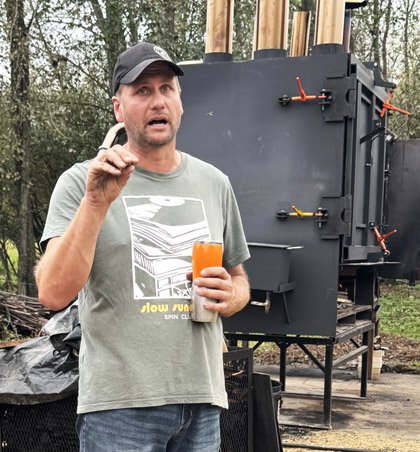
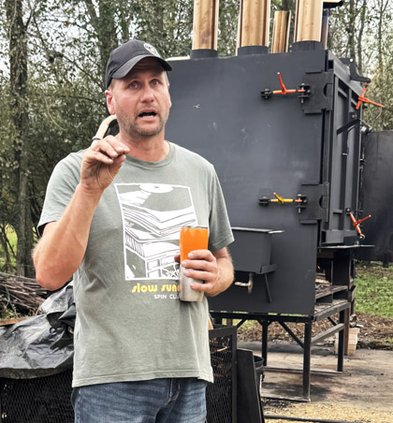
WEST FORK KICKAPOO - The Monroe County Climate Change Task Force’s fall tour took participants to view a biochar production facility in the West Fork of the Kickapoo River.
Jordan Bendel, Lars Bergan and Ryan Schams are partners in the ‘West Fork Organics’ biochar production business in the West Fork of the Kickapoo River, near Bloomingdale. The three have worked together to innovate in kiln fabrication, production efficiency, and methods to incorporate their product into agricultural production systems.
The biochar product, when incorporated into soils, helps to hold nutrients and water where you want them, increase productivity, and sequester carbon over the long term.
“This project is about mimicking deep, ancient patterns of how people have worked with the land,” Bergan explained. “Right here, the reason that North America, and this part of North America in particular, has had such fantastic soils is that the indigenous inhabitants of the land burned it year after year, and stabilized carbon in a way that it would stay in the soil and feed organisms and plants.”
Bergan explained that he and his partners got started with the idea that the purpose in farming, and particularly organic farming, is to raise the organic matter in the soil and keep it there for as long as possible. He said in recent years, there also became an interest more broadly in taking carbon from a gaseous form into a solid form to help to slow and reverse climate change by reducing greenhouse gases in the atmosphere.
The impetus
Bergan explained to the group that in part, the idea for the biochar business is the work that he and his business partner Ryan Schams had done, working in the wood recycling industry, for a company called RotoChopper.
“Ryan and I have been working in wood recycling together for 15 years, so we know the big wood recycling world, like the semi-load world,” Bergan said. “Here in Vernon County, we're in the log truck world or the dump truck world of scope and size.”
He said that both in the larger wood recycling world, and in their little, local world, they really saw the need to figure out a way to stabilize carbon and get it into the soil. He said they had heard about biochar, and saw it as an important piece of the puzzle.
“We just started experimenting with 55-gallon drums and simple systems, and doing the research,” Bergan shared. “If we could buy something where you could put a bunch of wood waste in a container and heat it up with other wood waste, and let it go through a cycle, that's the principle - that's what biochar is. You're basically baking wood, but the beauty of a system like ours is that you're baking the wood mainly using the energy from that wood itself.”
Bergan said that through some of his composting customers in his row chopper world, he had learned about Practice 336 from NRCS, where farmers could be subsidized to apply biochar and/or compost to their soils as a method of improving the soil and sequestering carbon.
“I looked into it, and people hadn't really been applying for it, largely because biochar is extremely hard to get hold of, so you don't want to agree with the government that you're going to do something that you don't know you can actually do, because you can't get the stuff to do it with,” Bergan pointed out. “So, we thought, well, if we can make biochar, with a reactor that's really reliable, then we can make this stuff. NRCS’ Justin Olson from Vernon County listened patiently, and helped us with the paperwork. So, I think we are the first farm in Wisconsin to be applying biochar under this program, and there's a whole soil testing regime.”
Bergan says he’s been to the biochar shows and listened to the scientists talk. He said he’s learned that there's very little of any kind of scaled experimentation with biochar. He said there's not that much biochar you can get, and what you can get is very expensive.
“The principle here is that for love of the land and love of each other, we want to do something that, if it works, can work for a lot of people, Bergan explained. “This is a simple system, you don't have to plug it in. People off the grid could use it, you could use it to heat a greenhouse or a shop. Once we get this figured out, and once we get some real response from our land, we can share that with the world. Vernon County is a perfect place for this to start because we're a place that is known for innovation, and also has all the ingredients like a very high number of organic farmers and a ton of sawmills, so that if this can work anywhere, it can work here.”
Bergan said he’d learned that, to the extent biochar is being produced in the U.S., everyone has basically designed their own system.
Part of the vision here is that we'll have a really great local source of biochar, so farmers that want to try it can use it,” Bergan said. “But also that we'll be developing a technology that that could be available commercially, so that other regions can also make this happen for themselves.”
Production system
Bergan’s business partner Jordan Bendel is really the one that operates the kilns to produce the biochar.
“A lot of our feedstock comes from flooring mills in this area,” Bendel told the group. “The flooring mills have a hard time getting rid of this material, and from their perspective, it could go in a pile and get burned in a ditch. It could go to someone to be chipped into mulch, which is expensive, and the profit margins aren't very good there. So, from the flooring mills' perspective, our operation is within a mile, and we come and get it, when they want to get rid of it.”
Bendel explained that they pick up either edgings or what's called end cuttings. The end cuttings are from the ends of the flooring as they make it. They pick up baskets, and they have a chopper with knives that rotate. He said that process chops it into chunks, which is really great to fill their crates that go into the kiln.
“Cooking biochar is similar to cooking meat in the oven. So, a roast takes forever, but a little layer of hamburger doesn't take very long to cook,” Bendel explained. “We want to stick the chopped wood in the oven, and we want to cook it as hard as we can, and then get it out of there.”
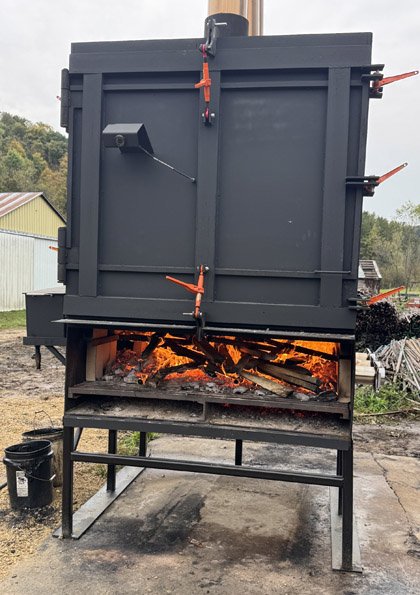
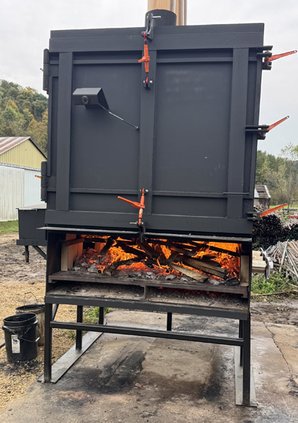
Bendel said he sets the basket of chopped wood in kiln, and then seals the door. The kiln is actually airtight, and when you start to bake the wood, it starts to off-gas, and so it pressurizes it. He said that they have to get rid of that pressure. So then, there is a hole that takes all the gas coming off the wood and sends it into a pipe. From there, the gas is piped into the wood fire below the airtight chamber containing the basket of chopped wood.
“The gas that's coming off the wood is first going to be wood vapor. As that wood vapor comes down, it goes into the condenser, and condenses out of the gas. That's how you get the wood vinegar, which is another product of the biochar process,” Bendel shared. “The secondary product that comes out of there is called wood oil, and so the two are mixed. If you put it in pails and give it some time, they actually separate. Wood oil sinks and wood vinegar goes to the top, so it separates. You can run it through a simple filter, and there's a variety of products that can be made out of it.”
Bendel said that as the temperature comes up in the kiln, the wood gas switches over to being flammable, and then the system actually powers itself. He said they stop adding wood at that point because it's self-cycling.
The temperature will go up to about 1,000 degrees in the kiln, and then it starts cooling down relatively quickly. When the temperature in the kiln gets down to about 600 degrees, they open the door and pull the biochar out with a skid steer.
“From there, the crate of cooked wood goes to a quenching station, and we run water over it. It puts out the fires so that the biochar doesn't turn to wood ash,” Bendel said. “It's also helping it for the grinding process to make it cleaner and safer, and also getting it ready for its next step. Because when it comes out of the kiln, it actually doesn't like water. You'll watch it; it'll bead over. You have to run a large quantity of water over it before the biochar turns into what we would call ‘charged biochar,’ where you want to field apply it.”
Bendel told the group that after quenching, the product goes into a gravity box, where they stack it for a while before running it through the grinder and elevator.
“Once the steel is heated up, we just want to keep utilizing that, so we can run three-to-four batches a day,” Bendel said. “How do we know when it's done? We watch how high the temperature gets, and then we watch the wood gas ports. When the wood gas ports stop burning and go out, we know the biochar on the inside is done.”
Bendel said they send the biochar away to be tested, which basically tells them everything about it. In addition, a test that they run right there is to grab a shovel, take a scoop, and dump it. If it sounds like glass, then they're on the right track. Another way is they'll taste a little bit, and as long as it has no taste, it's done.
Ag application
Bergan observed that farmers pursue building soil organic matter through a variety of practices, such as no-till, planting cover crops, roller-crimping cover crops at planting, and in smaller operations, using straw or wood chip mulch.
“Farmers are using more less stable carbon than biochar, and you get great benefits from it. But it also takes nitrogen really fast, and it also goes away quite quickly. So you have to keep adding it,” Bergan said. “Whereas the idea with this is, once you've gotten your biochar level to a point in your soil, it's there permanently. It's kind of the opposite of fertilizer. It will help all your fertilizer work better, because it's going to hold it on your farm.”
Bergan said that what is really key and pivotal for the Driftless Region is that they’ve done tests, and soil with biochar incorporated will hold eight times its weight in water. He pointed out that organic matter has always been a good proxy for how much water your soil can hold, but soil with biochar is like organic matter plus because they do the charring process. He said they're basically emptying out the cells in the wood, and then they can hold whatever they need to, be it nitrogen or phosphorus or water.
One participant asked how many pounds of biochar should be applied?
“When we dealt with Justin from NRCS, we learned you can apply anywhere from 4-12 yards per acre,” Bendel responded. “You can measure it in pounds, but almost everyone measures it in volume. The reason for that is once you start quenching it, you're adding a lot of weight, and you’ve got to account for it somehow. So they do it by the yard.”
Bendel said that soil type has a lot to do with what the recommended amount would be. So, for instance, he said that the amount would be greater in sandier soils, and less in the clay typically found on ridgetop fields. He said that if you were working with NRCS on a project like this, they would walk you through it.
“In California, what they actually do is when they're planting perennial crops like fruits and nuts, they're putting a column of biochar next to the plant. It's six inches deep, and the reason they're doing that is because it holds so much water,” Bendel explained. “There's a variety of ways to apply it, and there's more research in progress to identify what should be done and exactly how to do it.”
He said that their team is working closely with NRCS, and for instance, they put it in their manure pack so it gets charged. He said that their mineral feeder for their cattle has biochar in it. And they’ve run pastured poultry, and spread it on the ground after they've been through.
“So, I think, however you can imagine holding it there, you could do it,” Bendel shared.
Another participant asked if any study has compared how much carbon they’re sequestering versus releasing in the production process?
“For everything from respiration to composting, all carbon has to get broken down. This is about the only way we know to not have it all break down,” Bergan responded. “For instance, if you make compost, 100% of that stuff goes through the process, and at the end, there's some carbon left, but not that much. What's unique about this process is the carbon which remains is stable for thousands of years.”
Bergan said that using application of oxygen to carbon to make energy is the whole principle of life. He observed that half the organic matter levels in American farmland in general have collapsed, and the topsoil has gone down the Mississippi River.
He said the best way to measure net carbon sequestration would be to run their system on straight propane. That’s because how much wood they're burning, how high moisture that wood is and what species all factor into the equation. But if you put propane into it, you would weigh the propane tank at the beginning and weigh the propane tank at the end. All the gas coming off the wood is basically being burned. The charred wood is basically being burned. So your number would be the propane you use.