By GILLIAN POMPLUN
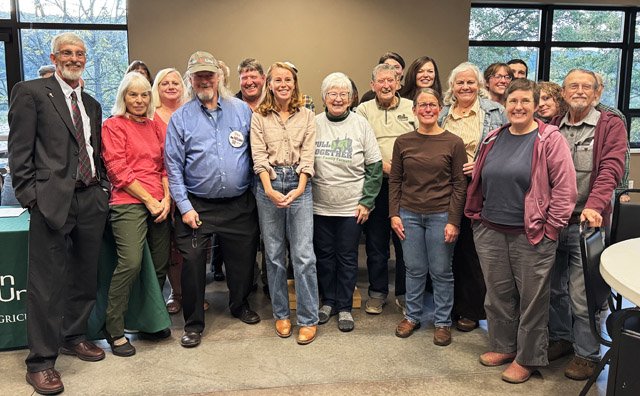
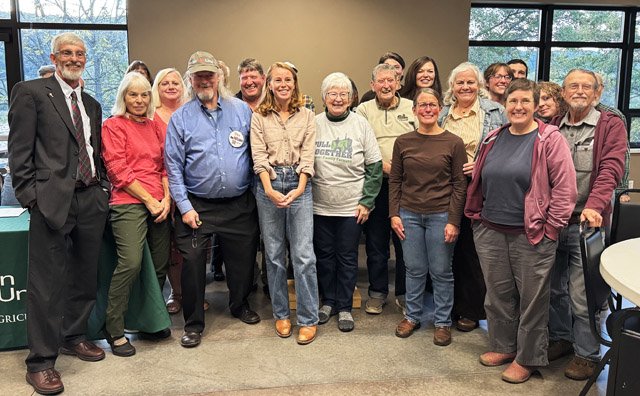
GAYS MILLS - On Friday, October 9, the Vernon-Crawford Chapter of the Wisconsin Farmers Union (WFU) hosted a candidate forum at the Gays Mills Community Commerce Center. Though all candidates were invited, only Democratic incumbents seeking re-election or election to another office, or candidates seeking office as Democrats were present.
Present were two candidates for the U.S. Third Congressional District, Rebecca Cooke (D) and Alexander Kent (Ind.), opposing incumbent Derrick Van Orden (R) (not present).
At the state level, Rep. Jenna Jacobson (D), running for the Wisconsin 17th District Senate seat was present, while incumbent Howard Marklein (R) was not. Representative Tara Johnson (D), incumbent, representing the 96th Assembly District, was present, while her opponent Jim Green (R) was not. John Rindy (D), candidate for the 49th Assembly District was present, but incumbent Travis Tranel (R) was not.
Michelle Ramirez-White, WFU Government Relations Director, moderated the discussion in which a total of four questions generated by WFU, and two generated by members of the audience were posed to the candidates.
Candidate Rebecca Cooke was on a district -wide tour with former Montana U.S. Senator John Tester, and stayed only for the introductions and the first question.
Introductions
Tara Johnson: I'm so happy to be here. My name is Tara Johnson. I have the absolute privilege of representing the 96th Assembly District, a beautifully bifurcated district between southern parts of La Crosse County and all of Vernon County, and I am a proud member of Wisconsin Farmers Union. I am especially proud of the work that I've been able to do on the agriculture committee, the health committee, and especially working to address the issues. I want to put in what will I hope be several plugs for the BadgerCare Public Option bill that I was the lead author on. When the Democratic Party has control of both houses of the State Legislature, and the Governor’s office, we will be reintroducing that piece of legislation.
John Rindy: I grew up on the farm. The family farm is where it's at. We have to do everything possible to save the family farm, and I'm with everyone here on that 100%. I have 14 brothers and sisters, and you learn something about fairness when you grow up in such a huge family. When I'm in the Assembly, that’s what I'll be bringing forth. It's a sense of fairness for everyone that I represent in District 49.
Jenna Jacobson: I currently represent the 50th Assembly District, and am running against Howard Marklein for the 17th Senate District. I'm also a member of the South Central Chapter of Wisconsin Farmers Union, and the ranking member on the Assembly Agriculture Committee. While I didn't grow up on a farm, I grew up around farming communities, and am very proud to be supporting our agricultural heritage, and the future of farming in Wisconsin.
Alexander Kent: I'm an Independent running for the Third Congressional District here in Wisconsin. All of these big life and death issues we face at the federal level have a common cause: political corruption. And these issues are not new. All of these issues - farm policy, food production, healthcare, education, war, clean water, healthy soil, energy - all of them are linked back to political corruption, which is why we are running an anti-corruption campaign. We are committed to doing this campaign with no donors, no lobbyists, no Super PACs, and no political parties. We also believe in full voter empowerment. It is time to bring our republic online and ask all voters yes and no on all issues. It's time to build an honest and transparent republic with true liberty, true freedom, and true justice for all. It's time that you, the voters, we, the people, run this country.
Rebecca Cooke: I've been in Vernon County a lot over the last couple of weeks. I was at the County Fair, and bought a pig from a young man in La Farge. I hosted a roundtable up in Westby last week, talking about diesel and fertilizer prices with a number of area farmers. These are frustrating times for our agricultural communities. I grew up on a farm up in the Eau Claire area. We raised registered Holsteins. My first office I ever held was president of my 4-H club, but I think it bears a lot of clout in a district like this. I'm running against somebody, and an administration, that has done little to help farmers. We've seen the impact that reciprocal tariffs have had on our soybean and cranberry producers. We see this war in Iran and increased diesel prices, increased fertilizer prices that are frustrating everyone, and also driving up costs at the grocery store. I'm running because I want to even the playing field for our small and mid-sized farms. I want to craft a Farm Bill that actually caters toward our agricultural families. I want to make sure that we can protect our farmland from foreign nationals, which is both a national security and a food security issue. I want to make sure that we have control over what gets built in our backyards. I see somebody with the No 765 line hat on here – a big leader in the organization. I’m grateful for the work that you're doing, and I called for a data center moratorium because I think that we've got to press pause until we can learn more about the impact that has on our ratepayers, our environment, and our communities in the long term. I'm here today and showing up because unlike someone that doesn't show up, I believe it's important to have these conversations in our community.
Question One: as the average age of farmers climbs to 55 years old, the need for robust healthcare access in rural areas is only increasing. However, for too many farmers healthcare options are unaffordable or inaccessible. How would you ensure that rural Wisconsin has access to care when and where they need it?
Rebecca Cooke: a big part of my campaign platform is making healthcare more accessible and more affordable. We've seen with Congress's failure to expand the Affordable Care Act (ACA) tax credit premiums, many folks that are on the exchange have seen their premiums go up from $400 to $1,800 dollars a month. When I think about my family growing up, we had insurance on and off depending on whether my mom could get a good job in town or not. When the exchange came along, a lot of small business owners and a lot of farmers signed up. And now because of Congress’ failure to move this forward, people are really struggling. I think about long-term solutions. In the Eau Claire area, we've seen two major hospitals close, and that was before the reconciliation bill. In neighboring Menominee, we've seen labor and delivery close. One of the things that we can do is increase Medicare and Medicaid reimbursement rates. But you look at the way Derrick Van Orden votes, and I want us to understand why we're in this pickle right now is because of the One Big Beautiful Bill. I've had conversations with rural hospital CEOs and administrators across this district, asking what do you need to keep your doors open? I've met with the administrator down in Richland Center - they've been trying to recruit an orthopedic surgeon for three years. I've met up at Vernon Health with administrators there. I think one of the first things that Congress should do is expand the ACA tax credit premiums for three more years, but that just stops hemorrhaging for right now. What I'd like to see Congress move on is to pass a public option. You can keep your private insurance if you like it, but I think a public option is a better solution. And then I'd like to expand Medicare to cover vision, dental, and hearing - the things that deteriorate as folks age. My parents they go on a once-year trip down to Mexico to get their dental work done because it's cheaper to do there than it is in our own country. Our parents and grandparents should be able to age with dignity. But when it comes to the systems as a whole, every time somebody comes into a rural hospital that's on Medicare or Medicaid, those hospitals hemorrhage money because the reimbursement rates aren't enough.
Alexander Kent: when the last Farmers Union event happened, it was up in Eau Claire, and I asked for some audience participation because democracy and living in a republic isn't about us telling you what we believe - it's supposed to be representing you. Our platform, a voter-directed network, is supposed to source the will of the people directly from voters on all issues. So I'm just going to tell you what I believe, and I'd ask you to raise your hand if you agree. I believe in Medicare for all. This is what democracy should be like.
Jenna Jacobson: at the state level, Representative Johnson mentioned her Badger Care Public Option Bill. I think we need to provide something like that while we work at the federal level to get a more comprehensive solution done. Other things that we need to be doing to support rural healthcare include Medicaid reimbursement rates, increasing those so that specifically our rural hospitals and clinics can not only continue to keep their doors open, but that Medicaid reimbursement is covering the cost of care, which it frequently is not. We also co-authored a bill that would have regulated the pharmacy benefit managers. People in this role are the middlemen that decide that, John and I have the same prescription, but maybe we pay different prices because he went to hometown pharmacy and I went to Walgreens, for example. We know that a lot of our independent pharmacies are struggling because of those pharmacy benefit managers, and we don't have any meaningful regulation around them, so we need to get that passed as well. Another big thing is the workforce issues around healthcare. It is increasingly harder to get folks to get into nursing, for example, and when they do, a lot of times because of pay rates, they're working in more urban settings. We can be getting grants to our local two- and four-year colleges, to make sure that we have enough staff to train that workforce, and then incentivize them to stay in those rural communities, so that we have people who can provide that care. Expanding dental, vision, hearing, and mental health care all needs to be a part of that. The fact that we still don't comprehensively look at the whole person when we're talking about health care is wild to me. And again, prioritizing local coverage so that you can be in your community getting care from your local clinics, and at your local hospitals. I was talking to somebody in Prairie du Chien the other day, and their Medicare Advantage plan doesn't cover anybody in Crawford County, so they had to buy additional insurance for that coverage, and that's not acceptable in my opinion. We need to make sure that you can get coverage in the areas that you live.
John Rindy: I see healthcare as a basic right. I'd like to expand Medicare to make it available to everyone in the state, regardless of their income - poor or wealthy. I've been out knocking doors, and there's definitely a need as far as our EMS services. There's some counties or communities out there where it's all volunteer, and they're not getting the volunteers. So I'd like to have some grants available so that there's people on call. They might be sitting at home, but if the buzzer goes off, out the door they go. It's something that we really need to address and get on top of because a lot of us are getting older, and it's going to be that way for a couple more decades.
Tara Johnson: I'm going to be respectful of time and do a quick checklist of the things that I agree with that have already been said. I have always been, and continue to be, a universal healthcare person. Period. The pharmacy benefit management issue that Jenna raised is very real, and absolutely has to be addressed because it does most directly affect folks in rural communities. Expansion of coverage for dental, vision, and mental healthcare - that's part of the universal health care. I want to add a couple of points to what has already been said. This is a place where pressure gets put on the state because the federal government is not doing its job. The Big Beautiful Bill is wreaking havoc on individual lives, and it is also wreaking havoc on state budgets, because states are the number one providers of Medicaid services. In the State of Wisconsin. We have to have reliable partners at the federal level who understand what the effect is of the votes that they take, so that the state budget is not being consumed with basically the trickle down effect of absolutely terrible decision-making at the federal level. I talked with a woman the other day who had a mammogram. She's a 36-year-old, and there were concerns about the mammogram. She needed to go back for a second one, $900 out of pocket, and she genuinely still doesn't know whether she's going to be able to pay for it or whether she should. Those are the decisions that people are making.
Question Two: farmers consistently report difficulty finding enough workers to fill year-round and seasonal agricultural jobs. A 2023 survey by the UW-Madison School for Workers found that more than 10,000 undocumented workers performed about 70 percent of the labor on Wisconsin dairy farms. At the same time, Section 287G agreements have been signed between local sheriff's offices and the U.S. Immigration and Customs Enforcement, or ICE, under which local police may investigate immigration status, detain individuals, and/or begin deportation processes, depending on the type of agreement signed. What is your stance on 287G agreements, and if elected, how would you balance public trust, local budgets, and road stability when it comes to immigration?
Tara Johnson: I am opposed to 287G agreements. I understand that there are county sheriffs who perhaps see this as a revenue stream. To the issue of local budgets and county budgets, this may be seen as some kind opportunity to be able to collect money by housing those folks for the feds. I get that the flow of money is attractive. I see this as an imbalance between public trust and those fiscal needs that local communities have. So, for me, the equation equals not supporting 287G agreements.
John Rindy: we're all immigrants. At some point, our parents, grandparents, great grandparents (were immigrants.) And as far as ICE goes, if you’ve got to wear a mask to do your job, well, that's not a job. We should be above it on the federal level and the state level. We're above it in our own community. These folks are our neighbors. They're helping us put in our crops and helping us milk our cows. My stance on it from the hip is absolutely not. We need to find ways to speed up their immigration status and actually make them legal.
Jenna Jacobson: we actually had a bill in the Assembly that would have forced sheriff's departments to collaborate with immigration and customs enforcement at risk of 15% of their revenue from the state. I voted against that bill. I do generally believe in local control, but I've yet to hear a good reason why our local sheriff's departments should be doing the work of the federal government in regards to these 287G agreements. I recognize that it is a revenue stream, but it is a revenue stream that comes with more work. And the ultimate problem is that our sheriff's departments, like so many other of our municipal services, has been starved of funding for years. Our local communities are struggling. Costs of everything is going up. It's harder to recruit people to join law enforcement, and get them trained. And then we're enticed by this this idea that this agreement will help solve these problems, but it doesn't. It tears apart our neighborhoods. It pits neighbors against neighbors, and it puts extra work on our local sheriff's departments when they're already struggling. So I don't think that that our sheriff's departments should be in collaboration with these 287G agreements. I think we, as a state, need to be funding our community services appropriately so that they can do the work that we are asking them to do, and we need to be supporting our neighbors because that's what we do in Wisconsin. We take care of our neighbors. We fight for what's right.
Alexander Kent: just to give a general overview related to immigration and all of these issues at the federal level. The Republican Party controls Congress and the White House. They collectively could solve almost all of these issues within a month. Previously, before the Republican Party had control, who had control? The Democratic Party did. At the beginning of the Biden administration and at the beginning of the Obama administration, they had control of the White House and Congress. Party politics doesn't represent you. That said, I would propose completely reworking our immigration system in a way that keeps families together, that allows labor to freely pass our border, that keeps our communities safe, and prioritizes our economy and compassion at the same time. Please raise your hand if you agree.
Question Three: the number of licensed U.S. dairy herds decreased by 63 percent from 66,825 in 2004 to just 24,811 in 2024, according to the USDA Economic Research Service. Many smaller dairy farms are being driven out by government policies and industry practices that favor mass production of commodities over family farm viability. If elected, how would you support family-scale dairy farms, and ensure that Wisconsin remains America's Dairyland?
Alexander Kent: Again, please raise your hands if you agree. I believe unions are the backbone of our economy, and I believe farmers are the backbone of our community. Direct subsidies from the federal government to farmers to support local farmers makes sense. Candidate John Rindy interjected, “you need to pay the dairy farmer a decent price.” Kent clarified he meant the federal government should provide direct subsidies to family farms. Wisconsin Farmers Union President Darin Von Ruden commented, “that makes more sense than your first statement.” Local farmer Kraig Oppriecht pointed out that specialty crops, like small-to-midsize farms, don’t receive the same amount of subsidies as corporate farms do. “So all of these good ideas - this is what democracy is about: bringing these ideas forward,” Kent said.
Jenna Jacobson: the Farming Forward bill that I wrote first addressed what we could be doing to support the next generation of farmers. It's really hard and requires a lot of capital. What the bill does is it gives a 5% refundable tax credit to both the existing farmer who is looking to sell or lease and a 5% refundable tax credit to the beginning farmer. It used the federal definition of a beginning farmer, so there was no differences between what the state and the federal government are doing as far as mirroring the federal programs. And that refundable tax credit could be taken over multiple years, and would cap out at $75,000. With that funding, you can buy land or lease land, you could buy animals, you could invest in a new piece of equipment, or put solar panels on your barn. It was very flexible. It was up to the individual recipient. It capped it so that anybody who has a net worth of $200,000 or more could not receive it. We need to be incentivizing our family farms. That's what people think about, when they think of Wisconsin. They think about our rural family farms. They think about our communities, and so we have to be nurturing both of those things. So, unfortunately, because I am a Democrat and we have Republican-led Legislature, while there was a lot of excitement around the bill, they wouldn't give it a hearing. One of the things we hope to change when we get into the Legislature is to let good ideas be good ideas, irrespective of political party. But yeah, I think we can be doing more of things like that, and then also supporting the other areas that our family farmers need such as healthcare, transportation, and whatever we can do around the edges to make sure that we're being as supportive as possible while we work on federal government incentives as well.
John Rindy: farming has seen so many changes in the last 30-to-40 years, and now we're at this point. We got these large CAFOs and huge operations, and it's crazy. It's taken the fun out of farming. It's taken a lot of the good things out. It's turned it into a business. And when it comes to subsidies, well, the average farmer isn't seeing any of that. It's the big guys, and it's the food manufacturers. We've reached this point after 40 years of going bigger, working harder, longer hours working, bigger tractors, everything else. And meanwhile, we're still losing farms. We're going to be down to just a handful in just a few years. So when it comes to subsidies, and subsidies are good, I see them as helping to get through the bad times. So when it comes to the dairy farms and saving the family farm, what I'd like to do is introduce solar all over again, make it so that no one can turn it down. So there's solar on every farm, not out in the fields, not out in the parking fields, but on their homestead. You know, run it along the southern bank of their buildings and everything, and alleviate some of their bills. I'd also like to see farmers throwing their money together and start adding some value to the raw commodities. Because when you are selling corn, soybeans, or raw milk, you are not the price maker. You take what's offered to you. So, we’ve got to add value to that. We've got to take some money away from Kraft, Nabisco, the big guys. There's only so much money in the pool, and part of that belongs back home. They throw their money together, and they start selling their ice cream, their yogurt, and keep things local, providing food to schools, prisons, and any agency that’s receiving money from the state – that food should all be coming from our farmers.
Tara Johnson: I want to start with an apology - I think the fact that we are having to have this conversation in 2026 is shameful, and to those of you who are farming right now, I wish it wasn't as difficult as it is. I really wish that this table was full of all the candidates who are running for office, because I think this question is for me the one that gets at the heart of Wisconsin Farmers Union and the work that we need to be doing in the State Legislature to protect and preserve family farms, dairy farms - who we are as a state. I am really proud to be a member of Wisconsin Farmers Union and a supporter of your legislative agenda, because I find that we share those values, and I am grateful for the direction. I think that lobbyists such as Wisconsin Farmers Union play an important role in the work that we do in state government. Having good ideas come from you to help me with that work in invaluable. I think a couple of other things, like Right to Repair, healthcare, and investing in public education so that we can lower local property taxes is a way to help all of us, including local farms.