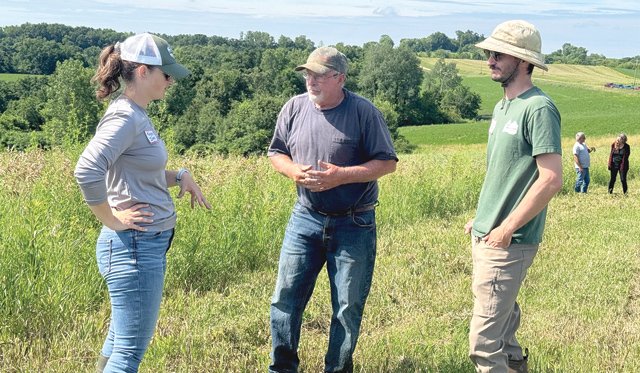
Mississippi Valley Conservancy (MVC) has been forging ahead with conservation projects at their 1,600-acre Plum Creek Conservation Area in rural Wauzeka since acquiring the property in spring of 2022. A group of about 25 citizens assembled at a ridgetop field on the western side of the property for a ‘Grazing for Birds’ field day last Saturday.
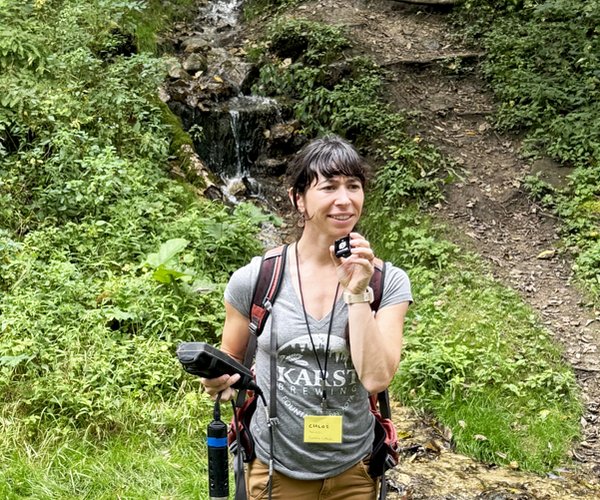
There to educate the group were Michael Reitz, MVC Restoration Ecologist, and Krysten Zummo, Audubon Grassland Ecologist, who works with their Conservation Ranching program.
Efforts on the property have included planting 11,200 trees on a ridgetop field in spring of 2024, and now ongoing work on converting 172 acres of ridgetop fields to perennial prairie, and cold and warm season grazing mixes.
A portion of the acres is intended for grazing by beef cattle. Neighboring farmer Mike Mullikin is partnering with them on the grazing project.
In addition, this summer they are also undertaking an ambitious streambank restoration project intended to improve habitat. The idea is to connect Plum Creek to its floodplain, and reduce flooding impacts downstream.
The two ridgetop projects are each designed to provide habitat for different populations of migrating birds.
“One of the goals of the property is get the agricultural fields into some sort of perennial cover - forest, prairie, or some sort of agricultural practice that has perennial cover. That's important for us,” Reitz explained. “We’ve hit all our milestones, and got all tillable acres into some sort of perennial cover. An 18-acre area on the east side of the property planted into trees is designed to provide habitat to support interior forest birds. The 172 acres we’re viewing today is a demonstration of where agriculture and conservation meet - prairie plantings for pollinators - the second biggest in the state by less than an acre, and acres planted into grazing mixes for beef production.”
Zummo explained to the group the benefits of rotational grazing for grassland birds, and Reitz shared information about the two different treatments, plans for the acres planted into prairie, and the scientific research that this would allow.
“We’re working with ways to do it that make more sense for both grazing and grassland bird species, and it's kind of interesting research in that regard,” Reitz told the group. “When we got it, it was all corn, and obviously, corn is not the best thing.”
“You can just say corn sucks, and I grow corn,” Bad Axe Watershed Steward’s Kent McClurg observed. Just lay it out there – but, beans are worse, absolutely.”
“We’re working to see where we can push the field forward in some ways, and be more experimental,” Reitz explained. “We have the 40-acre pasture that we've devoted to agriculture, and we have the rest of the acreage enrolled in CRP prairie plantings.”
Reitz said an early bird survey of the property revealed that the birds really like to be by Plum Creek and the Kickapoo River, so the western upland areas seemed to them to be a good spot to focus their agricultural efforts.
“So, we devoted the 40-acres that we're standing on to pasture, working with grazier Mike Mullikin,” Reitz told the group. “On 32 of the 40 acres we planted a cool season mix. The cows are going to come from his property to the south, rotate across the road, and then make a big loop around. On the other eight acres, we're experimenting with using warm season grasses, a very similar mix to our prairie on the CRP acres. So, seeing where we can mix in native habitat for pollinators and birds with grazing.”
Grazing systems
Flags throughout the field indicated the path for the water pipeline that would be installed, allowing ease for the producer in moving the cattle from paddock to paddock. In the hilly terrain common in the Driftless, the system would be configured for gravity feeding.
“Water is a big thing when moving them constantly, and Mike Mullikin is going to rotate his herd of 25 beef stockers every three days minimum,” Reitz told the group. “The paddocks will be super flexible, and the plan is for the cattle to go in when the forage gets about 16 inches high, and then they mow it down to four inches, and then they move to the next one.”
Zummo explained that as an alternative to the relatively rigid, proscriptive system required by NRCS for grazing systems, Audubon focuses on a process they call ‘adaptive grazing.’
“Other programs give you a set number of acres, with a set number of animals, for a set number of days, and you have to stick to that regimen, Zummo explained. “When adaptive grazing is being used, it's more looking at where have the cattle gotten the grass down to, and deciding to move them based off of the height of the vegetation instead of a set regimen of days. It sounds like it takes a lot of time, but the great thing about it is, you go out there and once you have the main fencing and the water set up, you can move your animals in like five minutes.”
Zummo pointed out that with adaptive grazing, cattle actually gain weight faster because they are being moved in a timely fashion that means they always have access to fresh food. Planting a mix of cool and warm season grasses in your pastures greatly facilitates this process.
Establishment
Reitz explained that they were two years in to the three-year ‘establishment period,’ and after that, grazing would begin. He explained that on the CRP lands, with a native prairie planting, they are prevented from grazing it if they want to use the income to offset the property taxes MVC has voluntarily agreed to pay on the property. For this reason, 578 acres of the western portions of the property is also privately leased for hunting in the fall in order to help pay the property taxes. On eastern portions of the property, almost 1,000 acres are open to hunting and fishing.
“On the CRP property, we will manage it with fire according to our contract,” Reitz explained. “This will provide contrast, with respect to bird habitat, with the portion of the acres managed through rotational grazing, and provide useful insights to those wishing to manage their lands for both birds and grazing.”
Audubon program
Krysten Zummo is a Grassland Ecologist who works for Audubon, and a self-confessed ‘bird nerd.’ She previously worked for MVC in conservation easement development, and was instrumental in the acquisition of the Plum Creek Conservation Area Property.
She administers Audubon’s ‘conservation ranching’ program regionally in the Driftless Regions, and parts of the Great Lakes and Upper Mississippi Region.
“Grassland birds have been the steepest declining group of birds in North America,” Zummo told the group. “Audubon asked itself, ‘what can we do about this’,” because 90% of land in Midwest and Eastern states is privately held, and pretty much all of the grasslands that we have left in North America are either privately held or leased federally for grazing operations. So, Audubon concluded that if we were going to do anything in terms of improving grassland bird habitat, working with those landowners who are doing grazing was really going to be the key way to do that.”
Zummo pointed out that this landscape used to have bison on it that would pass through an area, eat the vegetation down, and then move on. They would not return to that area for a long time, giving that vegetation ample time to regrow.
“We don't have bison here anymore, but we do have cattle, Zummo observed. “Rotational grazing can create that same kind of impact on the ground as what bison would have created.”
Zummo said that grassland birds are less sensitive to the species mix planted in prairie and grazing lands, and much more sensitive to the structure of the lands. She said they don’t like vertical structural elements like trees, which she explained can harbor hunting predators that can predate on them or their nests.
“What we're finding more and more is that grassland birds don't necessarily love or hate a specific species. It's more about the structure,” Zummo said. “We really love grazing for grassland birds, because you can utilize it to create really low areas, which will support birds like upland sandpipers and vesper sparrows and horned larks, and then can also graze on the medium height, which is good for savanna sparrows, some meadowlarks, and other things like that. And then you can have stuff that you set aside for a year or two, and that will bring in henslow sparrows, and birds like that.”
Zuumo shared that the Conservation Ranching Program is actually a production system certification that can be displayed on product packaging. She said they are beginning to develop the dataset, working with producers, wholesalers and retailers, to demonstrate the kind of price premium that might be available from this bird-friendly production model.
“We work with the producers to develop a habitat management plan that's based off of a set of protocols that are run from the national level to the regional level, with a regional set of protocols for the Driftless Region,” Zummo explained. “That habitat management plan is basically the individualized farm-level set of protocols, where I work with a landowner to identify their goals. In the process, we identify ways to improve their grazing as well as to improve bird habitat, and then bring grant funding to bear to support the producer in upgrading their system.”
Zummo said that once the plan is implemented, they go through a third-party audit that checks off that they are meeting all the protocols, which allows them to put the ‘Audubon Certified – Grazed on Bird Friendly Land’ bug on their product labels.
“What we were trying to do is turn consumers into conservationists,” Zummo explained. “When you start seeing this label on packaged products for beef and bison, you know exactly how that that animal was raised, and that it was raised not just to support the grasslands, but the birds and the wildlife that rely on them.”
MVC easements
Karen Solverson, MVC Director of Communications and Outreach, asked Reitz and Zummo to explain what a conservation easement is, and is not.
Reitz explained that the Plum Creek Conservation Area property was purchased from a farmer who had put several farms together, ultimately owning about 11,000 acres. That landowner sold 1,600 acres to Wisconsin DNR on the east side of the Kickapoo River, but wanted to find a way to transfer other parts of the property to a group that would pursue conservation treatments on the acres.
“There was a long period of time involved in getting the funding to purchase such a large acreage, and the landowners were very patient, wanting to make sure that it got to the right place,” Zummo explained. “It was a 10-year or more process between when the conversation started, and when the funding was actually ready and in place to do the transfer.”
Ultimately, one large anonymous donor, with some funding from the Nature Conservancy, produced the funding needed to put the deal in place.
“If you're worried about development or keeping farmland as farmland, or in conservation practices, you can work with us to put an easement on your land, which restricts use in perpetuity, depending on your values,” Reitz explained.
“With conservation easements, there's a whole bunch of landowner rights that come with owning a piece of property,” Zummo clarified. “Allowing the public access is one of those – it’s not required - it's totally up to you.”