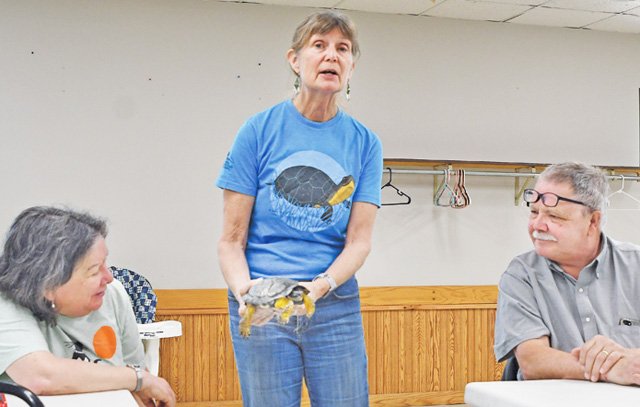
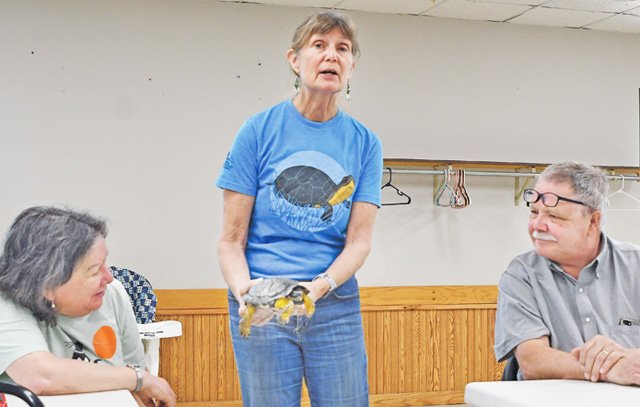
DE SOTO - Live turtles and a variety of other educational materials captivated 27 curious individuals who participated in the Sunday, May 3 ‘Turtle Talk program at the De Soto, Community Center.
A day earlier, smilar program was held at Driftless Education and Visitors Center near Lansing, where 55 people participated. Rebecca Christoffel, one of Wisconsin’s premier turtle experts, enthusiastically presented both programs.
The Friends of Pool 9, sponsored these programs, and were delighted that so many people came to ‘Turtle Talk’ to be exposed to many new and interesting details about turtles, and to gain overall knowledge about the nine species of turtles living with us in our beautiful area.
There are only about 260 turtle species in the entire world. Fifty-five of those are native to the United States, and just a treasured nine live in our area. Some turtles are totally land dwellers, some spend part of their lives in the water and on land, while others are in water continuously except for the vulnerable females that must always lay their eggs on dry land to perpetuate their species.
This story will focus and expand upon one key part of the ‘Turtle Talk’ program, what young and older individuals can do for our cherished turtles that so many appreciate.
How to help turtles
- Please be extra alert when driving during May and June. This is by far the most seriously threatening time of year for pregnant female turtles of all nine of our local species. All female turtles must lay their eggs on land. However, they often must cross roadways and other open areas in search of places to lay their precious eggs. This is when too many people become careless and harmful.
It only takes a couple of female turtles being killed annually on a stretch of road to cause a sharp decline in local turtle populations. Please drive a bit slower and always more carefully during their brief but critical nesting season, which is taking place right now.
- If a turtle is seen crossing a roadway, move the turtle in the direction it was going - but do so only when it is safe. Pick up small turtles gently by the back of the shell. Then carry them off the road to a safe location where vehicles do not go. Large turtles can be lifted carefully and carried to safety with a shovel. Rebecca Christoffel recommended a plastic shovel. Every part of a turtle has nerves and is sensitive; therefore, a plastic shovel is best. Stay away from the head of one species–the Snapping Turtle!
- Keep turtles in the wild. Turtles were living with dinosaurs 200 million years ago. Dinosaurs have been extinct for 66 million years. But we still have our wonderful turtles! Such extreme longevity should be admired, honored and protected. And, each turtle species deserves the opportunity to follow the way of life it has led for its 200 million year history.
By far, the two biggest threats to turtle populations are vehicles crushing the bodies of females carrying eggs, plus the loss of natural habitats where they spend their lives. In other words, what humans do. Please observe and enjoy turtles in their wild homes.
- Turtles make poor pets for children. Choose something else for a child’s pet. Turtles do not do well in captivity, unless carefully taken care of, on a daily basis, by well trained specialists. If a child touches a turtle, be sure they wash their hands, as diseases can be transmitted.
- Prevent or reduce loss of habitat. This is the single largest overall threat to turtles and all other forms of wildlife. As human populations expand non-stop, our demands on nature’s habitats likewise and continually increase. Fewer and fewer natural habitats are available. Let your elected decision-makers, at every level, know that you want wildlife habitat preserved in your area.
- Keep pets indoors. Dogs and cats are extremely efficient predators on newly hatched turtles. Your pets are safest when indoors, or kept on a leash when outdoors. Newly hatched turtles, with their soft bodies, deserve a chance to survive dogs and cats, and to live out their lives in their natural habitats.
- Encourage and support county, state and federal regulations, which protect turtles, as well as their essential habitats.
- Share what you know about turtles. The amazing details and living habits essential to turtles are not well known by most people. Especially so for the serious threats to females as they search for places to lay their eggs this month and next.
It has been estimated that for a turtle population to persist, adult mortality must be kept to less than five percent annually. Let your family members and friends know about these and other important turtle facts. This is a useful understanding! Put it to good use.
- Learn more about our wonderful turtles. There are many books about the fascinating characteristics, identification, and living habits of local turtles. Please visit nearby libraries, or book stores. Or, do a Google search, to expand your knowledge.
Three resources
Here are three user-friendly resources to choose from, starting with the most basic: ‘Turtles & Lizards of Wisconsin,’ by Rebecca Christoffel (who led both of our ‘Turtle Talk’ programs). ‘The Natural History of the Turtles of Iowa’, by Terry VanDeWalle and Neil Burnstein; and ‘Amphibians & Reptiles of Minnesota, Wisconsin & Michigan’, by Allen Blake Sheldon.
And for avid readers who wish to understand the complete inside story of how two concerned young ladies provided superb help to a number of injured turtles: ‘Of Time and Turtles ~ Mending the World, Shell by Shattered Shell’, by award-winning author, Sy Montgomery. This book delves into the tight connection between humans and turtles, and is highly recommended.
Knowing about and appreciating the animals with unique shells on their backs can lead to a career, or perhaps a second career, as a naturalist, ecologist, veterinarian technologist, or natural resource conservationist.
People, especially young people, in this ‘turtle loving group,’ are increasing quite quickly and steadily in a world that too often seems cruel and uncaring.
The mission of the Friends of Pool 9, a not-for-profit organization, is: To conserve the cultural and natural resources within Pool 9 of the Upper Mississippi River National Wildlife Refuge, and to foster wise public use and enjoyment of the Refuge and the Upper Mississippi River.
Friends of Pool 9 achieves their public mission by creating and facilitating successful partnerships with various recreation and service organizations, corporations, and communication outlets; as well as with local, state and federal conservation agencies.
Ric Zarwell is a Founding Board Member Emeritus, Friends of Pool 9 - Upper Mississippi River Refuge