A common refrain from citizen interactions with the developers of the proposed 765kV MariBell electric transmission line is that answers are not being provided to questions asked about the project. Those developers are Dairyland Power Cooperative (DPC) and GridLiance (GL).
Citizens are told by the developers to submit their questions in writing, or to make an appointment with project subcontractor Doyle to negotiate a contract to survey landowner’s properties. Citizens have turned to their town and county governments to pass resolutions seeking answers to their questions, as well as to the local electric cooperatives of which they are members.
In response to these information request resolutions, the developers are scheduling meetings with towns and counties as they move through the ‘public information phase’ of the project. State law requires developers to work with landowners and respond to their questions.
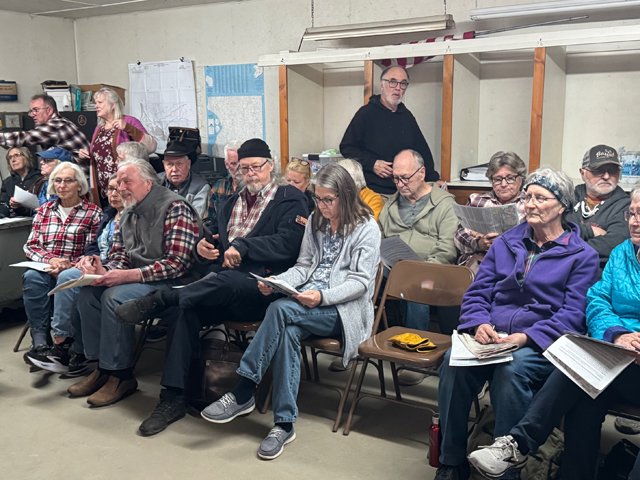
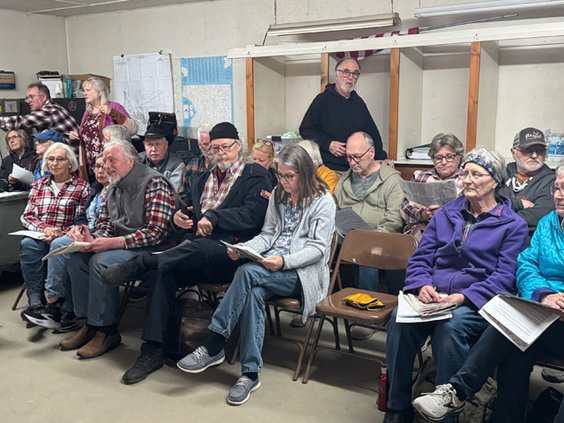
The Crawford County Town of Freeman passed an information request resolution, and in response the developers scheduled a meeting at the Town of Freeman Hall on Monday, April 20. Almost 50 concerned citizens packed into the tiny space to hear answers to their questions.
The developers came with a big TV, and a presentation that conveyed the same information made available at other meetings, but none of the written documentation requested in the town’s information request resolution.
“I want to point out that the Town of Freeman sent you guys a letter, a resolution, asking a bunch of questions,” Town of Freeman resident Edie Ehlert said. “I'm asking that you send written documentation answering those questions that the town asked for.”
“You're responding to the resolution, where's the written documentation?” Town of Seneca resident Jay McCloskey followed. “I believe what you said is we'll get it, is when the Certificate of Public Convenience and Necessity (CPCN) is out there, and that’s too late for us to get answers to our questions.
“A lot of the questions will be answered once the application is filed with the Public Service Commission, and a docket is created,” Dairyland’s Doug Maly responded. “Once the docket gets created, they'll take public comments. You can submit all of that as a public comment.”
“So, if you invite us, they asked for written documentation,” another town resident said. “We expected you to have the documentation when you came so we would have a chance to review it and find out if there's any further questions.”
“Right now we are filling out the application. That's what we're going through,” Maly explained. “That's why we can't answer the questions Jay, because we don't have those documents yet.”
“Well, documentation explaining MISO’s (Midcontinent Independent Systems Operator) calculation, the net monetary benefit for Wisconsin residential electric customers - you'd think that within your 1,000 people who've been planning this, that information would be available,” McCloskey responded.
Maly said that the planning and forecasting was done by MISO, who doesn’t necessarily share everything with developers like Dairyland.
“Okay, have you requested it?” McCloskey asked. “You could have said you have this meeting in Freeman Township coming up, and you've been requested to provide documentation that MISO would have possession of. Have you asked for that yet?”
“I have not specifically, no,” Maly responded.
“Why not? The town’s resolution very clearly outlines things that we wanted in documentation, which would imply being written. It's a document,” McCloskey said. “And there are other things in here that in the many hours, 1000s of man hours of planning all this, that one would think that you would have like documentation of the acres of additional land use for the right of way, for instance. Since you're the guy who I understand is leading that, I think that would be documentation that you would have.”
Need for line
One big thing the developers will need to demonstrate to the PSC is the need for the line and the benefit Wisconsin ratepayers will get from it. The Dairyland (DPC) and GridLiance (GL) representatives gave Town of Freeman citizens a preview of the case they would make to PSC in the permitting process.
“A lot of people think, you know, we don't need transmission, we don't need additional power here. We have enough power,” GL’s Lori Dunham told the group. “So the MISO is the regional transmission organization (RTO). They oversee the electric grid and the regional transmission planning through the central area of the United States. MISO is a not-for-profit entity that has the responsibility established by the Federal Energy Regulatory Commission to identify needed transmission projects. MISO has identified that congestion will increase over the next 20 years as demand grows by 1.14% a year.”
One participant pointed out that in 2005, MISO had forecast that in the next 20 years, demand would grow by 2% per year. Instead, they pointed out that in that time period, demand for electricity had been flat in Wisconsin, and even declined slightly.
“Given MISO’s prior demand forecast was so wrong, why should we believe you?” the meeting participant asked.
“MISO spent multiple years studying the Midwest system, and they took a look at everything - the generation, the transmission, the reliability issues that are going on out there,” Dunham responded. “They looked at the generation retirement. They looked at new generation coming on, and they came up with Tranche 2.1 which is 1,800 miles of 765 kV backbone that supports future reliability and resiliency of the power grid across the United States. There's 24 different projects across the MISO Midwest region, and they directly assigned Dairyland Power a portion of these projects in MariBell because of their existing 161 kV network. I think it's important to realize they're not going out and finding new land. It will be sited where the existing 161 kV line is.”
“So why is this line needed?” Maly continued. “Among other things, coal thermal power plants are closing, and the rate of electricity use is increasing. The economy is electrifying. We are re-shoring manufacturing.”
“There are other high voltage lines and routes other than going through the heart of the countryside, for example, going down the highway,” McCloskey responded. “I'm not going to debate the fact that there is a need for upgrading the electric grid. I will debate that we need a 765 kV line. In fact, MISO’s own independent analyst David Patton has said on three separate occasions, it's not needed, it’s overpriced, and it’s over built.”
“I'd like to speak to that, though, because there's also 1,000s of hours and hundreds of other people that all agreed that it was needed. The exact person you're referring to didn't speak up when they were all talking. He did it after the fact.”
“The bottom line is no matter where this line is sited, it’s going to feed the grid and solve the congestion you refer to,” McCloskey pointed out. “We don't need to go into our farms, in our homes, in our backyards. And you know, so using the congestion idea, basically what you're doing is you're building a super highway through the rural community with no off ramp. It's just a straight line shot out east according to MISO and Scenic Rivers and other electric co-ops statements. It's needed for the AI data centers.”
You mentioned the increase in electric vehicle utilization. University of Michigan just put out a study in January that projected in rural areas they expect that electric vehicles adoption rate will be 5%, with 56% in cities and suburban areas,” McCloskey pointed out. “You're building an electricity super highway through our communities that we will have no benefit from. And if you go down a different route that's not going through our farms, and through a region that nature managed to leave alone throughout three ice ages - you know it's considered a national treasure. And you want to basically desecrate a national treasure with a super highway that provides no benefit to us directly, and any benefit we would get could be provided by any other route that you take to feed the electric grid.”
Karst, wildlife, dairy
Town of Freeman resident Edie Ehlert spoke about the crossing of the Upper Mississippi River Fish & Wildlife Refuge, and the impacts the massive transmission line could have.
“This is, this is Pool Nine of the Mississippi River. It's the richest, most diverse habitat of any of the pools. 100 eagles live there. It took decades for the eagles to become restored here. It is prime, amazing habitat, and you want to run what amounts to what you call an interstate right across there of a 765 kV line, bigger than anything in Wisconsin,” Ehlert emphasized. “This is the main part of the of the Mississippi River flyway, and the tundra swan migration. How are they going to all deal with this? And you talk about mitigating. How many dead eagles is mitigating? So I'm really, really concerned about this. Let's hit the richest, the most diverse place that we can find. I find this completely objectionable for that reason alone.
“I'm speaking for the local farmers too,” Ehlert said. “I know that some of your work has said that that the low level of EMFs is not an issue. The newer studies say it really is. We have a lot of small farms. We have a lot of grazing going on here. You can't just give them some money and say, go move that organic farm. These are generational farms that have been here a long time.
“Are there peer reviewed study on effects on dairy animals located near these lines?” Town of Utica organic dairy farmer Jim Wedeberg asked.
“I'm not sure. I have not looked into that specifically,” Maly responded.
“Well, I think it'd be good to look into it, because dairy cows are very sensitive to electricity,” Wedeberg replied. “And another thing, I think a little bit earlier, you might have misspoken by saying that you're following the existing right of way, because it splits at my farm and you're going south. We're on the alternative right away, alternative plan, and you're going to take more farms that don't currently have a power line on it. And I was told that at the public information meeting that you're doing that so you avoid Gays Mills because you don't want to deal with the politics of Gays Mills.”
“You're absolutely right. You're talking about the substation right there, we were going mostly south to avoid the Kickapoo River and Gays Mills,” Maly said. “I've never heard it referred to as the politics of Gays Mills. It was just a river, and to stay farther away from the city itself.”
“It's not just birds, it’s also amphibians, insects and bats. It affects orientation of mammals like cattle and deer. That's where the research has been done,” Town of Freeman resident Sara Tedeschi pointed out. “Guess what? We're mammals too. So the magnetic pull of the Earth has a lot to do with how animals orient themselves and their migration patterns, and the way they move and navigate. So this is a really big deal for wildlife and theoretically, for all of us.”
Tedeschi went on to ask about how the land would be prepared for the line, and specifically how the footings for the towers would be sited.
“The proposed style is a lattice tower. It would have four footings, four quarters with a concrete foundation. So you would drill the hole and you would pour the concrete. You do that four times, and then you would erect the structure on top of that,” Maly responded. “Prior to that, you have to take what are called soil borings, geotechnical investigations, to see what kind of soil you have and how close is the bedrock. It varies on how tall the structure is, how heavy it is, and what the geotech finds.”
“What you’ll find across this entire region is karst geology, and water pollution can go directly into the groundwater with that kind of disruption,” Ehlert pointed out.
Maly shared that in order to construct the footings for the towers, bigger derricks, bucket trucks, something to drill the holes, concrete trucks, and something – either a crane or a helicopter to erect the towers on top of the footings.
“Well, I must say, knowing some of the land that this will pass through, it’s very hard for me to picture the kind of disruption that that will mean,” Tedeschi responded. “It’s definitely really hard to picture, it’s kind of catastrophic and kind of science fiction in this landscape.”
Siting, easements
Residents attending the meeting seemed particularly offended by the developer’s right to take additional land for their easement by use of eminent domain if the project is permitted by the PSC.
“If I'm not mistaken the existing right of ways are 90 feet, but you're going to go up to 250 feet,” McCloskey said. “If the landowner on the current easement does not want you to do that, if this is approved by PSC, you're going to condemn the property by eminent domain in order to take the right of way whether the landowner likes it or not. Is that correct?”
“You're skipping some steps, but in broad strokes, I'd say yes, that’s accurate,” Maly responded. “What I mean by skipping steps is we are required to negotiate with all landowners. That's state law. There's a whole process for this. And every utility that I'm aware of does whatever they can to reach voluntary agreements. They want to work with landowners because that's the best way.”
Maly also responded to the suggestion that the line should be built to run down the interstate.
“It sounds like what you're saying is to go put it on someone else's homes and farms,” Maly responded.
“No, I'm saying you should go down the highway, or bury it, or go along the railroad or other paths, other than through our homes and farms in the Driftless,” McCloskey responded.
“We can't go down Interstate 90 because you can't cross in the City of LaCrosse because of the airport. Once you get past La Crosse, the next thing you run into is Fort McCoy,” Maly explained. “McCoy is federal. The airport is federal. I'm not sure we can get around the federal permitting barrier. So that's why you can't go down 90. Now, burying the line, which comes up frequently, has never happened for a 765, that we're aware of, not yet.”
One meeting participant pointed out that this is not true, because the SOO Green 765 kV line is currently being built in Iowa. That line will carry direct current electricity underground, across the Mississippi River, and to a substation located in northern Illinois just a few miles from where the MariBell/BECI 765 kV alternating current line would terminate.
GridLiance’s Lori Dunham said that buried transmission lines, because of the trenching involved, have a big impact on the environment, and also are more expensive to build and more difficult to repair. She showed a slide with several bulleted points to explain why burying the line is not feasible.
One meeting participants said, “you might as well just get rid of all the other bulleted points on your slide, and keep the first one where it says it’s too expensive, because that’s why you don’t want to do it.”