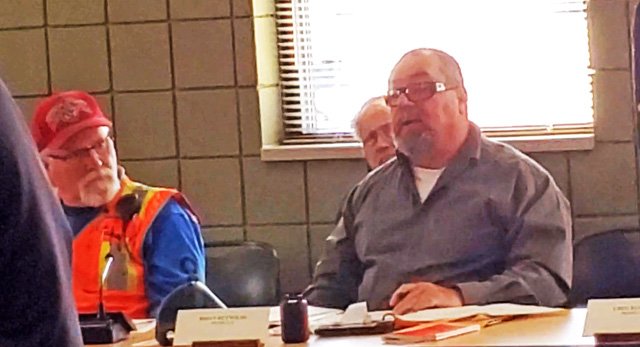
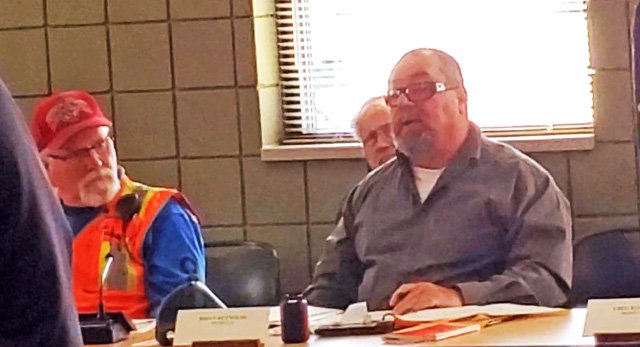
The Crawford County Board of Supervisors heard from MariBell 765kV transmission line developers Dairyland Power Cooperative and GridLiance at their meeting on Tuesday, April 21. The appearance was scheduled in response to an information request resolution passed by the board at their January meeting.
The information presented by the developers was identical to that provided to the Town of Freeman the night before, also in response to an information request resolution. Present from Dairyland were Government Relations Manager Branden Yates, and Land Lead Doug Maly. Present from GridLiance was Director of Development Lori Dunham.
Supervisors from northern parts of the county, which will be directly impacted by the siting of the massive transmission line, posed tough questions for the representatives of the developers present. Those supervisors included Brian Reynolds from the Town of Seneca, Mary Kuhn from the Town of Utica, Harrison Heilman from Soldiers Grove/Town of Clayton, Craig Anderson from Gays Mills/Town of Clayton, and Al Thompson from Town of Freeman/DeSoto/Ferryville.
GridLiance’s Lori Dunham explained who the developers are, and how the Midcontinent Independent Systems Operator (MISO) does the demand forecasting, transmission expansion planning, and securing of investment for a region in the central United States across 15 states and part of Canada.
“Part of MISO’s role is to identify needed transmission projects, as well as overseeing overall congestion,” Dunham explained. “MISO’s forecasting predicts demand for electricity will increase over the next 20 years by 1.14% a year, adding approximately 500 megawatts of additional demand. When you have increased demand without increasing transmission capacity you get congestion, when the amount of power exceeds the capacity of the transmission lines.”
Dunham said that in MISO planning, 765 kV was identified in the MISO planning process as the preferred solution for the region because it can efficiently carry large amounts of power, needs fewer lines to carry the same amount of power, and uses less land than building more smaller lines.
Dairyland’s Land Lead Doug Maly once again explained why the line can’t run down the interstate, and why it can’t be buried. Despite admitting that he is aware of the 765 kV direct current buried SOO Green Line currently being built in Iowa just the night before in the Town of Freeman, he once again claimed to be unaware of any buried 765kV lines.
What he might mean is ‘buried alternating current lines,’ which aren’t feasible because of the heat generated by alternating current transmission. Always, the prohibitive cost of building buried lines is mentioned.
Of course, like the Town of Freeman, Crawford County’s information request resolution asked the developers for written documentation, and again, none was furnished.
Supervisor questions
Newly elected District 12 Supervisor Brian Reynolds from the Town of Seneca was the first to speak.
“I was at the Town of Freeman meeting last night, and obviously this is a super hot topic in areas that I represent,” Reynolds told the developers. “One of the key questions that came up last night is my constituents have submitted a number of questions that they're looking for answers to, and they haven't got those answers yet. Another point is they're all chipping in their own money, $1,000 a pop, to fight this.”
Reynolds pointed out that if you look at the power needs in this area, they have actually gone down a little bit. He said it's only fair to say that these lines are going to go through the Driftless, you're going to have these big towers that nobody is interested in looking at anchored into the karst, and local residents are supposed to be happy about it. But ultimately, he said, a lot of this power is for Chicago or for somewhere else, and then you have big data centers coming into the area, and some of that power is for them.
“It is a huge controversy. I know it affects other county board members that are here and their constituents,” Reynolds stated. “It'll end up where it ends up, but I think it's fair to say there's going to be a decent fight before this is all done.”
Mary Kuhn
Mary Kuhn, from the Town of Utica, was the next supervisor to pose questions to the developers.
“So you want to increase the easement to 250 feet - what if my house is in that easement area, and I don't want to give you the easement?” Kuhn asked.
“One of the things that we're looking at with the preliminary routing is trying to utilize as much of the easement as possible,” Dairyland’s Rob Maly responded. “But that doesn’t necessarily mean going down the exact same center line. So you can adjust the center line a little bit to still utilize the entire easement, and then avoid other things that are in the way.”
“If my house is in the easement by a lot, are you going to move the easement so my house isn't in it?” Kuhn asked. “When you look at a picture of where houses and buildings are, a lot of those are going to be right in the easement. If I don't want to give you an easement over my house, are you going to come in with eminent domain and say, too bad you have to give it to us anyway?”
“When a Certificate of Public Convenience and Necessity (CPCN) is issued by the Public Service Commission, one of the things that provides the utilities is the right of eminent domain,” Maly responded. “But, there’s a bunch of steps prior to that. It is never any utility’s first choice to use eminent domain. There’s a whole legal process that requires good faith negotiations. I can’t sit here today, however, and say there are homes that will definitely have to be relocated – I don’t know that yet.”
But, if I don't want it to come over my land, you're going to take it anyway. Regardless of the process, you can still run your line with that easement over my property by taking it through eminent domain, right?” Kuhn pursued.
Kuhn went on to point out that 20 years ago, the utilities were also forecasting increased demand that never materialized.
“Did you not use the same projections over the last 20 years to justify what you wanted to do?” Kuhn asked. “The projection was that electricity use in this area was going to go up so much percent every year, but that didn't happen. So if that projection was wrong, why should we believe the current projections you’re using to argue that putting this giant transmission line in is needed?”
“The economy is electrifying, it’s much more digital than it ever used to be. Transportation is electrifying, and we're re-shoring manufacturing,” Maly responded in defense of the projection of increased demand for electricity.
“The Vernon County Board, I understand, is sending a letter to the Public Service Commission, and they are talking about legal action to stop the transmission line,” Kuhn told the developers. “Richland County is in the process of doing the same thing, and I can't imagine that at any meeting that you have been to in this area, people are saying they’re happy you're doing this. So does public opinion here not matter to you at all, that it's obvious that people around you don't want it - doesn't that matter to you?”
“All of this feedback is part of the PSC process,” Maly responded. “It is the PSC that will make the final determination.”
Karst, routes, timeline
Supervisor Harrison Heilman, from Soldiers Grove and Town of Clayton asked about the increased weight of the proposed towers, and how that will work with the area’s karst geology.
“I don't know the exact weight of the structures. I don't think anybody does now, because it's a design thing. It's based on a variety of factors, and it changes with every single structure,” Maly responded. “As part of that process, you have to do something called geotechnical review to see what your foundation is - what is the soil, what's the geology underneath the ground? And with that information, you can design footings to handle the weight.”
Supervisor Craig Anderson from Gays Mills and Town of Clayton expressed disappointment that detailed maps of affected parcels were not part of the developer’s presentation. Maly said that detailed maps had been provided for both the proposed and alternative routes at recent open house events held in Gays Mills and Retreat.
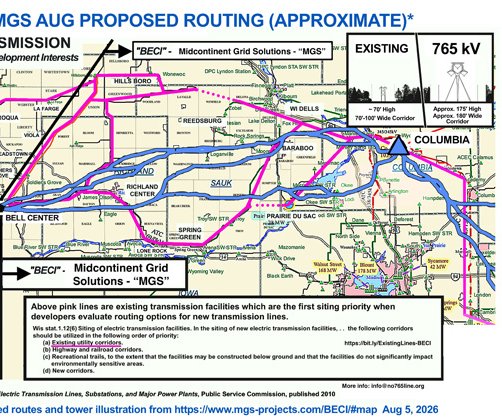
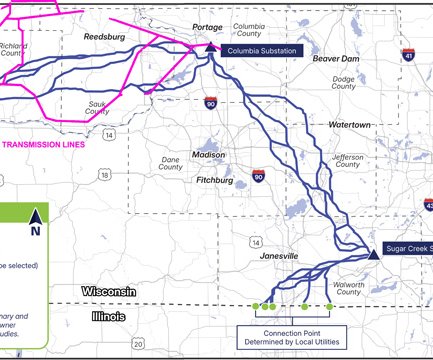
“Both of the routes start at the crossing of the Upper Mississippi River Fish & Wildlife Refuge near Genoa, and both of them end near Bell Center,” Maly explained. “The proposed route follows the existing 161 kV line, and goes primarily southeast diagonally to our substation near Seneca, and then it goes primarily east to Bell Center. The alternative is following the existing 69 kV line, but before it gets to Gays Mills, we are proposing a small section that would be on ‘greenfield’ [land previously without a transmission line easement] to avoid the Kickapoo River bottoms and Gays Mills.”
Anderson also observed that, compared to other recent transmission line projects in the state such as Cardinal-Hickory and Badger Coulee, the public information phase for the MariBell project seems very rushed, not allowing adequate time for landowners to receive answers to their questions or negotiate with the developers. Maly responded that it didn’t seem rushed to him.
Is anyone listening?
Last up was newly elected District 7 Supervisor Al Thompson from the Town of Freeman.
“I first started contacting Dairyland last fall, and I told them this is going to be a tough sell. And I commend you guys for trying to push a bad product onto people that are willing to fight. That's tough,” Thompson told the developers. “Can you tell me if you've persuaded even one person in all these meetings?”
“I've talked to numerous people that were much happier when they left the meeting than when they got there,” Maly responded. “Anything that's new, anything that's a big change, seems like a lot, until you can sit down and look at it. I can’t say that I changed someone’s mind. No one has said those words to me directly, and I can't read their mind.”
“Yesterday, I went to a public meeting in Rochester where they were discussing this route,” Dairyland’s Branden Yates responded. “They talked about reliability and affordability issues in southeast Minnesota, across the grid, and the potential for rolling blackouts. The 765 discussion opened up a whole new way - MISO has to plan for the future. I understand how it's a difficult conversation, but I think that without these upgrades, we would have a lot more difficult conversation in the future.”
Thompson said his second question is about how citizen feedback from all the meetings is being reported back up the developer’s command structure.
“What is the reporting process back to your superiors? Are they aware of all the resistance, all the people that have really legitimate concerns, and how often do you report back? Is it making a difference?” Thompson asked.
“We definitely reported about it, and we also noticed it for the PSC record during the public outreach phase,” Maly responded. “So, the exact reporting process at Dairyland is we talk about it as a team, and then we have our own leadership structure that it gets reported up to.”
“The route is not determined by us. It’s the Public Service Commission, which is who I think you may refer to as a ‘supervisor.’ We don't work for them,” Dairyland’s Branden Yates explained. “They make the final determination on the route.”