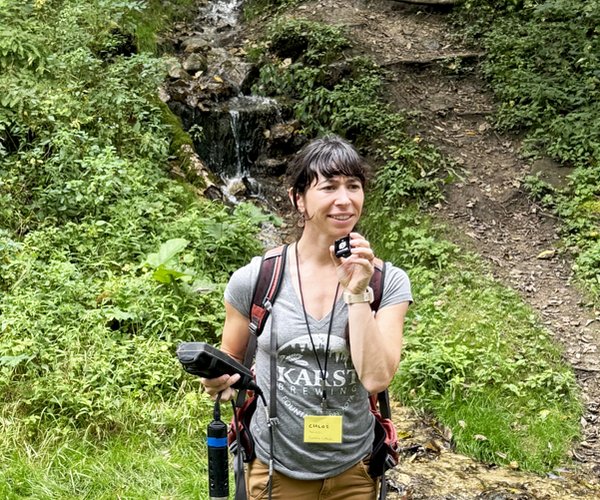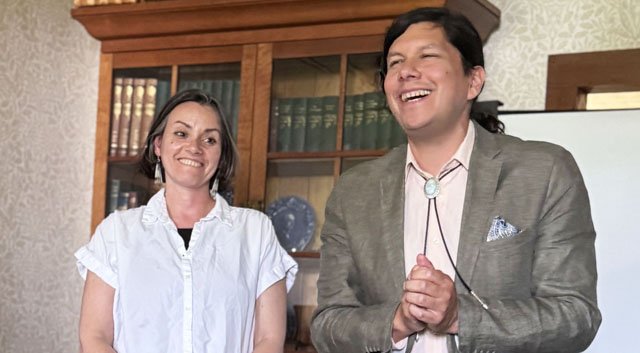
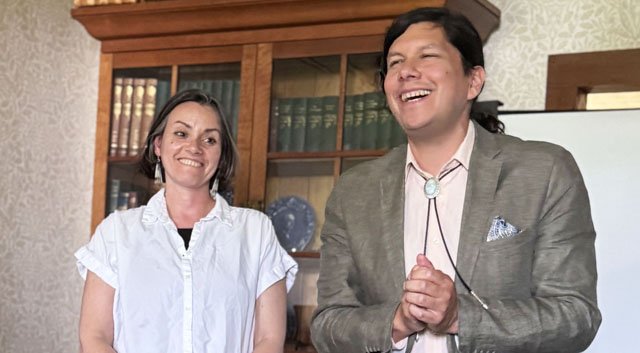
PORT ANDREW - Film artists Casey Brown and Julia Pello participated in an ‘Artists in the Farmhouse’ event at the Crosscurrents Heritage Center near Port Andrew in Richland County on May 30. The two are co-owners of the film company Thirteen Tribe Productions.
Brown is a Ho-Chunk Nation member, and winner of a regional Emmy Award for a film he made about Ho-Chunk artist Truman Lowe. Pello is an immigrant from Russia, and Filmmaker in Residence at Northwestern University, where she also works as a professor.
The current project the two are working on is a film called ‘Indian Mounds in a Year,’ filmed mostly in the Lower Wisconsin River Valley. That area is widely believed to have once contained the largest number of bird mounds on the planet, including what is believed to be the largest bird mound of all, ‘The Giant Ghost Eagle.’ That mound, though long since tilled over in an agricultural field just below the Frank’s Hill Effigy Mounds site, is believed to be the largest bird mound in the state of Wisconsin, with a wingspread of almost one-quarter of a mile.
“The mounds represent our pre-history. They have been there for thousands of years, and they're telling us something. It's our job to learn what it is, and we're getting closer,” Brown told the group. “The film is in four parts, and what the film essentially is trying to do is give a native perspective on the study of Indian mounds, because most of the stuff I've seen, especially the film I've seen, talks about them in a very linear time frame, uses a lot of words that no native person would have used. This is a more academic approach, as opposed to our film, which is taking a look at how the mounds are expressed throughout the year.”
“The structure of the film, is essentially cyclical, which is a more native way of viewing the world,” Pello shared.
“It's just like the cycle of life as it goes through all the four seasons, and then starts all over again,” Brown explained. “We are doing the film in four parts. It's not necessarily like we want to follow with what people are expecting, but we're trying to also break their expectations. This will be a film that at the end you can essentially start over. I think that sort of recognition of structure will come through in this project.”
Brown’s father Ritchie Brown is a major contributor in finding and attempting to protect the mounds built by his tribe’s ancestors, the Woodland People. Brown explained that though there are a lot of bird mounds in the Lower Wisconsin River Valley, there is a broader diversity of the sizes and shapes of the mounds. He said the most common are conical and linear mounds, which were built earlier than the mounds in the shapes of various animals.
“In addition, we also have panthers which are water spirits, bears, lizards, snakes, and more,” Brown explained. “One thing I need to say about mounds is they all have their own character. Some do a lot of things, or some just do one or a couple of things, but they all have their own spirit in and of themselves.”
A continuous event
Brown said that one of the things he and Pello are trying to show in their film is how many of the mounds are oriented toward the cyclical astronomical events of the year, such as equinoxes and solstices. He said that others may be pointing to water sources, or to an important cultural site.
“So, these mounds have a meaning, they weren't just set there randomly,” Brown said. “The construction of the mounds is actually very sophisticated. What you find is that the bottom of the mound below the ground is equal to the top of the mound above the ground, and the structures were built in such a way that they are still around thousands of years later.”
Brown emphasized that one of the things they are trying to show in the film was the expertise, astronomical knowledge, and hard work that went into building the mounds.
“Just look at the ghost eagle for instance. The amount of work and time and sophistication needed to create something like this, and to get someone that can not only find the spot, but get where the spot is. It typically would be someone like a guy would go out and fast - that's kind of the old way, and stare at the stars, and figure out where everything was. We want to show the amount of work and sophistication that was put in. It's science, it's art, it's history, it's architecture, it’s storytelling.”
Pello shared that she and Brown bring a good, symmetrical relationship to the project, each contributing something unique.
“I went to live in France for five years in my late 20s and early 30s, and when I came back to this country, I suddenly had a very different feeling about the land, and I suddenly started to think about its history,” Pello shared. “I really became interested in history and the way that it's told, because I noticed that often enough it was told problematically. So, I think it's important thing to question what you're seeing, and how that story is being told.”
Pello said that in her creative process, she is working on the challenge of discovering how to film the land, because as she said, “it’s kind of still.”
“Sometimes you go somewhere, and you know that something has happened there that’s historically important, but there are no remnants of it,” Pello observed. “So, the challenge as a filmmaker is how do you even begin to approach that history? One of the best answers is to speak to folks who are from that land, find people like Ritchie who belong to whichever, whatever land we're talking about, whatever tribal histories are there. Those people are still around. Talk to them - they will teach you a lot.”
A key thing Pello says she has learned by doing exactly that is that “a mound doesn't symbolize ancestral presence, it's not an object carved out of its context. It is a continuous event that is still happening right now.”
“This is the thing that I want you all to take away with you. A mound is not something from the past - it is a living thing, it is right now,” Pello explained. “If you look at things this way, the deep past and the present become indiscernible. That's sort of bringing us back to this idea of civilization, that we are all living something that we can know a little bit about, but we may not know everything about, but that's our part in this sort of chain of knowledge.”
Aerial footage
Brown and Pello discussed their techniques and insights for incorporating aerial footage into their film. Brown pointed out that the best views of the mounds are actually obtained from above, and since the area where they’re filming is dominated by bird mounds, that aerial view of the landscape provides a, so to speak, birds eye view.
“We’ve seen a lot of footage from the air made by drones, and sometimes it feels like it's a surveillance shot,” Pello observed. “When Casey and I were looking at footage that we filmed from the plane, it was doing something that the drone doesn't do. It was rolling on its Z-axis, so it was moving, like with the earth. When it moves like an airplane, it's like a bird, it really resembles the movement of a bird much more than a drone image does.”
“The tilt effect that you get from a plane gives you more that a drone doesn't necessarily give,” Brown shared. “When you're in the plane, you can see a bit more of the topography of the ground, as opposed to just looking straight down, so it has a more natural feel.”
Pello shared an experience the two had, where a bird had flown over, and they’d seen its shadow on the ground.
“We saw the shadow on the ground, and we were like, well, that's what the mound builders were seeing,” Pello remembered. “That was like a little moment into the past, and emotionally it was kind of spectacular and kind of wild.”
Connection to nature
One audience member observed that the cyclical nature of the film’s concept seems related generally to the cycle of life, and asked if part of what the artists hoped to convey is a connection to nature in general?
“At Frank's Hill, if you go over to the west side of the road, there is a line of conical mounds that function as a calendar,” Brown shared. “It has bumps for all the different lines where the sun is going to be, that actually tells you about the different types of seasons, and what's going on. So, there's information about where to go during certain times of the year, when to harvest, and when to leave for your winter dwelling in a cave. The Ho-Chunk people tell stories in the winter, because that’s the time of year when you’re supposed to tell stories, for instance.”
Brown said they had been thinking a lot about how to structure the film now that they're getting all the content in, and where to put it in, and what season is most accurate. He said he’d been talking with different people and tribal elders about what they think, and how to go about it.
“The animals and everything else is kind of a part of it,” Brown explained. “The Ho-Chunk Nation General Council passed the ‘Rights of Nature,’ meaning the water, the air, the animals have the same rights as humans. In our Ho-Chunk way, those are our brothers and sisters, like we're related to them. It’s like we’re working together with the whole ecosystem, and everyone has their role to play, so yeah, animals and everything else is certainly a part of this.”