The Driftless Area Water Study (DAWS) group, composed of conservation and health department staff and community groups, in Crawford, Vernon and Richland counties, recently concluded their fifth round of well water testing. Overall, results were generally good compared to state averages. Some higher test results for coliform bacteria and nitrate were seen in areas dedicated to agriculture or in proximity to septic systems.
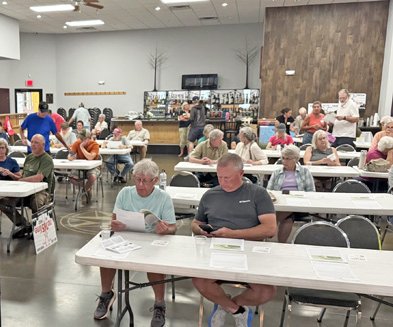
At a public education event held in Gays Mills on Saturday, June 27, Crawford County Conservation Director Dave Troester kicked off the presentation. The event was attended by about 50 citizens.
“This past spring’s round of well water testing probably had the best results out of any of the years that we've done sampling,” Troester told the group. “With nitrate levels in particular, there wasn’t a lot of variability between the counties with a fairly consistent trend, and nothing too alarming so that’s good.”
Troester detailed the history of well water testing in Crawford County. He pointed out that the first modern efforts to conduct broader well water testing had been undertaken by the Tainter Creek Watershed Council in Crawford and Vernon counties. He pointed out that after the Southwest Wisconsin Groundwater and Geology study (SWIGG) results had come out in 2018 and 2019, with some fairly alarming results, this stimulated conservation and health professionals in Crawford, Vernon and Richland counties to come together to test wells in those counties. As a result, the DAWS Study was formed.
The goal of DAWS is to develop a picture of groundwater quality in the three counties, and develop a dataset over time that could identify any developing trends.
Troester emphasized that the support of community groups like Crawford Stewardship Project and Valley Stewardship Network had been instrumental in the success of the program.
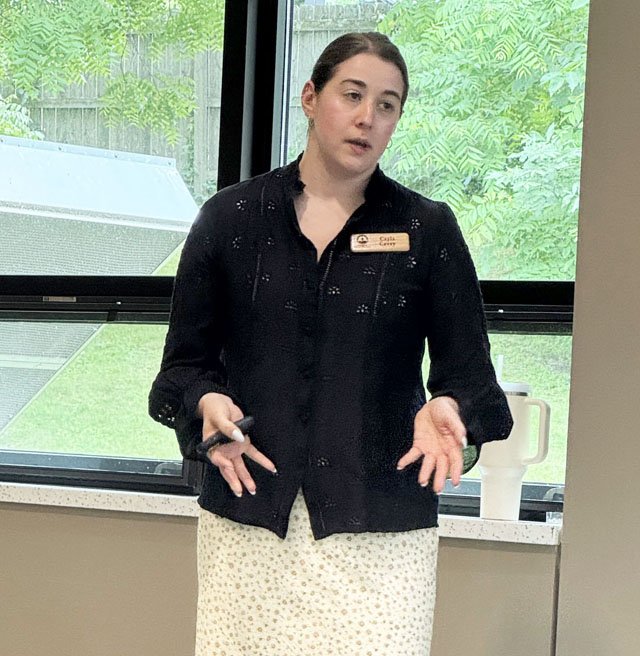
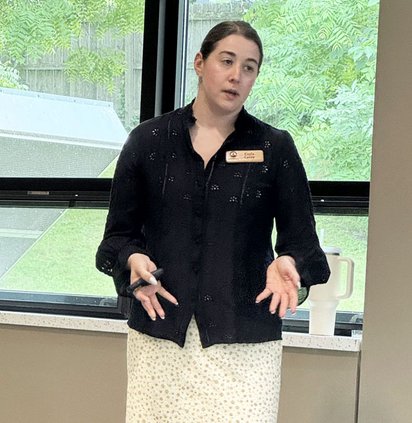
Cayla Cavey, an educator from UW-Stevens Point and UW-Extension’s Center for Watershed Science and Education, led the group in an educational talk designed to explain how groundwater works in Wisconsin, what an aquifer is, and what their private, individual well water test results mean.
Cavey explained that in the DAWS area, the bedrock is generally dolomite or limestone, which is easily dissolved and can become fractured. This means it can transmit water rapidly from the surface, into bedrock layers containing the aquifer (the zone in the bedrock completely saturated with water). Those bedrock layers are often sandstone, located much deeper in the bedrock profile, which transmit water much more slowly. She emphasized also, that groundwater is tied to surface water, providing baseflow that leads to our area’s world class trout streams.
Across the three counties, 352 well water samples were submitted in this spring’s round of testing. That was 100 from Crawford County, 160 in Vernon County, and 88 in Richland County. Tests were limited to 10 per township in order to achieve good distribution of tests across each of the counties. The analysis tested water for 22 common water quality contaminants.
SWIGG results
SWIGG results from initial rounds of testing in November of 2018 and April of 2019 revealed a picture of well water quality in Grant, Iowa and Lafayette counties. Results in November showed that 16% of 301 wells tested positive for nitrate, with 34% positive for coliform bacteria, and 4% showing E.coli present.
In April of 2019, of 539 wells tested, 15% tested positive for nitrate, with 16% positive for coliform bacteria, and 2% showing E.coli present.
“SWIGG was a big coordinated effort to do hundreds of well water samples, and some of the results that came back were surprising - some would say alarming,” Troester shared. “It was kind of eye-opening for everybody.”
The time of year that wells are tested can also have an impact on well water testing results. SWIGG results showed higher levels of contaminants in the November testing versus the April testing, for instance. In spring, it’s just been winter, with typically less mobility of surface contaminants through the soil and bedrock profiles. In addition, in winter there is less agricultural activity such as spreading of manure or application of fertilizers and agricultural chemicals, and less use of lawn fertilizers.
Bacteria results
Cavey explained that the standard for coliform bacteria in well water is either “present or absent.” State well construction standards maintain that a well should be able to deliver consistently bacteria-free water.
Cavey told the group that presence of coliform bacteria, which can be naturally occurring, isn’t necessarily a health risk. It is, however, an indication that a pathway exists for substances from the soil surface to enter a well.
“In this round of testing, we had about 11% of samples overall throughout the three counties, positive for coliform bacteria, which is pretty on par with what we typically see, especially in a bigger group,” Cavey explained. “So, nothing extremely high or low, pretty average.”
The well water educator said that for any test result positive for coliform bacteria, the sample was then automatically tested for Escherichia coli (E. coli). E.coli is a type of bacteria that naturally lives in the intestines of healthy humans and animals. Any well owner who received a positive result would have been contacted immediately by their county’s health department.
“A positive E.coli result indicates the presence of fecal coliforms, and those are from fecal matter, so human or animal waste,” Cavey said. “E coli can make you sick, and if we have E.coli present in a well, we know that the source of contamination was from human or animal waste.”
Cavey said that in the spring round of testing, results showed that less than 1% of wells tested showed a positive result for E.coli. For those whose wells tested positive, Cavey indicated they would be advised to immediately obtain an alternative source of water for drinking, cooking, brushing teeth and bathing, especially for infants and pregnant women.
Then, a re-test of the well water to confirm the result is recommended. The next step would be to inspect the well for defects, such as cracks or looseness of the well head cap. Then, the well should be disinfected or ‘shocked’ with bleach, and finally, the well should be re-tested to confirm that disinfection was successful.
Nitrate results
The most common groundwater quality contaminant in Wisconsin is nitrate, which is not naturally occurring pretty much at all in groundwater, according to Cavey. Any naturally occurring levels are usually less than 0.2 milligrams-per-liter. She noted that when we see nitrate, it's often from agricultural activity, whether that's fertilizer or biosolids application, or from septic systems or lawn fertilizer.
“Nitrate is something that we don't want to consume in the long term, and especially for some populations at all. There's a health standard for nitrate of 10 milligrams-per-liter,” Cavey detailed. “When we start to see well water testing results above two, getting closer to five, we know that there's some land use impact on a well, whether it be from septic, lawn, agriculture, or oftentimes a combination of things. When we get closer to 10, you may want to start to test annually and address potential treatment options.”
Across Crawford, Vernon and Richland counties, of the 352 wells tested, 95 showed no nitrate detected (27%), 119 showed nitrate at or below naturally occurring levels (34%), 67 showed nitrate levels above the naturally occurring level at 2.1-5% (19%), and 55 showed nitrate levels between 5.1 and 10% (16%).
A total of 13 wells tested positive for nitrate above the health standard of 10 milligrams-per-liter. Of those, nine wells were in the 10.1-20 range (3%), and four were in excess of 20 milligrams-per-liter (1%).
In Crawford County there were only two wells that showed results above the health standard in the northwest part of the county.
In Vernon County, there were a cluster of results above the health standard in Franklin Township and in rural Viroqua, and one sample above 20 milligrams-per-liter in the far northwest part of the county. In Richland County, results above the health standard were more common in far southern parts of the county, near the Wisconsin River, in sandier areas.
Cavey said that the DAWS results compare favorably with statewide averages, where typically 7-10% of wells tested show nitrate levels above the health standard.
“If we were to look at the health effects of nitrate, the most vulnerable population would be infants,” Cavey said. “Nitrate can actually affect how well blood and oxygen get distributed throughout an infant's body, and people who are pregnant are at higher risk for miscarriages and birth defects, if they're drinking water really high in nitrate. Livestock is at risk of this too. Everyone should reduce exposure, because it can increase risks of thyroid issues and certain cancers over time.”
Treatment for nitrate includes a few different options, according to Cavey. She listed reverse osmosis, what we call anion exchange, and then distillation, with reverse osmosis being by far the most common.
“What we do at the land surface is connected to the groundwater, even though we can't necessarily see it,” Cavey emphasized. “What we have here in the Driftless north of the Wisconsin River is a really interesting case where we have agriculture, but it's not uniformly distributed like we have in a lot of other parts of Wisconsin. That leads to a less intense impact from this activity than in areas where we have vast swaths of uninterrupted intensive agriculture. If we were to overlay some of the results from this round of testing, we see the excesses in those areas that are flatter and a little bit more intensive for agriculture.”
Cavey noted that while agriculture is less intensive here, we also have a fractured karst bedrock system that conducts water relatively quickly, overlain by a relatively shallow layer of soil.
“Here, we have a very thin layer of soil to bedrock, so it's just a shorter pathway and an easy pathway for things to move through into the groundwater,” Cavey said.
It is not recommended to drink or cook with water above the standard for nitrate, but that it is fine for bathing and laundry, according to Cavey. She explained that any water treatment systems can be confined to water used for drinking or cooking.
Other contaminants
Cavey detailed that contaminants generally fall into the categories of health threats, aesthetic problems, or both. Contaminants like E.coli, arsenic, pesticides (not analyzed in these tests), lead and nitrate can cause health problems either quickly (acute) or from exposure over time (chronic).
She said that DAWS tests reveal that arsenic is not a big problem in this area, with less than 1% of samples showing positive for arsenic at very low levels. She said arsenic is much more common in eastern Wisconsin.
Manganese is a contaminant that can have both health and aesthetic impacts, if present in well water. She said DAWS results showed less than 1% of samples above the health standard of 0.3 milligrams-per-liter. Aesthetically, manganese can cause black particles in drinking water, and can stain laundry or fixtures.
Lead and copper in well water are contaminants that come primarily from plumbing in the home, with fairly straightforward solutions. Because water in the DAWS counties tends to be very hard, it is much less corrosive, meaning less likely to dissolve lead and copper into drinking water.
“We have a lot of the dolomite geology present in this area, so almost 90% of the samples were considered hard water,” Cavey explained. “Hardness is from minerals in water, like calcium and magnesium, and this ties into the geology of the area. While not a concern for health, some find it a nuisance, and correct it with a water softener. Others find hard water tastes better, and even can provide some health benefits.”